

Mishimoto
Well-Known Member
- First Name
- Mishi
- Joined
- Jul 5, 2018
- Threads
- 20
- Messages
- 371
- Reaction score
- 475
- Location
- Garnet Valley, PA
- Website
- www.mishimoto.com
- Vehicle(s)
- Jeep Wrangler JL
- Thread starter
- #1
Hey everybody!
We're excited to be back on the forums to announce the pre-sale of our 2018+ Jeep Wrangler JL & 2020+ Gladiator 3.6L performance air intake! As always, we're happy to share our R&D process with you all. This intake shares a lot of the development process with our 2.0T intake, so if you haven't checked that out, take a look.
Our R&D post is below and you can find more details on the pre-sale on our website: Mishimoto 2018+ Jeep Wrangler JL 3.6L Performance Intake Pre-Sale
Thanks!
-Steve
As automotive technology advances and manufacturers try to squeeze more power out of every drop of fuel, forced induction (specifically turbocharging) is becoming increasingly prevalent. But, while forced induction can make a 4-cylinder as powerful as an engine twice its size, nothing compares to a naturally-aspirated engine’s linear powerband. Natural aspiration is power in its purest form – a one-to-one connection of right foot and forward motion.
For many Jeep enthusiasts, the simplicity of natural aspiration has kept them loyal to the 3.6L Pentastar V6 in their 2018+ Wrangler JL or 2020+ Gladiator. That simplicity also makes modifying an N/A engine straightforward. Unlike modern turbocharged systems that usually require a tune to gain power from bolt-on modifications, N/A powerplants benefit tremendously from anything that improves airflow to or from the engine. One of those simple modifications that many enthusiasts install is an intake. While intakes on turbocharged engines usually just increase turbo sounds, a well-tuned intake on a naturally-aspirated engine can make significant power.
...Continue Reading>>>
We're excited to be back on the forums to announce the pre-sale of our 2018+ Jeep Wrangler JL & 2020+ Gladiator 3.6L performance air intake! As always, we're happy to share our R&D process with you all. This intake shares a lot of the development process with our 2.0T intake, so if you haven't checked that out, take a look.
Our R&D post is below and you can find more details on the pre-sale on our website: Mishimoto 2018+ Jeep Wrangler JL 3.6L Performance Intake Pre-Sale
Thanks!
-Steve
As automotive technology advances and manufacturers try to squeeze more power out of every drop of fuel, forced induction (specifically turbocharging) is becoming increasingly prevalent. But, while forced induction can make a 4-cylinder as powerful as an engine twice its size, nothing compares to a naturally-aspirated engine’s linear powerband. Natural aspiration is power in its purest form – a one-to-one connection of right foot and forward motion.
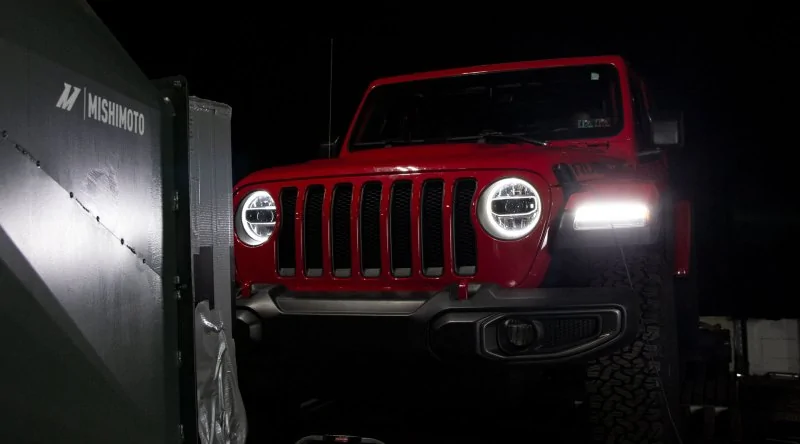
For many Jeep enthusiasts, the simplicity of natural aspiration has kept them loyal to the 3.6L Pentastar V6 in their 2018+ Wrangler JL or 2020+ Gladiator. That simplicity also makes modifying an N/A engine straightforward. Unlike modern turbocharged systems that usually require a tune to gain power from bolt-on modifications, N/A powerplants benefit tremendously from anything that improves airflow to or from the engine. One of those simple modifications that many enthusiasts install is an intake. While intakes on turbocharged engines usually just increase turbo sounds, a well-tuned intake on a naturally-aspirated engine can make significant power.
...Continue Reading>>>
Sponsored



 In most cases, the ambient air ducting is just to reduce intake air temps. In the case of the JL, the ambient air duct pulls air from the fender (behind the liner), so there's no positive pressure from the vehicle moving forward. Even for vehicles that do have a forward-facing duct, there are so many variables that I wouldn't think it would effectively increase VE except in very specific circumstances. Optimization is likely a combination of engineering budget and packaging considerations


