ALeeL
Well-Known Member
- Thread starter
- #1
My wife recently purchased a Rivian R1S dual motor performance with the max battery (410 mile range— per EPA), and I have been itching to take it to our farm to go over several mild obstacles we have out there. Rivian’s are touted as being capable off-road and the R1S can have up to 14.9 inches of ground clearance at max height. I saw a few of these on the easy trails, like Gemeni Bridge, the last time I was in Moab and have been curious on what they can do.
With 665 horsepower / 829 lb-ft of instant torque on tap, this thing is a fun highway and city cruiser. It is unreasonably quick at 3.5 seconds 0-60, and I can’t imagine how the 1,025 hp / 1,198 lb-ft quad motor R1S feels like at 2.6 seconds. Unfortunately, all that torque does not translate to off-road capability.
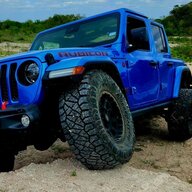
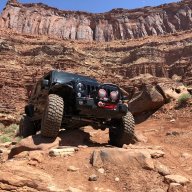
The dual has one motor in the front axle and another motor in the rear with a gear reduction optimized for highway driving ,so you can imagine how that would be off road without a low range. Because of this, my Rubicon Ecodiesel feels like it has more torque off road than the Rivian when in 4-low . Since these things don’t come with lockers, it relies solely on traction control which is not as well programed as the Wrangler. It takes a lot more wheel spin for it to finally send power to the other wheel and a lot of pedal manipulation to get it to do what you want it to do. Not a comfortable or confidence inspiring feeling.
It is independent suspension all the way around, but it has good articulation considering what it is. While nowhere near a Wrangler’s articulation with the stabilaizer detached, it does a lot better than other independent vehicles I have driven. This is due to not having a stabilizer bar and instead uses adaptive hydraulic system to control body role. A system similar to what the latest McLaren sports car uses. At high speed it resists roles, but at low speed it uses the hydraulic valving to push the other tire down. Very neat, but at the same time probably very expensive and less reliable.
Since the electric motors utilize regenerative braking, going down obstacles is really a non-event. You can customize how much regenerative braking you want with three different modes. In fact, I hardly ever use brakes when driving on-road and just slowly let off the accelerator as I come to a stop. It takes some time to get used to it and found myself stopping way too soon a few times, but after 30 minutes behind the wheel it becomes second nature.
Short distance overlanding and camping would be good with this thing. In camping mode, you can level the vehicle out for sleeping, it has 120v outlets in multiple locations that can actually be used for more than just charging things, storage everywhere including a huge frunk, and of course, you can use the AC at night without disturbing others too much.
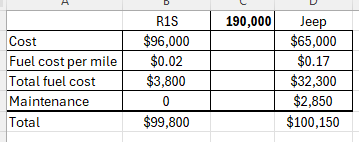
Fuel wise, it’s real-world average for the 5k miles she has driven this thing is 2.57 miles per kwh, which is equivalent to 86 mpg. We got a home charger to charge at night when our electric is 6 cents per kwh. Charging her 140 kwh hour battery to full would be $8.47. So, that is real world range of 360 miles for $8.47.
Keep in mind, she did not get this thing to save the planet or even money for that matter. She got it because she is horrible at keeping up with maintenance, hates going to the gas station, and loved the idea of a frunk along with waking up to fully "fueled" vehicle every morning.
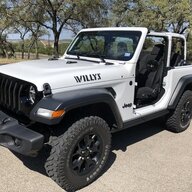
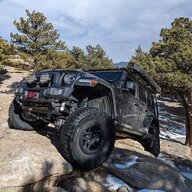
Lockers and a low range gear would really help this thing out, but even then, it is hard to get past its 7k curb weight. It is fun and comfortable to drive on roads, but I would still choose my Jeep when going off road. I might take this thing to stay a night on the beach or short camping trip, but any long trips or real off-roading, Ecodiesel all the way.
With 665 horsepower / 829 lb-ft of instant torque on tap, this thing is a fun highway and city cruiser. It is unreasonably quick at 3.5 seconds 0-60, and I can’t imagine how the 1,025 hp / 1,198 lb-ft quad motor R1S feels like at 2.6 seconds. Unfortunately, all that torque does not translate to off-road capability.
The dual has one motor in the front axle and another motor in the rear with a gear reduction optimized for highway driving ,so you can imagine how that would be off road without a low range. Because of this, my Rubicon Ecodiesel feels like it has more torque off road than the Rivian when in 4-low . Since these things don’t come with lockers, it relies solely on traction control which is not as well programed as the Wrangler. It takes a lot more wheel spin for it to finally send power to the other wheel and a lot of pedal manipulation to get it to do what you want it to do. Not a comfortable or confidence inspiring feeling.
It is independent suspension all the way around, but it has good articulation considering what it is. While nowhere near a Wrangler’s articulation with the stabilaizer detached, it does a lot better than other independent vehicles I have driven. This is due to not having a stabilizer bar and instead uses adaptive hydraulic system to control body role. A system similar to what the latest McLaren sports car uses. At high speed it resists roles, but at low speed it uses the hydraulic valving to push the other tire down. Very neat, but at the same time probably very expensive and less reliable.
Since the electric motors utilize regenerative braking, going down obstacles is really a non-event. You can customize how much regenerative braking you want with three different modes. In fact, I hardly ever use brakes when driving on-road and just slowly let off the accelerator as I come to a stop. It takes some time to get used to it and found myself stopping way too soon a few times, but after 30 minutes behind the wheel it becomes second nature.
Short distance overlanding and camping would be good with this thing. In camping mode, you can level the vehicle out for sleeping, it has 120v outlets in multiple locations that can actually be used for more than just charging things, storage everywhere including a huge frunk, and of course, you can use the AC at night without disturbing others too much.
Fuel wise, it’s real-world average for the 5k miles she has driven this thing is 2.57 miles per kwh, which is equivalent to 86 mpg. We got a home charger to charge at night when our electric is 6 cents per kwh. Charging her 140 kwh hour battery to full would be $8.47. So, that is real world range of 360 miles for $8.47.
Keep in mind, she did not get this thing to save the planet or even money for that matter. She got it because she is horrible at keeping up with maintenance, hates going to the gas station, and loved the idea of a frunk along with waking up to fully "fueled" vehicle every morning.
Lockers and a low range gear would really help this thing out, but even then, it is hard to get past its 7k curb weight. It is fun and comfortable to drive on roads, but I would still choose my Jeep when going off road. I might take this thing to stay a night on the beach or short camping trip, but any long trips or real off-roading, Ecodiesel all the way.
Sponsored
Last edited:




 ... jk on the last part, don't tell her I said that.