Sponsored

Mopar Lift - Control Arm Torque Question

GATORB8

Well-Known Member
First Name
Matt
Joined
May 30, 2021
Threads
29
Messages
8,830
Reaction score
11,726
Location
CLT NC
Vehicle(s)
21 JLURe, 06 LJ, 25 HDZR2
No worries.

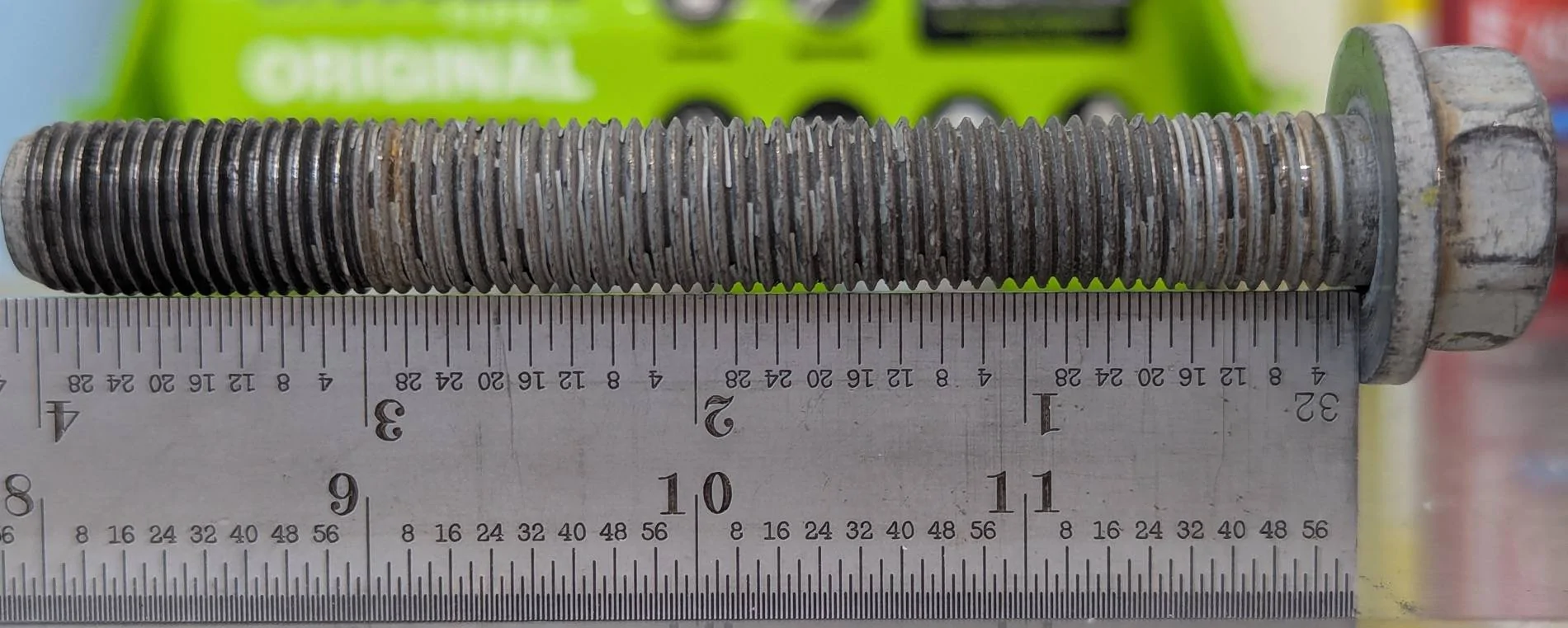
I have continued looking at a bunch of these parts and some parts lists show an M16 bolt for front and rear lower control arms. I measured mine, so I know they are M14. That means they have some discrepancies in their parts catalog too. I thought it might be possible that the Gladiator could be using larger rear control arm bolts but it looks like those are M14 too.
Did you notice if the rears have the capacity for M16? Looks like that's what Grimm uses in their replacement kit.

Side note if you go down the replacement route down the road, make sure that you use high-end coated hardware, it's a rough life down there and I've had to replace some corroded aftermarket parts.
Sponsored
 

BDinTX

Well-Known Member
First Name
Brad
Joined
Jul 18, 2020
Threads
49
Messages
2,945
Reaction score
5,452
Location
Dallas, Tx
Vehicle(s)
2020 JLU Rubicon Recon, 2021 JLU Rubicon
lol jeez did I start the "can't read" trend?

The only thing I don't like about McMaster Carr is that you can't normally buy just 1 bolt. I do have a fair number of spares now though...
 
OP
OP
Yardstick

Yardstick

Well-Known Member
Joined
Jan 16, 2021
Threads
15
Messages
83
Reaction score
38
Location
Arizona
Vehicle(s)
Jeep Wrangler JLURD, Tundra, 4Runner, Sprinter
This bolt torque saga continues to be weird. I used to do this kind of analysis so while I wait for replacement bolts I went to work on the various specs. I won't bore you with the math. It is interesting how Torque + Angle works to minimize the effect of friction on loading the joint. You can read about that in a few places. Also, these aren't (or shouldn't be) torque to yield fasteners. I'll put up the example of the Rear LCA to Axle fastener since that's the one that started failing on me.

The bolt spec is: M14x1.5x104.15 mm, Class 10.9. Mine is roughly 107 mm long right now. :surprised: From what I found, a 10.9 bolt should have a min Yield Strength of 940 MPa.
The Torque + Angle spec is 100 Nm (74 ft-lbs) + 50°. I calculated a clamping force of 66.3 kN (~15,000 lbs) and Axial Stress of 593 MPa (~86000 psi). So we're a little above halfway to minimum Yield with that torque spec.

I calculated the (roughly) equivalent torque to the Torque + Angle spec to be 158 Nm (117 ft-lbs) by backing it out from the total clamping force that I came up with.

The AEV and the other Mopar chart agreed that the torque should be 122 Nm (90 ft-lbs) on that bolt. That gives a clamping force of 51.1 kN (~11,500 lbs) and Axial Stress of 457 MPa (~66,300 psi). Substantially lower forces for some reason, but now we're at less than half of Yield.

The WRONG instructions that I have call for a torque of 251 Nm (185 ft-lbs)! That results in a calculated clamping force of 105 kN (~23,600 lbs) and Axial Stress of 941 MPa (~136,500 psi). Hey, that's more than the minimum Yield! Remember where I said it gets weird? I never got that bolt to 185 ft-lbs. My torque wrench reported a max torque of 155 ft-lbs before it kept reporting lower and lower peak torque values as the bolt continued to turn and stretch. At 210 Nm (155 ft-lbs) the clamping force is 88.0 kN (~19,800 lbs) and the Axial Stress is 787 MPa (~114,000 psi). So it's possible that the bolt is faulty!

Before I got to the Rear LCA to Axle bolt I managed to tighten the Rear UCA to Frame bolts to 200 ft-lbs, which actually puts their Axial Stress at 1016 MPa (~147,400 psi). That is just below what I found for a maximum Yield on a 10.9 bolt: 1034 MPa (150,000 psi). So those might be okay. The Rear LCA to Frame and Axle have the same torque spec and the ones that didn't fail might still be within their limit. I'm not going to take the chance though. I haven't torqued the Rear UCA to Axle bolts as that will require some kind of torque adapter. Or maybe I could just guess and keep an eye on it since the torque specs are all over the place!
 

GATORB8

Well-Known Member
First Name
Matt
Joined
May 30, 2021
Threads
29
Messages
8,830
Reaction score
11,726
Location
CLT NC
Vehicle(s)
21 JLURe, 06 LJ, 25 HDZR2
This bolt torque saga continues to be weird. I used to do this kind of analysis so while I wait for replacement bolts I went to work on the various specs. I won't bore you with the math. It is interesting how Torque + Angle works to minimize the effect of friction on loading the joint. You can read about that in a few places. Also, these aren't (or shouldn't be) torque to yield fasteners. I'll put up the example of the Rear LCA to Axle fastener since that's the one that started failing on me.

The bolt spec is: M14x1.5x104.15 mm, Class 10.9. Mine is roughly 107 mm long right now. :surprised: From what I found, a 10.9 bolt should have a min Yield Strength of 940 MPa.
The Torque + Angle spec is 100 Nm (74 ft-lbs) + 50°. I calculated a clamping force of 66.3 kN (~15,000 lbs) and Axial Stress of 593 MPa (~86000 psi). So we're a little above halfway to minimum Yield with that torque spec.

I calculated the (roughly) equivalent torque to the Torque + Angle spec to be 158 Nm (117 ft-lbs) by backing it out from the total clamping force that I came up with.

The AEV and the other Mopar chart agreed that the torque should be 122 Nm (90 ft-lbs) on that bolt. That gives a clamping force of 51.1 kN (~11,500 lbs) and Axial Stress of 457 MPa (~66,300 psi). Substantially lower forces for some reason, but now we're at less than half of Yield.

The WRONG instructions that I have call for a torque of 251 Nm (185 ft-lbs)! That results in a calculated clamping force of 105 kN (~23,600 lbs) and Axial Stress of 941 MPa (~136,500 psi). Hey, that's more than the minimum Yield! Remember where I said it gets weird? I never got that bolt to 185 ft-lbs. My torque wrench reported a max torque of 155 ft-lbs before it kept reporting lower and lower peak torque values as the bolt continued to turn and stretch. At 210 Nm (155 ft-lbs) the clamping force is 88.0 kN (~19,800 lbs) and the Axial Stress is 787 MPa (~114,000 psi). So it's possible that the bolt is faulty!

Before I got to the Rear LCA to Axle bolt I managed to tighten the Rear UCA to Frame bolts to 200 ft-lbs, which actually puts their Axial Stress at 1016 MPa (~147,400 psi). That is just below what I found for a maximum Yield on a 10.9 bolt: 1034 MPa (150,000 psi). So those might be okay. The Rear LCA to Frame and Axle have the same torque spec and the ones that didn't fail might still be within their limit. I'm not going to take the chance though. I haven't torqued the Rear UCA to Axle bolts as that will require some kind of torque adapter. Or maybe I could just guess and keep an eye on it since the torque specs are all over the place!
I was actually thinking about mentioning torque to yield the other day, and knowing that couldn't be the case.

Your previous mention of deformed lock nuts made me think, I'd bet the spec is required to ensure proper torque of the fastener with an undefined (variable within specification) amount of additional resistance from the thread deformation.
 
OP
OP
Yardstick

Yardstick

Well-Known Member
Joined
Jan 16, 2021
Threads
15
Messages
83
Reaction score
38
Location
Arizona
Vehicle(s)
Jeep Wrangler JLURD, Tundra, 4Runner, Sprinter
I looked for information on adjusting the typical torque equation for various types of lock nuts. There are friction adjustments for different coatings and other adjustments for lubricants but none that I could find for lock nuts. The best I could come up with was a suggestion to physically test the fastener arrangement. Someone did that and came up with a relatively low torque to overcome the friction of a stover type (deformed thread) lock nut. I have started to wonder if the lower torque spec on the Mopar and AEV lift sheets (not the one I got) are deliberate because the threads would be slightly damaged from re-using the original hardware and so the lock nut would create less drag on the bolt. That might explain the difference between my calculated 117ft-lbs equivalent to the torque + angle spec and the 90 ft-lbs that Mopar/AEV show.

The torque + angle spec probably has something to do with the fastener type in this case. Now that I’ve done the math, I kind of like the angle spec even more. It makes the fastener tension mostly independent of any friction modifiers like surface finishes or lubrication. You always have to deal with some of that to get the joint closed up and maybe preloaded to some extent, but the angle part makes the rest pretty straight-forward with no additional need to consider friction.
 

Sponsored

maxp0wers

Well-Known Member
Joined
Jan 9, 2024
Threads
20
Messages
113
Reaction score
65
Location
Northern California
Vehicle(s)
Rubicon 4XE
I'm not grasping what "angle spec" is. Im swapping in the mopar lcas next week.

The analysis in this thread is impressive albeit all touch beyond my comprehension.

With that said the 190 ft lb torque seemed wild to me so it does make sense that you are reverse engineering something different/more reasonable.

So for someone who understands a torque wrench and settings but has never heard of "angle spec"...what the heck are we talking about here? I feel like I grasp the idea with your explanation above bur not full comprehending it.
 
OP
OP
Yardstick

Yardstick

Well-Known Member
Joined
Jan 16, 2021
Threads
15
Messages
83
Reaction score
38
Location
Arizona
Vehicle(s)
Jeep Wrangler JLURD, Tundra, 4Runner, Sprinter
I'm not grasping what "angle spec" is. Im swapping in the mopar lcas next week.

The analysis in this thread is impressive albeit all touch beyond my comprehension.

With that said the 190 ft lb torque seemed wild to me so it does make sense that you are reverse engineering something different/more reasonable.

So for someone who understands a torque wrench and settings but has never heard of "angle spec"...what the heck are we talking about here? I feel like I grasp the idea with your explanation above bur not full comprehending it.

There are two torque specifications floating around that seem reasonable. One is given as 'Torque + Angle', the other is just a straight, conventional Torque.

I suspect the 'Torque + Angle' specification is correct for new factory hardware. In the case of the rear LCA bolts the spec is 74 ft-lbs + 50°, so you would torque the bolt to 74 ft-lbs then tighten it an additional 50°. They make angle gauges for this or you could estimate ~45 degrees and add a little more.

My guess is that if you're reusing hardware you will want to use the lower specs they supplied for some of the kits. For the bolt I'm referring to here that is 90 ft-lbs.
 
OP
OP
Yardstick

Yardstick

Well-Known Member
Joined
Jan 16, 2021
Threads
15
Messages
83
Reaction score
38
Location
Arizona
Vehicle(s)
Jeep Wrangler JLURD, Tundra, 4Runner, Sprinter
I have more interesting findings that I might as well write down in case anyone else goes through this in the future. The torque wrench I’m using is an AC Delco ARM303-4A-340 1/2" Heavy Duty Angle Digital Torque Wrench. It reports the final torque after you reach the required angle in the torque spec, so now I have some real-world numbers for OEM bolts. I still wouldn’t rely on the end numbers that I got to torque up used hardware. Even new, I would prefer the torque + angle spec rather than trying to match these numbers. I think you’ll see why.

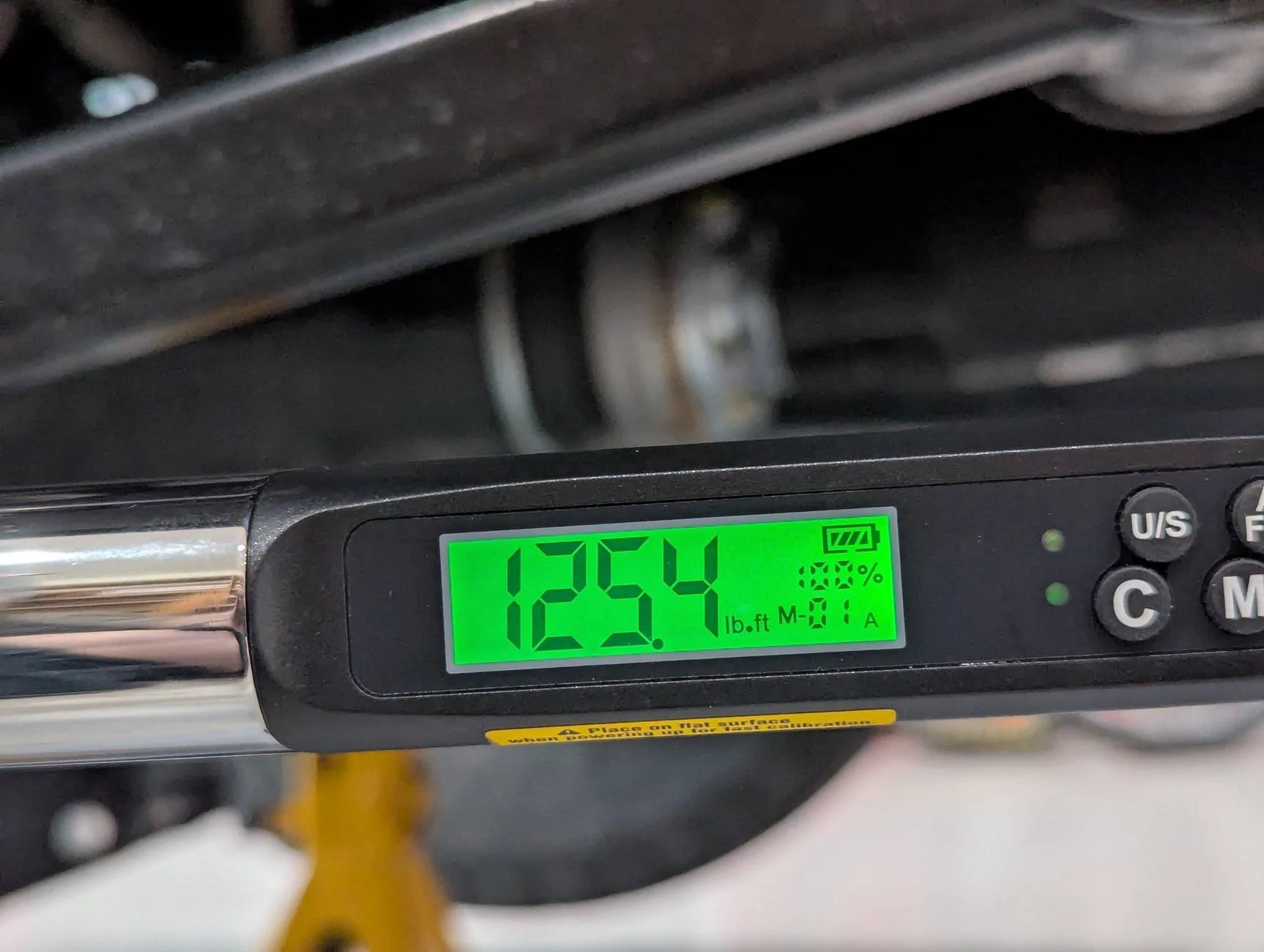
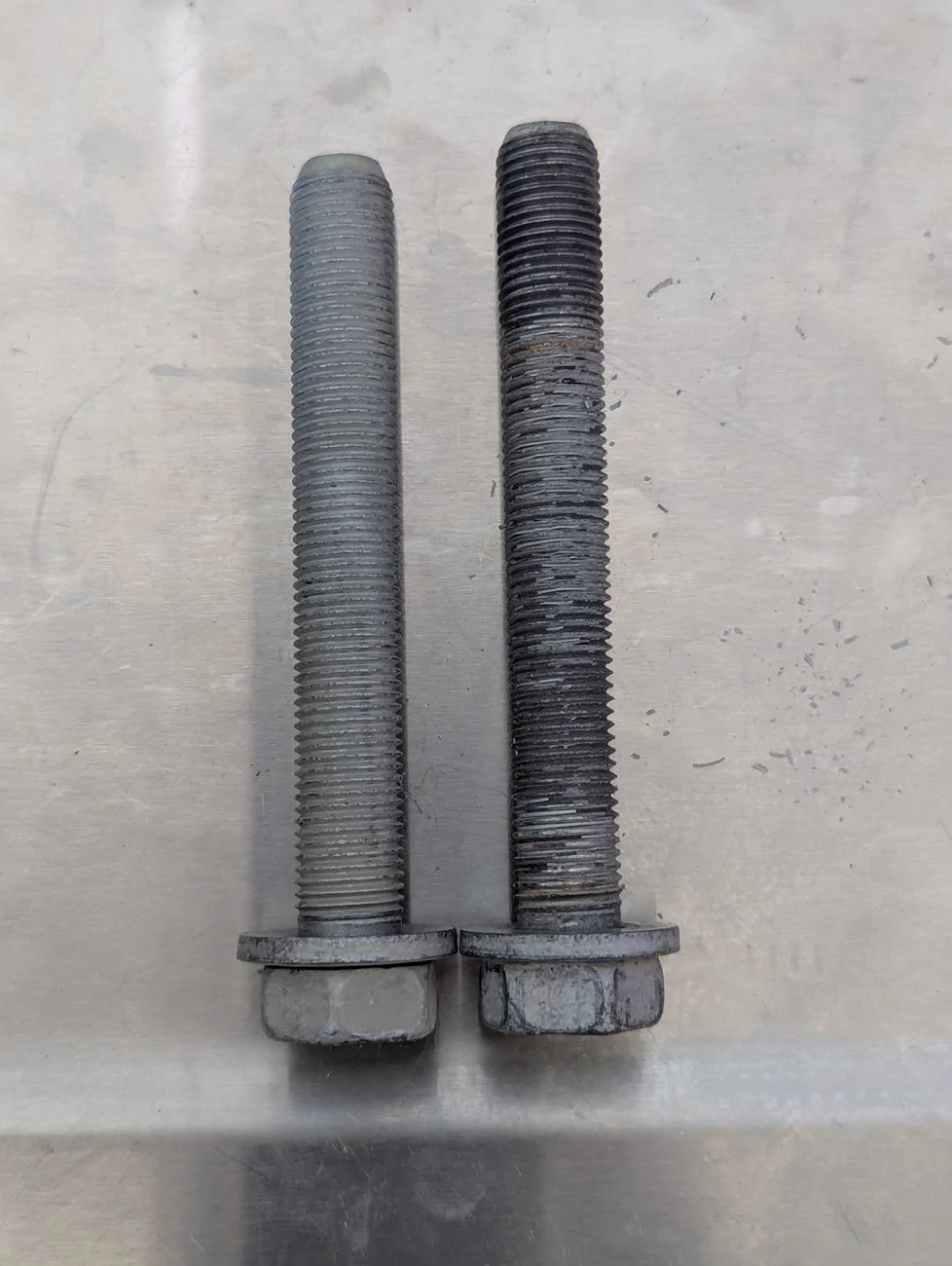
The rear lower control arm to axle torque spec in the FSM is 74 ft-lbs + 50° - That translates to about 125 ft-lbs. I say ‘about’ because one side hit 125.4 ft-lbs as the final torque and the other side was 129.3 ft-lbs. I calculated that it would be about 117 ft-lbs so I don’t feel too bad about the calculation. There could be some small error from the friction coefficient that I used or the modulus of elasticity that I used or something else. The Mopar lift instructions suggest 90 ft-lbs for that bolt. That’s quite a bit lower, but it’s probably what you want if you’re reusing the fasteners. Just don’t try to go to 190 ft-lbs like my instruction sheet said. You can see the results of that in the bolt that stretched. You can see the elongation compared to the new replacement and you can see the necking that happened compared to the straight edge of a ruler. The galvanizing was also flaking off of the bolt. I’m glad that bolt didn’t break!

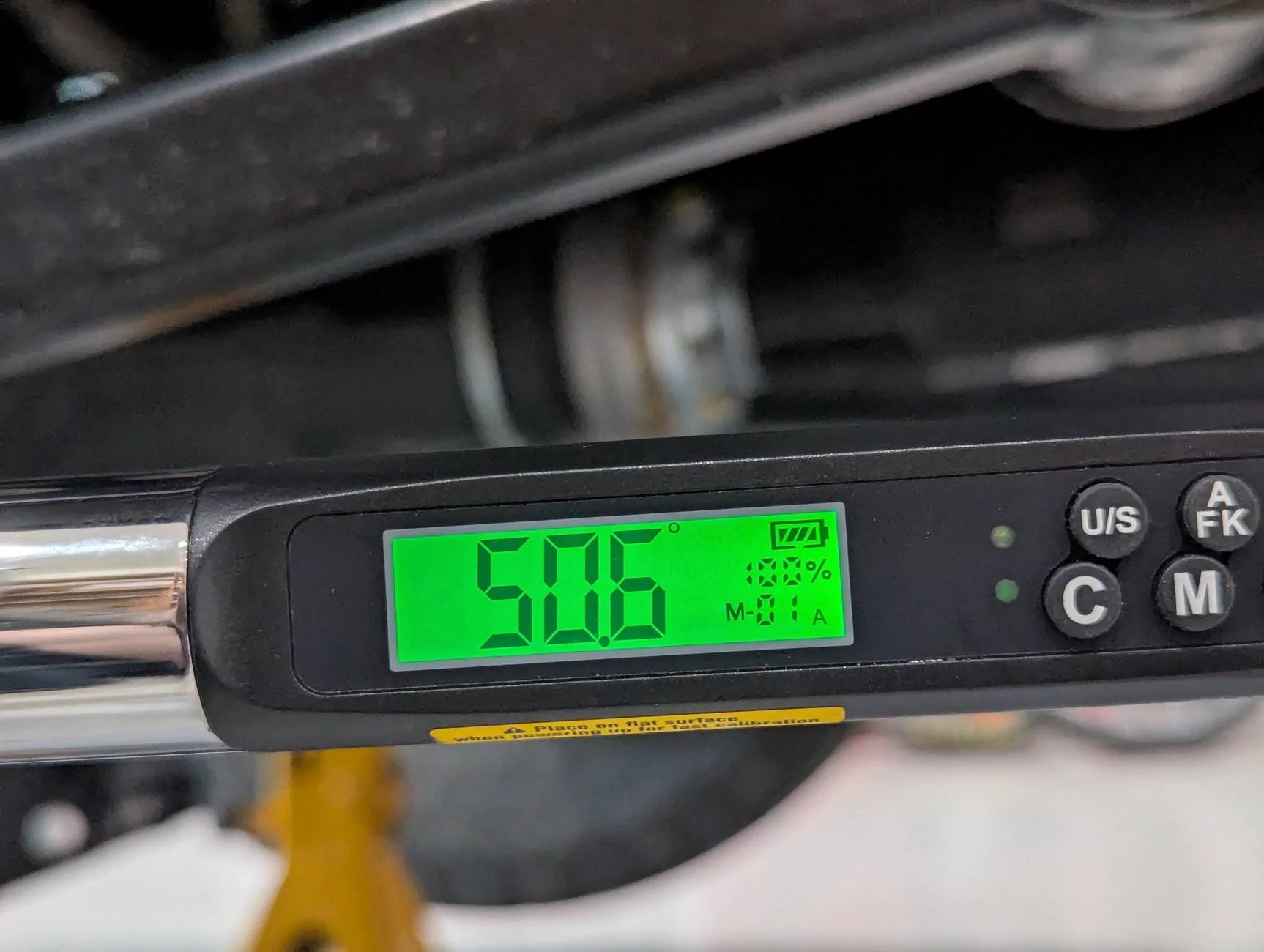
Final angle measurement on the digital torque wrench.
Jeep Wrangler JL Mopar Lift - Control Arm Torque Question PXL_20250725_183237031


And the final torque after going to 74 ft-lbs + 50°.
Jeep Wrangler JL Mopar Lift - Control Arm Torque Question PXL_20250725_183237438


These bolts should be the same length. The one on the right was stretched an additional ~3mm while under tension.
Jeep Wrangler JL Mopar Lift - Control Arm Torque Question PXL_20250725_174328093


Necking deformation of the failing bolt. So glad this didn't break!
Jeep Wrangler JL Mopar Lift - Control Arm Torque Question PXL_20250725_182347360~2


The rear lower control arm to frame torque spec is also 74 ft-lbs + 50° - This one gets interesting because one side got to 135.4 ft-lbs and the other got to 133.5 ft-lbs. I’m guessing that the difference has to do with a slightly different grip length between this fastener setup and the one on the axle. The bolts are the same length but something else is different.

The rear upper control arm to frame bolt torque spec is 74 ft-lbs + 80°. That seems like a much higher torque, and it is higher, but not as much as you might think. Again, I think the grip length has something to do with getting a final torque value of about 145 ft-lbs. I caught 145.6 ft-lbs on one side but didn’t catch the final value on the other side.
 
Last edited:

GATORB8

Well-Known Member
First Name
Matt
Joined
May 30, 2021
Threads
29
Messages
8,830
Reaction score
11,726
Location
CLT NC
Vehicle(s)
21 JLURe, 06 LJ, 25 HDZR2
I have more interesting findings that I might as well write down in case anyone else goes through this in the future. The torque wrench I’m using is an AC Delco ARM303-4A-340 1/2" Heavy Duty Angle Digital Torque Wrench. It reports the final torque after you reach the required angle in the torque spec, so now I have some real-world numbers for OEM bolts. I still wouldn’t rely on the end numbers that I got to torque up used hardware. Even new, I would prefer the torque + angle spec rather than trying to match these numbers. I think you’ll see why.

The rear lower control arm to axle torque spec in the FSM is 74 ft-lbs + 50° - That translates to about 125 ft-lbs. I say ‘about’ because one side hit 125.4 ft-lbs as the final torque and the other side was 129.3 ft-lbs. I calculated that it would be about 117 ft-lbs so I don’t feel too bad about the calculation. There could be some small error from the friction coefficient that I used or the modulus of elasticity that I used or something else. The Mopar lift instructions suggest 90 ft-lbs for that bolt. That’s quite a bit lower, but it’s probably what you want if you’re reusing the fasteners. Just don’t try to go to 190 ft-lbs like my instruction sheet said. You can see the results of that in the bolt that stretched. You can see the elongation compared to the new replacement and you can see the necking that happened compared to the straight edge of a ruler. The galvanizing was also flaking off of the bolt. I’m glad that bolt didn’t break!

Final angle measurement on the digital torque wrench.
PXL_20250725_183237031.jpg


And the final torque after going to 74 ft-lbs + 50°.
PXL_20250725_183237438.jpg


These bolts should be the same length. The one on the right was stretched an additional ~3mm while under tension.
PXL_20250725_174328093.jpg


Necking deformation of the failing bolt. So glad this didn't break!
PXL_20250725_182347360~2.jpg


The rear lower control arm to frame torque spec is also 74 ft-lbs + 50° - This one gets interesting because one side got to 135.4 ft-lbs and the other got to 133.5 ft-lbs. I’m guessing that the difference has to do with a slightly different grip length between this fastener setup and the one on the axle. The bolts are the same length but something else is different.

The rear upper control arm to frame bolt torque spec is 74 ft-lbs + 80°. That seems like a much higher torque, and it is higher, but not as much as you might think. Again, I think the grip length has something to do with getting a final torque value of about 145 ft-lbs. I caught 145.6 ft-lbs on one side but didn’t catch the final value on the other side.
Wow! Thanks for sharing!
 
OP
OP
Yardstick

Yardstick

Well-Known Member
Joined
Jan 16, 2021
Threads
15
Messages
83
Reaction score
38
Location
Arizona
Vehicle(s)
Jeep Wrangler JLURD, Tundra, 4Runner, Sprinter
This lift is the gift that keeps on beating me over the head. :headbang: I have not had a chance to get the alignment checked yet and have only been doing a little bit of local, lower speed driving. Today a message came on the screen saying, “Exhast Filter Nearing Full - Safely Drive at Constant Speed to Clear”. I was on my way to a different vehicle dealer to pick up a different problematic diesel vehicle so I changed plans and did my best to get on the freeway so that I wouldn’t be stuck in stop and go traffic. The message changed to, “Exhast System Regeneration in Process Continue Driving”. So I took a different highway that wouldn’t take me sooo far out of my way. On that highway there was a diagonal road imperfection. When the Jeep came off of that bump it went into full death wobble at 70mph! :surprised: Maybe it’s time @JeepCares took a look at this thread and my other thread about this problematic diesel Wrangler.

 

Sponsored

JeepCares

Well-Known Member
Joined
Feb 1, 2018
Threads
16
Messages
5,423
Reaction score
2,800
Location
Auburn Hills, MI
Vehicle(s)
JL
This lift is the gift that keeps on beating me over the head. :headbang: I have not had a chance to get the alignment checked yet and have only been doing a little bit of local, lower speed driving. Today a message came on the screen saying, “Exhast Filter Nearing Full - Safely Drive at Constant Speed to Clear”. I was on my way to a different vehicle dealer to pick up a different problematic diesel vehicle so I changed plans and did my best to get on the freeway so that I wouldn’t be stuck in stop and go traffic. The message changed to, “Exhast System Regeneration in Process Continue Driving”. So I took a different highway that wouldn’t take me sooo far out of my way. On that highway there was a diagonal road imperfection. When the Jeep came off of that bump it went into full death wobble at 70mph! :surprised: Maybe it’s time @JeepCares took a look at this thread and my other thread about this problematic diesel Wrangler.

Hello, thank you for tagging us and bringing this to our attention. Please send us a private message with the last eight characters of the VIN and mileage so our team can look into this for you.

Yenori
Jeep Cares
 

GATORB8

Well-Known Member
First Name
Matt
Joined
May 30, 2021
Threads
29
Messages
8,830
Reaction score
11,726
Location
CLT NC
Vehicle(s)
21 JLURe, 06 LJ, 25 HDZR2
This lift is the gift that keeps on beating me over the head. :headbang: I have not had a chance to get the alignment checked yet and have only been doing a little bit of local, lower speed driving. Today a message came on the screen saying, “Exhast Filter Nearing Full - Safely Drive at Constant Speed to Clear”. I was on my way to a different vehicle dealer to pick up a different problematic diesel vehicle so I changed plans and did my best to get on the freeway so that I wouldn’t be stuck in stop and go traffic. The message changed to, “Exhast System Regeneration in Process Continue Driving”. So I took a different highway that wouldn’t take me sooo far out of my way. On that highway there was a diagonal road imperfection. When the Jeep came off of that bump it went into full death wobble at 70mph! :surprised: Maybe it’s time @JeepCares took a look at this thread and my other thread about this problematic diesel Wrangler.
First thing to check is the torque on the track bar bolts.
 

jeepingib

Well-Known Member
First Name
Dusty
Joined
Jun 26, 2018
Threads
25
Messages
10,231
Reaction score
40,053
Location
College Station, TX
Vehicle(s)
18' JLUR Punk'n
Occupation
BBQ prophet
Interesting thread. I teach failure analysis for heavy equipment, and one of the things that I've found is that the supplier really makes the difference when it comes to having reliable hardware. We manufacture our own hardware, because when we sourced externally, the bolts didn't fail in a predictable manner. Even if they all fail below what they are rated at, if you know the failure point, you can ensure that the bolts don't meet it.
 
OP
OP
Yardstick

Yardstick

Well-Known Member
Joined
Jan 16, 2021
Threads
15
Messages
83
Reaction score
38
Location
Arizona
Vehicle(s)
Jeep Wrangler JLURD, Tundra, 4Runner, Sprinter
I did a double-check of everything once but I'll go through it all again, just in case. The Jeep has an appointment to see a dealer next week.

I didn't get to take a video showing the steering wheel vibrations but I realized that my dash camera might have caught something. It's not as severe as some I have come across but you can see the fenders shaking and the scenery appears to shake in this dash cam video:

 
First Name
Cedric
Joined
Jun 17, 2025
Threads
12
Messages
21
Reaction score
6
Location
Baie-Comeau
Vehicle(s)
wrangler sport 2025!
Sorry to bump this thread

I have the same questions for the rear control arms.

Old instructions are 90ft-lb for rear lca and 120 for rear uca and most aftermarket controls arms are in the 120-130 ballpark so I am a bit worried by the 185 and 200ft-lbs.

For now what I did is 120 for rear LCA, 140 for rear UCA.

Call it a day or I should torque it to the very high number the instructions calls?
Sponsored


Top