
Sponsored

3.6L ESS IBS Information

Yellow Cake Kid

Well-Known Member
Joined
Nov 20, 2019
Threads
107
Messages
980
Reaction score
619
Location
USA
Vehicle(s)
Jeep
Hi,
I stumbled my way through a similar path and had been reading about the Bosch IBS before I found this thread.

Thank you for the very helpful explanations and diagrams describing the ESS battery circuit on the other threads.

I have not had a battery problem yet, but want to understand what is going on in my Rubicon because I don't want the Jeep to die out in the desert and leave us stranded. We go places you should not go if you are not sure you can get back, so we rely on the Jeep to function properly.

Having said that I have been dwelling (pardon the pun) on the ESS battery circuit in the JL and have been considering ideas mentioned in these two articles:

Battery Management With an Intelligent Battery Sensor

What happens when connecting two batteries of different amp-hour rating in parallel?

Now, I must confess I had previously never thought about battery "sensors" mounted to lead acid car batteries, but I did know that operating two dissimilar batteries in parallel was a bad idea.

So, I have been trying to reconcile an appreciation for the seemingly complex, yet surprisingly basic, function of the battery sensor technology with the fact that it is evaluating a system that has been implemented in a configuration that is well known to cause all sorts of trouble.

The ideas have raised questions in my mind, which have led me to make some assumptions that I would like to correct or confirm.

1) Does the battery sensor attempt to develop information specific to each of the two batteries? It does not appear to.

2) Does the battery sensing and charging system attempt to average the needs of the batteries? That's what I think is going on.

3) How can the system, as it appears to be implemented, make adjustments that are ideal for either or both batteries? We have two batteries, which are probably at different temperatures, often at different charge levels, almost always at differing capacity, and almost certainly presenting different resistance. How can a system with one intelligent sensor, and one charging generator provide ideal charging to two batteries that have different needs? I do not think the system does provide ideal charging. I think that after all the "intelligence" has been played out, the system just charges the array while ignoring the fact that each battery would benefit from well known engineering knowledge that is being disregarded.

I have adopted the habit of observing the "Battery Level" while driving. I assume that the read out is not an actual measurement of the battery, but rather the battery and the charging system. I make this assumption based on the observation that the readout sometimes says 14.+ which is normal for a charging system. The charging needs to be a few volts greater than the battery so that current will flow to the battery. In other words the Battery Level indicator may read 14.+ volts but the battery is probably down near the 12 volts we would expect. What this means is that the Battery Level indicator shows us, with a sort of proxy representation, what the capacity of the battery is with indication of how the charging system is reacting to the "intelligent" choices being made by the sensor technology and the LIN Bus "brain".

So, far everything looks "normal". When I start the car after it has been parked for a day or two and leave the house the charging system is robust and it tops off the battery. This is indicated by the "Battery Level" rising to 14.+vDC. Gradually, after driving some significant distance, the "Battery Level" is reduced to 12.+vDC, which I believe is an indication made, not without irony, that the sensor system, thinks the battery is now fully charged.

I have found it interesting to observe that once the battery charge seems to be restored that the "Battery Level" readout on my dash seems to dance a bit. By that I mean that it will abruptly change its reported value. This happens most often when I am driving at highway speeds and crest a hill so that the Jeep begins to coast. When the stress on the drive line is rapidly reduced I noticed that the Battery Level readout will jump from a mid 12 volt level up to a mid 13 volt level, but just for a very short period before it normalizes back to the nominal level suitable for the circumstance.

I do not use the ESS function very much. I routinely turn it off while driving in town, and most of our mileage is tracked off road while 4 wheeling so it is turned off automatically. I suppose I am also an outlier because we do not demand much from the auxiliary battery. We rarely use the HVAC, and don't listen to the radio that often. So, if the ESS does kick in the load on the aux power is fairly low. I am also a bit superstitious and habitually pull any charger accessories from the convenience sockets when we park.

As I mull over these ideas I am formulating the opinion that the concept of start/stop is independent of the problems JL series Jeeps have been having with the batteries.

The problems seem to be related to a charging system that is attempting to maintain a battery array that should never have been assembled and placed in the Jeep. I do not doubt that FCA engineers understand this, I am confident that they are informed, educated, and experienced, yet they have somehow made the decision to put this system in the field.

I wonder if this is a case of calculated risk, where a decision was made to balance the cost savings of adding a cheap mismatched battery into a system designed to maintain one battery against the expense of servicing complaints made during the warranty window. I do not mean to seem cynical, I am assuming this is just a symptom of technological expectations evolving a bit more rapidly than a large industrial complex may effectively react. I feel this is a sort of stepping stone experience, with a possibilty of improvements to be introduced in subsequent generations of vehicles.

I would like to make a long term plan, for my personal vehicle, to either implement a matched pair or eliminate the two battery system.

I would welcome any comments, corrections, thoughts you may have on this subject.

Thank you!
Sponsored

 

Rhinebeck01

Well-Known Member
Joined
May 9, 2018
Threads
169
Messages
12,679
Reaction score
19,170
Location
Ormond Beach, Florida
Vehicle(s)
'18 JL Rubi, '26 Cybertruck, '01 Harley FatBoy
Occupation
Retired at 55 ..
@JeepScares

Personally, I don't trust the JL, in regard to it's two batteries, the sensors and such..

With that said, and because of my distrust ........... I have been running with the N1 - N2 jumper/bypass with Aux. Negative cable disconnected full-time for over a year now and over 18,900 miles doing so.

Leaves me running the JL with just the Main battery. No issues or shortcomings doing so..

I feel less vulnerable, lets say, running with one battery (Main) in use on my JL, just as I ran all my past JK's...... with one battery.

My JL's, Aux battery is healthy but I don't trust it... 8-)

I still attach a Battery Tender to both batteries to maintain them, when my vehicle sits idle for a few days. JL behaves just fine running on just the Main.. I still use the wingnuts on all, just in case I need to go back to stock configuration and don't want to bother with tools.
 
OP
OP
Jebiruph

Jebiruph

Well-Known Member
First Name
Jerry
Joined
Feb 18, 2018
Threads
57
Messages
2,405
Reaction score
3,006
Location
Iowa
Vehicle(s)
2018 JLU, 2020 JT, 2024 WL
Hi,
I stumbled my way through a similar path and had been reading about the Bosch IBS before I found this thread.

Thank you for the very helpful explanations and diagrams describing the ESS battery circuit on the other threads.

I have not had a battery problem yet, but want to understand what is going on in my Rubicon because I don't want the Jeep to die out in the desert and leave us stranded. We go places you should not go if you are not sure you can get back, so we rely on the Jeep to function properly.

Having said that I have been dwelling (pardon the pun) on the ESS battery circuit in the JL and have been considering ideas mentioned in these two articles:

Battery Management With an Intelligent Battery Sensor

What happens when connecting two batteries of different amp-hour rating in parallel?

Now, I must confess I had previously never thought about battery "sensors" mounted to lead acid car batteries, but I did know that operating two dissimilar batteries in parallel was a bad idea.

So, I have been trying to reconcile an appreciation for the seemingly complex, yet surprisingly basic, function of the battery sensor technology with the fact that it is evaluating a system that has been implemented in a configuration that is well known to cause all sorts of trouble.

The ideas have raised questions in my mind, which have led me to make some assumptions that I would like to correct or confirm.

1) Does the battery sensor attempt to develop information specific to each of the two batteries? It does not appear to.

2) Does the battery sensing and charging system attempt to average the needs of the batteries? That's what I think is going on.

3) How can the system, as it appears to be implemented, make adjustments that are ideal for either or both batteries? We have two batteries, which are probably at different temperatures, often at different charge levels, almost always at differing capacity, and almost certainly presenting different resistance. How can a system with one intelligent sensor, and one charging generator provide ideal charging to two batteries that have different needs? I do not think the system does provide ideal charging. I think that after all the "intelligence" has been played out, the system just charges the array while ignoring the fact that each battery would benefit from well known engineering knowledge that is being disregarded.

I have adopted the habit of observing the "Battery Level" while driving. I assume that the read out is not an actual measurement of the battery, but rather the battery and the charging system. I make this assumption based on the observation that the readout sometimes says 14.+ which is normal for a charging system. The charging needs to be a few volts greater than the battery so that current will flow to the battery. In other words the Battery Level indicator may read 14.+ volts but the battery is probably down near the 12 volts we would expect. What this means is that the Battery Level indicator shows us, with a sort of proxy representation, what the capacity of the battery is with indication of how the charging system is reacting to the "intelligent" choices being made by the sensor technology and the LIN Bus "brain".

So, far everything looks "normal". When I start the car after it has been parked for a day or two and leave the house the charging system is robust and it tops off the battery. This is indicated by the "Battery Level" rising to 14.+vDC. Gradually, after driving some significant distance, the "Battery Level" is reduced to 12.+vDC, which I believe is an indication made, not without irony, that the sensor system, thinks the battery is now fully charged.

I have found it interesting to observe that once the battery charge seems to be restored that the "Battery Level" readout on my dash seems to dance a bit. By that I mean that it will abruptly change its reported value. This happens most often when I am driving at highway speeds and crest a hill so that the Jeep begins to coast. When the stress on the drive line is rapidly reduced I noticed that the Battery Level readout will jump from a mid 12 volt level up to a mid 13 volt level, but just for a very short period before it normalizes back to the nominal level suitable for the circumstance.

I do not use the ESS function very much. I routinely turn it off while driving in town, and most of our mileage is tracked off road while 4 wheeling so it is turned off automatically. I suppose I am also an outlier because we do not demand much from the auxiliary battery. We rarely use the HVAC, and don't listen to the radio that often. So, if the ESS does kick in the load on the aux power is fairly low. I am also a bit superstitious and habitually pull any charger accessories from the convenience sockets when we park.

As I mull over these ideas I am formulating the opinion that the concept of start/stop is independent of the problems JL series Jeeps have been having with the batteries.

The problems seem to be related to a charging system that is attempting to maintain a battery array that should never have been assembled and placed in the Jeep. I do not doubt that FCA engineers understand this, I am confident that they are informed, educated, and experienced, yet they have somehow made the decision to put this system in the field.

I wonder if this is a case of calculated risk, where a decision was made to balance the cost savings of adding a cheap mismatched battery into a system designed to maintain one battery against the expense of servicing complaints made during the warranty window. I do not mean to seem cynical, I am assuming this is just a symptom of technological expectations evolving a bit more rapidly than a large industrial complex may effectively react. I feel this is a sort of stepping stone experience, with a possibilty of improvements to be introduced in subsequent generations of vehicles.

I would like to make a long term plan, for my personal vehicle, to either implement a matched pair or eliminate the two battery system.

I would welcome any comments, corrections, thoughts you may have on this subject.

Thank you!
Based on my personal observations and analysis;

1. Agree. Since the battery sensor only monitors main battery current, it does not provide aux battery information.

2 & 3. Modern computer controlled alternator output is adjusted based on load and typically there's no way to know what is placing the load on the alternator. However in this case, if the battery sensor reports the main battery is not fully charged, the computer can increase the alternator output above what the current load requires to facilitate charging the main battery. There's no way to know that the aux battery is not charged. That's why there is a cold start test for the aux battery.

The concept of the battery issues being separate from the stop/start system being active/disabled is what I think people struggle with the most. Even when stop/start is disabled, the dis-similar batteries can still be negatively impacting each other whenever the engine is off.

The 2 battery ESS system is the upgrade to the single battery ESS system. With the single battery system, people were getting stranded in traffic when the single battery failed to restart. The 2 battery system uses the aux battery when auto stopped, reserving the main battery power for the restart.
 

Yellow Cake Kid

Well-Known Member
Joined
Nov 20, 2019
Threads
107
Messages
980
Reaction score
619
Location
USA
Vehicle(s)
Jeep
One possible "ideal" system would utilize a single battery with a very large capacity and have a monitor system that starts the motor, and begins recharging when a threshold of low capacity is recognized.

As I understand it, measuring the actual capacity of a battery is a complicated and time consuming process. In other words, there is no technology available that would make such a measurement possible while driving a vehicle, so the scenario I described as "ideal", is not a practical solution.

I suggest that this is why the implementation of a single battery ESS system has resulted in the inopportune failure of batteries. The one battery system risks an over discharge of the battery, and there is no reliable way to identify an onset of the condition.

Here are some notes describing the character of capacity and some methods to measure for it:

Tracking Battery Capacity

How to Measure Capacity


The use of the second battery may seem like a natural alternative, but the use of two dissimilar batteries wired in parallel seems like a worst case implementation of this idea.

Using two batteries that were designed to be identical will not solve all the problems, but it might help avoid the more obvious concerns.

On the other hand, there may have been an admission that no two batteries, even if manufactured to be identical, will exhibit the same characteristics. This is especially true if the batteries are utilized for different tasks.

It may have been recognized that wiring a pair of batteries in parallel for one size fits all charging, and then separating them, via relay switching, for different work is such an inherently bad idea that the problems which arise from use of dissimilar batteries are marginal when compared to the other influences that damage such a system. In other words, it may have been found that the use of two matched batteries results in the very same problems.

With the current state of technology, it seems as if the auxiliary battery should not be connected in parallel with the starter battery, the auxiliary battery should have its own intelligent battery sensor, and charging for both the starter and auxiliary battery should somehow be made exclusive to each battery.

I am optimistic that this is causing automotive engineers a headache and that there will be more technology applied to make the use of these systems seem less aggravating.

In the meantime, I will continue to plan to mitigate the problem on my personal Rubicon so that I may trust the system to work when I need it too.

Thank you!
 
OP
OP
Jebiruph

Jebiruph

Well-Known Member
First Name
Jerry
Joined
Feb 18, 2018
Threads
57
Messages
2,405
Reaction score
3,006
Location
Iowa
Vehicle(s)
2018 JLU, 2020 JT, 2024 WL
With the current state of technology, it seems as if the auxiliary battery should not be connected in parallel with the starter battery, the auxiliary battery should have its own intelligent battery sensor, and charging for both the starter and auxiliary battery should somehow be made exclusive to each battery.

I am optimistic that this is causing automotive engineers a headache and that there will be more technology applied to make the use of these systems seem less aggravating.
Each battery does need it's own sensor. As far as engineer headaches, know that this system was used in the 2016 Durango and Grand Cherokee, so it wasn't a new system for the Wrangler. They did go back and fix the no starting with bad aux in the 18 Wrangler in the PCM update.
 

Sponsored

DanFelix

Well-Known Member
Joined
Dec 22, 2018
Threads
30
Messages
327
Reaction score
152
Location
Riverside, CA
Vehicle(s)
2018 Wrangler JL Sport S, 3.6l
1. The IBS seems to have the option of measuring the Main and the Aux since it has separate connections to both and a connection to the frame.
2. Does the connection point for a trickle-charger make a difference? If I attach the clamp to one of the bolts on the IBS vs. attaching the clamp to the bolt on the neg post it would seem that the charge flow would go through the IBS or by-pass it.

Thoughts?
 
OP
OP
Jebiruph

Jebiruph

Well-Known Member
First Name
Jerry
Joined
Feb 18, 2018
Threads
57
Messages
2,405
Reaction score
3,006
Location
Iowa
Vehicle(s)
2018 JLU, 2020 JT, 2024 WL
1. The IBS seems to have the option of measuring the Main and the Aux since it has separate connections to both and a connection to the frame.
2. Does the connection point for a trickle-charger make a difference? If I attach the clamp to one of the bolts on the IBS vs. attaching the clamp to the bolt on the neg post it would seem that the charge flow would go through the IBS or by-pass it.

Thoughts?
The IBS only measures current into and out of the battery it's clamped on, in the JL it's the main battery.

Good point on the trickle charger connection, I never thought about that. If you clamp the charger directly to the battery terminal, the IBS does not detect the charge going into the main battery and it will detect the charge to the aux battery as discharge from the main battery. The charger should be clamped to the cable post, then it will detect the charge going into the main battery and will not detect the charge to the aux battery, which it doesn't care about anyway.

At least that's the way I think it will work.
 

DanFelix

Well-Known Member
Joined
Dec 22, 2018
Threads
30
Messages
327
Reaction score
152
Location
Riverside, CA
Vehicle(s)
2018 Wrangler JL Sport S, 3.6l
The IBS only measures current into and out of the battery it's clamped on, in the JL it's the main battery.

Good point on the trickle charger connection, I never thought about that. If you clamp the charger directly to the battery terminal, the IBS does not detect the charge going into the main battery and it will detect the charge to the aux battery as discharge from the main battery. The charger should be clamped to the cable post, then it will detect the charge going into the main battery and will not detect the charge to the aux battery, which it doesn't care about anyway.

At least that's the way I think it will work.
Thanks. Makes sense to me.
 

Yellow Cake Kid

Well-Known Member
Joined
Nov 20, 2019
Threads
107
Messages
980
Reaction score
619
Location
USA
Vehicle(s)
Jeep
How would the Intelligent Brake Sensor and a trickle charger interact?

The trickle charger is not in communication with the vehicle's Body Control Module via the IBS. Yes?


On another note; The two batteries, when connected in parallel, as they are almost all of the time, present themselves as one big poorly designed battery.

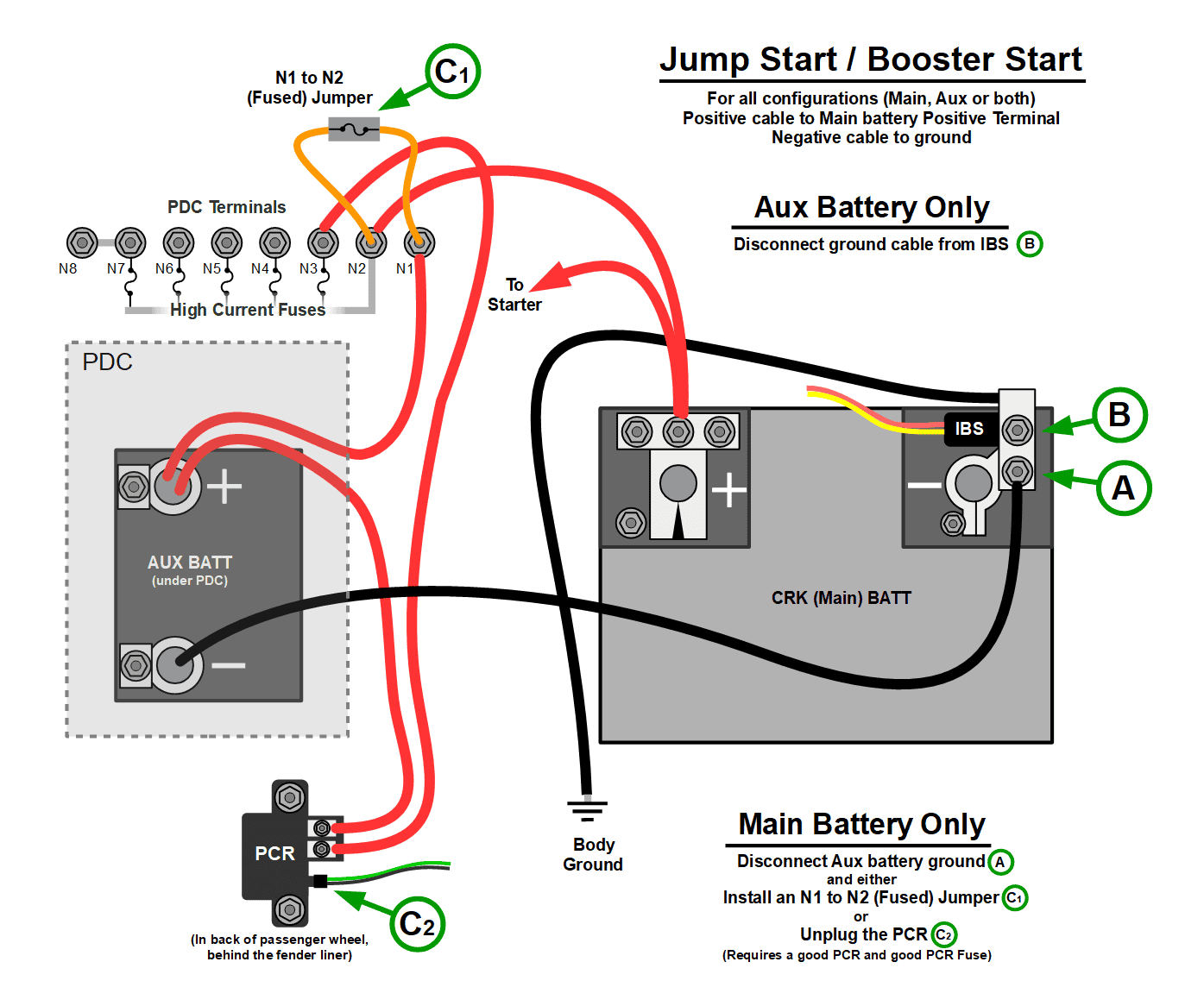
As has been shown in this excellent diagram which @Jebiruph prepared:

Jeep Wrangler JL 3.6L ESS IBS Information underhood-jumper-3a-


So, it is not that the IBS only monitors one of the two batteries, it actually monitors two dissimilar batteries as if they are one, and that does not seem like a very good idea

A really clever engineer might be able to grab some data from the IBS in the brief moments when the Power Control Relay has disconnected the parallel connection and then extrapolate from that data to make some assumptions about the characteristics of the individual batteries, but an engineer that clever would probably realize that measuring batteries is an inexact process and the small batches of data procured will not support meaningful conclusions, so the kludged system, as it seems to be implemented, is as good as any, for as long as the factory continues to install dissimilar batteries in a parallel configuration.
 
OP
OP
Jebiruph

Jebiruph

Well-Known Member
First Name
Jerry
Joined
Feb 18, 2018
Threads
57
Messages
2,405
Reaction score
3,006
Location
Iowa
Vehicle(s)
2018 JLU, 2020 JT, 2024 WL
How would the Intelligent Brake Sensor and a trickle charger interact?

The trickle charger is not in communication with the vehicle's Body Control Module via the IBS. Yes?


On another note; The two batteries, when connected in parallel, as they are almost all of the time, present themselves as one big poorly designed battery.

As has been shown in this excellent diagram which @Jebiruph prepared:

underhood-jumper-3a-png.png


So, it is not that the IBS only monitors one of the two batteries, it actually monitors two dissimilar batteries as if they are one, and that does not seem like a very good idea

A really clever engineer might be able to grab some data from the IBS in the brief moments when the Power Control Relay has disconnected the parallel connection and then extrapolate from that data to make some assumptions about the characteristics of the individual batteries, but an engineer that clever would probably realize that measuring batteries is an inexact process and the small batches of data procured will not support meaningful conclusions, so the kludged system, as it seems to be implemented, is as good as any, for as long as the factory continues to install dissimilar batteries in a parallel configuration.
The interaction between the trickle charger and the IBS occurs when current produced by the trickle charger passes through the IBS. If the charger negative is attached directly to the main battery negative post, the charging current going to the main battery does not pass through the IBS and would not be used by the IBS to calculate the main battery status. But the charging current going to the aux battery would pass through the IBS and would be used to calculate the status of the main battery.
 

Sponsored

Yellow Cake Kid

Well-Known Member
Joined
Nov 20, 2019
Threads
107
Messages
980
Reaction score
619
Location
USA
Vehicle(s)
Jeep
I must be missing something, when I hear the term "trickle charger" I think of an appliance you plug in to a household style wall outlet and use in the garage, carport, or driveway while the vehicle is turned off and the computer is in sleep mode.

In other words the Intelligent Battery Sensor's LIN Bus connection, which would manage the output of the vehicle's alternator is not in play.

I guess we are thinking about this differently, and I misunderstood the use of the term.
 
Last edited:
OP
OP
Jebiruph

Jebiruph

Well-Known Member
First Name
Jerry
Joined
Feb 18, 2018
Threads
57
Messages
2,405
Reaction score
3,006
Location
Iowa
Vehicle(s)
2018 JLU, 2020 JT, 2024 WL
I must be missing something, when I hear the term "trickle charger" I think of an appliance you plug in to a household style wall outlet and use in the garage, carport, or driveway while the vehicle is turned off and the computer is in sleep mode.

In other words the Intelligent Battery Sensor's LIN Bus connection, which would manage the output of the vehicle's alternator is not in play.

I guess we are thinking about this differently, and I misunderstood the use of the term.
That's the type of trickle charger I'm talking about.

The IBS is constantly monitoring and analyzing the status of the main battery, I expect (but have not verified) even when the vehicle is turned off. It does not control the alternator, but the battery status information it provides is applied to the alternator output calculation.
 

Yellow Cake Kid

Well-Known Member
Joined
Nov 20, 2019
Threads
107
Messages
980
Reaction score
619
Location
USA
Vehicle(s)
Jeep
Yes the IBS does not control the alternator, the IBS sends data via the Local Interconnect Network to the Module - Body Control. The BCM considers the data that the IBS sends and makes adjustments to the Alternator via the Gen Field Control, while monitoring the Gen Sensor signal.

How would the IBS and an off board appliance like a trickle charger interact?

The IBS may be able to observe the change in battery status effected by the trickle charger, even with the vehicle in sleep mode, but the vehicle is not equipped to communicate any info to the trickle charger, which might allow for best case charging of the battery array by the trickle charger.

Of course it could be possible, if it was specifically implemented as such, but it isn't in the current configuration.

With regards to the question posed "Does the connection point for a trickle-charger make a difference?" I do not think it does unless you disconnect the batteries from the parallel configuration and choose to charge one or the other.

If you do not disconnect the batteries the trickle charger sees one big battery with mismatched cells and it charges the system while the system reacts continually in an effort to balance itself.
 
Last edited:
OP
OP
Jebiruph

Jebiruph

Well-Known Member
First Name
Jerry
Joined
Feb 18, 2018
Threads
57
Messages
2,405
Reaction score
3,006
Location
Iowa
Vehicle(s)
2018 JLU, 2020 JT, 2024 WL
Yes the IBS does not control the alternator, the IBS sends data via the Local Interconnect Network to the Module - Body Control. The BCM considers the data that the IBS sends and makes adjustments to the Alternator via the Gen Field Control, while monitoring the Gen Sensor signal.

How would the IBS and an off board appliance like a trickle charger interact?

The IBS may be able to observe the change in battery status effected by the trickle charger, even with the vehicle in sleep mode, but the vehicle is not equipped to communicate any info to the trickle charger, which might allow for best case charging of the battery array by the trickle charger.

Of course it could be possible, if it was specifically implemented as such, but it isn't in the current configuration.

With regards to the question posed "Does the connection point for a trickle-charger make a difference?" I do not think it does unless you disconnect the batteries from the parallel configuration and choose to charge one or the other.

If you do not disconnect the batteries the trickle charger sees one big battery with mismatched cells and it charges the system while the system reacts continually in an effort to balance itself.
The IBS sits in-between the main battery negative terminal and the negative battery cable so it can monitor all current flow into and out of the main battery. If you connect a battery charger directly to the main battery negative terminal, you have bypassed the IBS for the charging current going to the main battery, but the charging current to the aux battery will go through the IBS. The IBS will use that current flow for it's main battery status analysis.

While the IBS monitors the battery in real time, it's not necessary that it communicates to the BCM in real time. At some point when the BCM comes up, it will need to know the current status of the main battery.

It's about time for another disclaimer: I may post like I know what I'm posting about, but I don't have any special insider information, only personal observation and information from the internet.
Sponsored


Top