
flanders
Well-Known Member
- Thread starter
- #1
Long time lurker, first time poster.
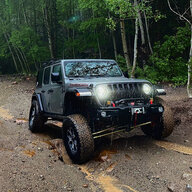
I am a proud new owner of a Sting grey 2021 JLUR. I have an emotional bound with that piece of metal I'll never be able to explain to my wife.
Although we go to Moab every summer, it will mainly be used as our overlanding rig. Awesome feeling packing everything you need to survive between the axles.
I'm sorry if this has been answered previously, but I've searching like crazy trying to figure this out.
I might be an unworthy jeep owner because I enjoy stock things. I'm an electrical engineer, and I get satisfaction knowing I'm using something within the constraints it was designed/optimised for. I like the power and gas mileage I get with my 33s, and I like having all the angles of my suspension close to stock.
After installing a winch and bull bar, I noticed the front was drooping, so I started looking at spring spacers. I decided if I was going to go through all that work, I might as well go for the 1.5"/2" TF spacers. (Just 4 hockey pucks and nothing else). Here's how I justified it to myself I wasn't changing stock angles.
I believe 'travel' is the distance between the bump stops and full shock extension. With spacers, you don't change the bump stops or the shock, so travel is the same. The only thing that changed its area of operation is the spring. The spring can now be compressed 2" more, and extends 2" less. Since an ideal spring is linear, I think that means it takes more force to hit the bump stop, and there is also more force on the shock when fully extended. I don't think that's too big of a deal, but I could be wrong.
Everything else other than the spring still sees the same range of movement, however at rest the suspension is biased higher. Basically I've traded equal amount of 'extension' range for 'compression' range, so the ratio is different. To me, I felt like that was a minimal change and kept things stockish.
Now to muddy the water, I'm pretty confused what shock extenders are for. If I were to throw a stock extender on my shocks, now I've changed the range of movement the shock sees. Now when I hit the bump stop, the shock is compressed 2 extra inches, like the spring. It also means the tire extends 2 extra inches when fully extended, but in the spirit of keeping things as stock as possible, I'm okay not gaining those 2 inches.
In my mind, 4 pucks without shock extensions is more true to stock. Is the only reason people use the extensions is to gain a few inches of travel when fully extended?
Thanks in advance for the help, and sorry for so much rambling.
I am a proud new owner of a Sting grey 2021 JLUR. I have an emotional bound with that piece of metal I'll never be able to explain to my wife.
Although we go to Moab every summer, it will mainly be used as our overlanding rig. Awesome feeling packing everything you need to survive between the axles.
I'm sorry if this has been answered previously, but I've searching like crazy trying to figure this out.
I might be an unworthy jeep owner because I enjoy stock things. I'm an electrical engineer, and I get satisfaction knowing I'm using something within the constraints it was designed/optimised for. I like the power and gas mileage I get with my 33s, and I like having all the angles of my suspension close to stock.
After installing a winch and bull bar, I noticed the front was drooping, so I started looking at spring spacers. I decided if I was going to go through all that work, I might as well go for the 1.5"/2" TF spacers. (Just 4 hockey pucks and nothing else). Here's how I justified it to myself I wasn't changing stock angles.
I believe 'travel' is the distance between the bump stops and full shock extension. With spacers, you don't change the bump stops or the shock, so travel is the same. The only thing that changed its area of operation is the spring. The spring can now be compressed 2" more, and extends 2" less. Since an ideal spring is linear, I think that means it takes more force to hit the bump stop, and there is also more force on the shock when fully extended. I don't think that's too big of a deal, but I could be wrong.
Everything else other than the spring still sees the same range of movement, however at rest the suspension is biased higher. Basically I've traded equal amount of 'extension' range for 'compression' range, so the ratio is different. To me, I felt like that was a minimal change and kept things stockish.
Now to muddy the water, I'm pretty confused what shock extenders are for. If I were to throw a stock extender on my shocks, now I've changed the range of movement the shock sees. Now when I hit the bump stop, the shock is compressed 2 extra inches, like the spring. It also means the tire extends 2 extra inches when fully extended, but in the spirit of keeping things as stock as possible, I'm okay not gaining those 2 inches.
In my mind, 4 pucks without shock extensions is more true to stock. Is the only reason people use the extensions is to gain a few inches of travel when fully extended?
Thanks in advance for the help, and sorry for so much rambling.
Sponsored


