
Sponsored

How to steal a lease?!?

CatskillsAlex

Well-Known Member
First Name
Alex
Joined
May 8, 2018
Threads
3
Messages
828
Reaction score
2,852
Location
Upstate NY + NYC
Vehicle(s)
2021 2-door Rubicon
Looks like there's some severe misunderstandings on leasing:

When you finance a car you are taking a specific amount of money and paying for it over a specific period of time. So let's take a $50k car for example.

Let's assume you finance with nothing down. You can choose the length of the term. Let's pick 60 months. During the first month you owe $50k so you will pay interest on $50k plus some amount towards the equity paydown. Every month you will owe less on the car so the interest portion of your payment is less because the principal balance is lower thus leaving more of your payment towards the principal paydown. Because we chose 5 years, on average you will have paid down approximately 20% of the initial price every year (slightly less in earlier years and slightly more in final years but negligible difference on 5 year loan). But because you are paying off so much of your car so fast the amount you still owe drops rapidly and thus the interest amount does as well.

The downside is you are artificially choosing 5 years. Realistically the car still has value after 5 years so you've actually paid down more of the cars value than you used, effectively building up equity. But you are not building equity in the sense that the asset has gone up in value, simply that you overpaid for the amount you used. Jeep figures the Wrangler Rubicon will be worth approximately 68% of its initial value after 3 years (residual). So they amortize the payment to match that.

Using the 5 year financing method above, after 3 years you only owe $20k on your Jeep, but Jeep thinks that car might be worth $34k at that time. So instead of having you pay down so much and then giving you a refund of $14k at lease end ($34k - $20k prinicipal left using a 5 year finance structure) they choose a point in the future and match your amortization schedule so your principal equals what they think is the value of the car at that future point. To have a $50k car have $34k remaining principal in 3 years, you would need to spread the amortization over 9 years.

So using Jeep's numbers, their lease is exactly like financing the car over a 9 year term but with the option to give the car back after 3 years because the principal remaining equals what Jeep thinks it will be worth.

Some of you might think its crazy to finance a car over 9 years but all you are doing when you finance it for a shorter period of time is using your car as a savings account. You are paying down the amount you owe faster than its depreciating and then if you sell, you'll recoup that extra money. But considering the low interest rates today, you are putting money into a 2% interest savings account. You could just as easily pay the actual amount that the car is depreciating and the "extra" money you would otherwise have paid to pay down your loan faster than depreciation, you could freely invest in anything you want. The probability that the best and highest risk adjusted return in the universe of investable assets is coincidentally the car you want to buy is unlikely.

A car is a depreciating asset and therefore has 2 costs, the amount of the value that depreciates during the time you own it and the interest on the asset for the time you own it. Paying more than that is fine, but there's no magic to it. It's exactly the same as a lease. Imagine walking into a hotel and asking how much it will cost to stay there for the next 2 years. The manager adds up the nightly rates and gives you the total. You could pay the total that matches the time you will use the hotel or you could tell the manager that you would like to pay a lot more than the total but have the difference refunded to you at the time you check out. That's the difference between financing a car using a artificially short amortization (4-5 years) and leasing with a more realistic amortization (based on objective measures of depreciation). If you do choose to pay for exactly the hotel cost, it makes no difference to the manager if you pay it every day or the entire amount upfront or any combination thereof. Same with a lease. You are paying for the depreciation for the duration of the lease plus interest on the remaining principal. If you choose to pay that upfront or monthly just affects your payments and barely affects the total amount you pay (I wrote barely because obviously with payments there os more principal outstanding during the lease term so total interest payment is a bit higher to cover interest on the higher balance).

Sometimes people act like these are 2 radically different mechanisms. Its the exact same thing just with different loan terms. The only real differences are:
1) Any interest rate difference (sometimes the lease interest rate or finance interest rate can be higher/lower depending on manufacturer or bank programs)
2) The extra protection of having the right to walk away at lease end. If car is worth more you can still sell it yourself but if it has depreciated equal to or greater than the lender's projection you get to "sell" at that higher price by turning the car in.
3) Any tax implications (usually if you have a business)

All the other stuff of extra fees etc. is nonsense. Anyone can request any fees they want and it's up to you to say no. There should be no difference in negotiated price or fees should you choose to lease or buy. Even the term buy is misleading, you are borrowing under an accelerated pay-back window.

As for keeping the car at the end of the lease. That goes back to point 1 above regarding interest rate differences. Financing upfront may be more advantageous if you can lock in a lower interest rate for the entire term of the loan versus splitting the loan into 2 portions with 2 different rates. The lease rate for the initial term and then the used car interest rate for the term following the buyout.


He's paying interest on the entire amount he is borrowing. When you lease you are borrowing the entire vehicle for 3 years (not just the value the car will lose while you own it) and therefore pay interest on the entire outstanding principal every month you still have the car. Just like if you finance a car, the first month you will pay interest on the entire value of the car and every month it will go down.
Thank you for taking the time to lay this out in clear terms. Agree that the leasing vs buying debate seems to be vastly misunderstood/misinterpreted/misrepresented. Heck, I work in finance and I still wouldn’t claim I have a clear understanding of all those dynamics, mostly because I’ve heard so much conflicting info over the years. The way you articulated your thought process was very helpful - thanks again.
:like:
Sponsored


Scott from NC

Well-Known Member
First Name
Scott
Joined
Aug 12, 2018
Threads
13
Messages
71
Reaction score
16
Location
North Carolina
Vehicle(s)
A mom Van, researching our next Wrangler
If the goal is to purchase the jeep at the end of the lease, is there ever a time when a lease makes sense?
 

beachbum

Well-Known Member
Joined
Aug 18, 2018
Threads
9
Messages
47
Reaction score
36
Location
naples, fl
Vehicle(s)
Tesla Model S
If the goal is to purchase the jeep at the end of the lease, is there ever a time when a lease makes sense?
Depends on what you value and the opportunity cost of your money. If you are just referring to total cost than a lease followed by buying out the car with financing will be more expensive because most companies charge an acquisition fee for a lease (about $500 - $600). If the lease interest rate is sufficiently lower to counter that extra cost than a lease might still be lower overall. However, right now the lease interest rate from Chrysler is higher than most banks finance interest rate. So your total ownership cost will be slightly higher with a lease followed by a buyout.

However, the idea of "goal is to purchase at end of lease" is open ended. What you really need to understand is the length of time you intend to own the vehicle. The only time you really "buy" a vehicle is if you intend on never selling it and instead run it until you sell its parts for scrap value. Otherwise there is some length of time that you intend to use the Jeep for and you are looking to minimize the total cost to you during that time (all payments minus any money earned when you eventually resell minus the opportunity cost of the money you paid). Is that term 4, 6 , 8, 10 years? The 4 year residual on a 4 door Sport S is about 70%. That means if you can buy the car at 12% below MSRP, you would only pay 18% of the MSRP over 4 years plus interest - that's REALLY good. If it depreciates even less (i really doubt it) you could always sell it for a profit at the end. If you are doing a Rubicon the residual percentage is lower. Choose the actual timeframe you want to own the car for and then just run the numbers. If you plan to hold for 8 years, compare financing vs 2 - 4 year leases (might be cheaper to just lease a new car in 4 years than to buy out your 4 year old car).
 

guarnibl

Well-Known Member
Joined
Apr 3, 2017
Threads
4
Messages
2,541
Reaction score
2,324
Location
Scottsdale / Sarasota
Vehicle(s)
'09 JK, '26 Willys
Also, to mention -- Florida is a friendly state to lease from a tax perspective. Be thankful you are not in Texas and trying to lease where you have to pay tax on the entire vehicle up front!
 

Sponsored

FranklinFlyer

Well-Known Member
First Name
Stanley
Joined
Dec 1, 2017
Threads
1
Messages
147
Reaction score
129
Location
Germany
Vehicle(s)
2007 Grand Cherokee Overland 2017 Jeep Renegade Limited
Occupation
Producer
Yeah. It's a really good thread. But I still don't understand completely. English is not my 1st language.

I like to get a JL now, just for 2 years, because I wanna have a Hybrid JL which is coming at the end of 2020 or 2021 maybe (EU version).
If I like to own the first one just for this 2 years, a Lease is a much better choice, isn't it?
 

travelboysteve

Well-Known Member
First Name
Steve
Joined
Feb 4, 2018
Threads
4
Messages
173
Reaction score
147
Location
Cali
Vehicle(s)
Escape, Fusion, ProMaster Van, FR3 MH
Alright so I've read a lot of posts on here which really helped me see the value in leasing a car being how well Wranglers hold theirvalue.

I've been searching for about a month now and trying to come up with the best deal...

I've got a deal in place and was hoping to get some opinions on it.

JEEP JLUR
MSRP: $47,910
Invoice: $43,799 (9% below msrp)
MF: .00208 (4.99% APR)
Term: 48/10
RV: 64% ($31,942)
Total Due at signing: $4,150
Mo. Payment: $400


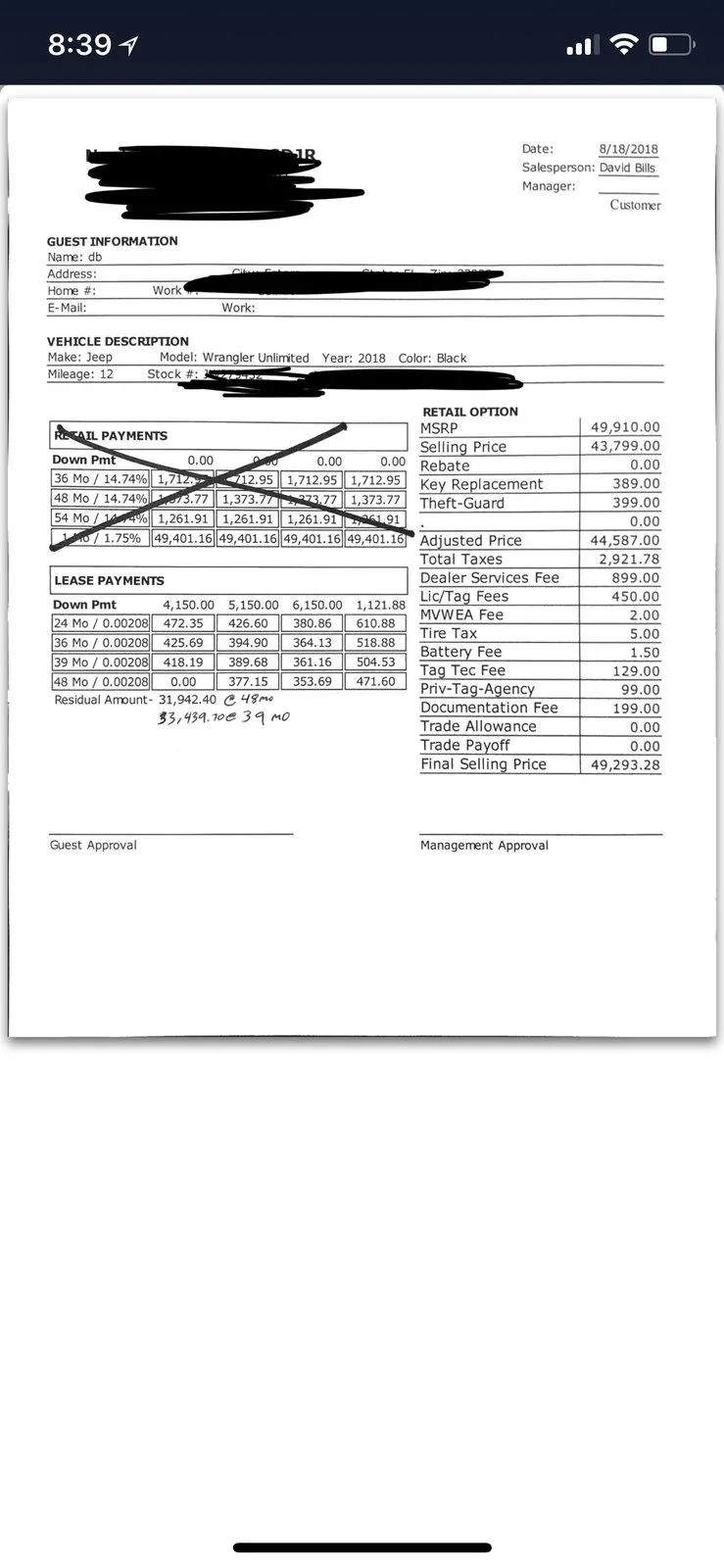
I've attached the breakdown sent by thedealership... i've been using leasehackr to help base the numbers and with everything I think I’ve learned so far something still doesn't seem right...

From what I added up, all of the "dealer fees" add up to $1,784.5 which the sales manager added up to $2049.00; so right there that doesn't make sense; maybe just bad

Based off what they broke down, they have a final sales price of $49,293. Here's where I think they are trying to pull the wool over my eyes... How does the final sales price become $1383 more than MSRP

Out of the $4150, I took the $1784.5 out for dealer fees which leaves $2365.5 that should be applied to net cap cost.. if i'm assuming correct, that 2365.5 should be directly deducted from the invoice of $43,799; no? All that I should be responsible for is the tax on net cap cost..

So if you take 41433.5 (new invoice # after Down Payment) - 31942 (RV) = $9,491.5 (Depreciation)

IDK, am i missing something? This is the first lease i've ever truly looked into the numbers to understand the math side of things and all it really makes me realize how corrupt dealerships are... i mean i get they need to make money but their approach in doing so is in hopes that the consumer is blind enough to just look at the mo. payment....

I'd love to get some feedback on this deal and possibly a strategy to best close this deal.

5BAC4241-2EF6-4143-A93E-B6F7B4D08657.webp

Leasing is good as well IF you can write the whole thing off.
Taxes have changed for us business owners in that regard.

Me?, I paid 44k for a fully loaded Rubi out the door. 2 door.
However, because I live in Kommiefornia, I got swamped with state taxes, ($4k)

Leases have their place
Financing has its place

Get another, or even 2 more comparable lease offers to compare.
Don't give the info about each other, just see who steps forward with their best foot.

I've had sales managers tell me on prior deals that a deal I had, (from a long time fleet mgr friend), was impossible.
nothing is "impossible", except walking on water, and even that hasn't been done yet.
Oh wait, my wife claims she does that all the time,..and there was this other guy alledgedly,....
 

travelboysteve

Well-Known Member
First Name
Steve
Joined
Feb 4, 2018
Threads
4
Messages
173
Reaction score
147
Location
Cali
Vehicle(s)
Escape, Fusion, ProMaster Van, FR3 MH
Yeah. It's a really good thread. But I still don't understand completely. English is not my 1st language.

I like to get a JL now, just for 2 years, because I wanna have a Hybrid JL which is coming at the end of 2020 or 2021 maybe (EU version).
If I like to own the first one just for this 2 years, a Lease is a much better choice, isn't it?

Yes
Less OOP
(out of pocket)
 

Wanderingwheelz

Well-Known Member
First Name
Daniel
Joined
Jul 28, 2018
Threads
14
Messages
527
Reaction score
567
Location
Delaware
Vehicle(s)
2018 JL Sport
Yeah. It's a really good thread. But I still don't understand completely. English is not my 1st language.

I like to get a JL now, just for 2 years, because I wanna have a Hybrid JL which is coming at the end of 2020 or 2021 maybe (EU version).
If I like to own the first one just for this 2 years, a Lease is a much better choice, isn't it?
You should do just fine by making as good a deal as can be done on a purchase (say, roughly 6-8% or so under invloice) and trading it in two years later on the new Wrangler- especially if you avoid any interest expense and leasing fees by paying cash. That should also allow you some additional miles which wouldn’t really matter since after 24 months you won’t have a high mileage car, regardless.

One other thing. FCA isn’t incentivizing the lease on the Wrangler. In order for the lease to begin to really make sense the manufacturer needs to incentivize it, from what I’ve found in my past new car buying endeavors.
 
Last edited:

PapaJoe

Well-Known Member
First Name
Joe
Joined
Jul 1, 2018
Threads
10
Messages
286
Reaction score
98
Location
Cary, NC
Vehicle(s)
2022 Jeep Wrangler 4xe Rubicon
Looks like there's some severe misunderstandings on leasing:

When you finance a car you are taking a specific amount of money and paying for it over a specific period of time. So let's take a $50k car for example.

Let's assume you finance with nothing down. You can choose the length of the term. Let's pick 60 months. During the first month you owe $50k so you will pay interest on $50k plus some amount towards the equity paydown. Every month you will owe less on the car so the interest portion of your payment is less because the principal balance is lower thus leaving more of your payment towards the principal paydown. Because we chose 5 years, on average you will have paid down approximately 20% of the initial price every year (slightly less in earlier years and slightly more in the final years but negligible difference on 5 year loan). But because you are paying off so much of your car so fast the amount you still owe drops rapidly and thus the interest amount does as well.

The downside is you are artificially choosing 5 years. Realistically the car still has value after 5 years so you've actually paid down more of the car's value than you used, effectively building up equity. But you are not building equity in the sense that the asset has gone up in value, simply that you overpaid for the amount you used. Jeep figures the Wrangler Rubicon will be worth approximately 68% of its initial value after 3 years (residual). So they amortize the payment to match that.

Using the 5 year financing method above, after 3 years you only owe $20k on your Jeep, but Jeep thinks that car might be worth $34k at that time. So instead of having you pay down so much and then giving you a refund of $14k at lease end ($34k - $20k prinicipal left using a 5 year finance structure) they choose a point in the future and match your amortization schedule so your principal equals what they think is the value of the car at that future point. To have a $50k car have $34k remaining principal in 3 years, you would need to spread the amortization over 9 years.

So using Jeep's numbers, their lease is exactly like financing the car over a 9 year term but with the option to give the car back after 3 years because the principal remaining equals what Jeep thinks it will be worth.

Some of you might think its crazy to finance a car over 9 years but all you are doing when you finance it for a shorter period of time is using your car as a savings account. You are paying down the amount you owe faster than its depreciating and then if you sell, you'll recoup that extra money. But considering the low interest rates today, you are putting money into a 2% interest savings account. You could just as easily pay the actual amount that the car is depreciating and the "extra" money you would otherwise have paid to pay down your loan faster than depreciation, you could freely invest in anything you want. The probability that the best and highest risk adjusted return in the universe of investable assets is coincidentally the car you want to buy is unlikely.

A car is a depreciating asset and therefore has 2 costs, the amount of the value that depreciates during the time you own it and the interest on the asset for the time you own it. Paying more than that is fine, but there's no magic to it. It's exactly the same as a lease. Imagine walking into a hotel and asking how much it will cost to stay there for the next 2 years. The manager adds up the nightly rates and gives you the total. You could pay the total that matches the time you will use the hotel or you could tell the manager that you would like to pay a lot more than the total but have the difference refunded to you at the time you check out. That's the difference between financing a car using an artificially short amortization schedule (4-5 years) and leasing with a more realistic amortization (based on objective measures of depreciation). If you do choose to pay for exactly the hotel cost, it makes no difference to the manager if you pay it every day or the entire amount upfront or any combination thereof. Same with a lease. You are paying for the depreciation for the duration of the lease plus interest on the remaining principal. If you choose to pay that upfront or monthly just affects your payments and barely affects the total amount you pay (I wrote barely because obviously with payments there is a higher principal outstanding during the lease term so total interest payment is a bit higher to cover interest on the higher balance).

Sometimes people act like these are 2 radically different mechanisms. Its the exact same thing just with different loan terms. The only real differences are:
1) Any interest rate difference (sometimes the lease interest rate or finance interest rate can be higher/lower depending on manufacturer or bank programs)
2) The extra protection of having the right to walk away at lease end. If car is worth more you can still sell it yourself but if it has depreciated equal to or greater than the lender's projection you get to "sell" at that higher price by turning the car in.
3) Any tax implications (usually if you have a business).
All the other stuff of extra fees etc. is nonsense. Anyone can request any fees they want and it's up to you to say no. The should be no difference in negotiated price and the only difference in fees is a possible one time acquisition and/or disposition fee for leasing. Even the term buy is misleading, you're always renting even when you "buy", you are renting for whatever term you choose to hold the asset then you return it to whomever is the next owner and your rent payments equal the value the asset lost while you held it plus interest for the asset during the time you held it.

As for keeping the car at the end of the lease. That goes back to point 1 above regarding interest rate differences. Financing upfront may be more advantageous if you can lock in a lower interest rate for the entire term of the loan versus splitting the loan into 2 portions with 2 different rates. The lease rate for the initial term and then the used car interest rate for the term following the buyout.


He's paying interest on the entire amount he is borrowing. When you lease you are renting the entire vehicle for 3 years (not just the value the car will lose while you own it) and therefore pay interest on the entire outstanding principal every month you still have the car. Just like if you finance a car, the first month you will pay interest on the entire value of the car and every month it will go down.
^^^ THIS 100%!!! (thank you!!!)

One advantage of a lease that has not been mentioned is that there is no need to worry about GAP insurance, which is a financial instrument used to protect a buyer in the event he/she totals the vehicle when they are upside down in their loan, which typically happens the moment you drive off the lot unless you've paid a large down payment. No need for GAP insurance with leases and most dealerships use scare tactics in order to sell buyers significantly over-priced GAP coverage. If you buy, decline the dealer GAP coverage and shop around...or, take it to be covered until you find a cheaper policy, then cancel and get your money back.
Sponsored


Top