
Sponsored

Anyone Running a Standalone Solar Setup?

Newbiehere

Active Member
First Name
Lauren
Joined
Dec 18, 2022
Threads
11
Messages
41
Reaction score
11
Location
Kentucky
Vehicle(s)
Jeep Wrangler Sport S
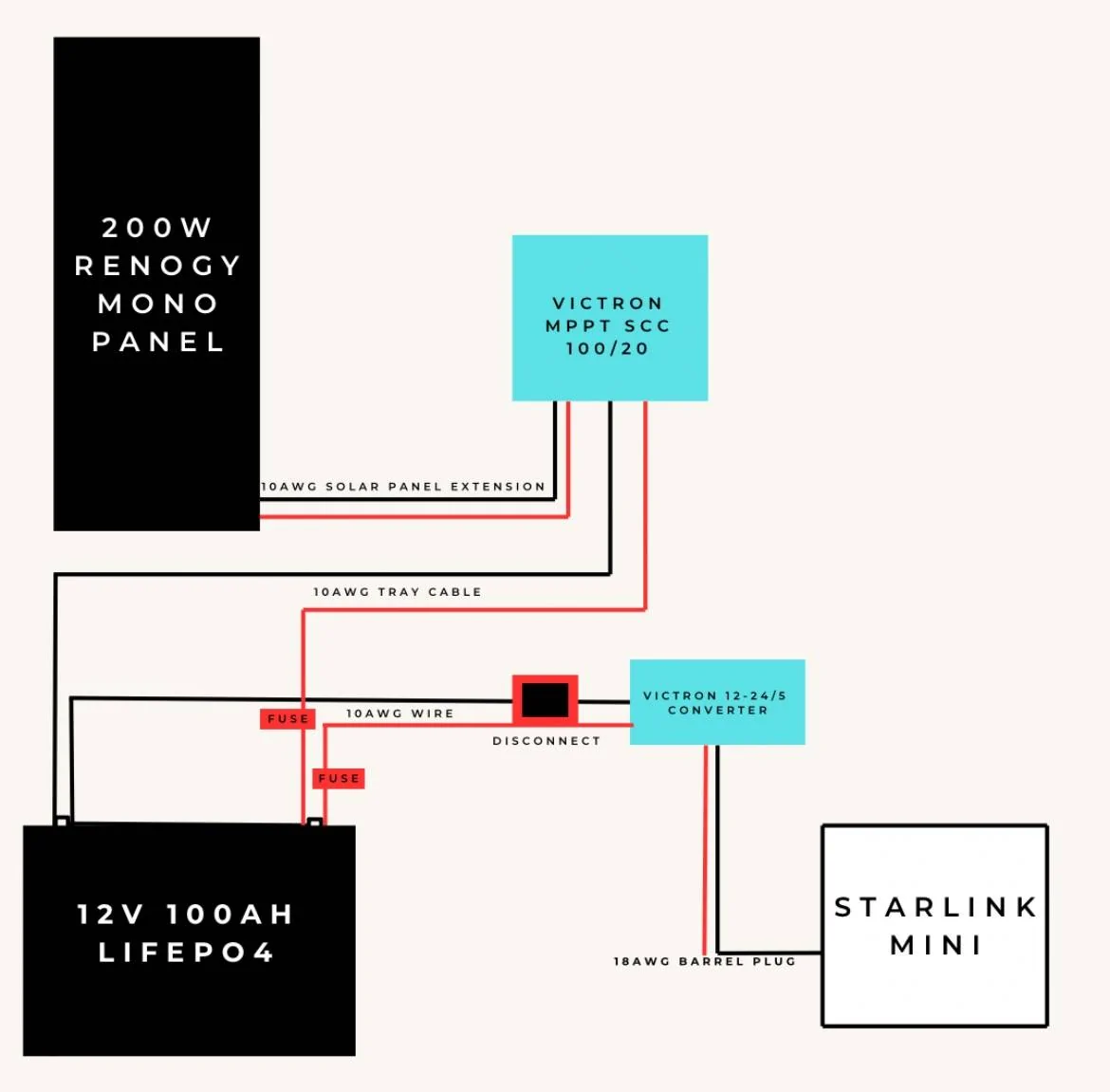
Putting together a solar system and looking for ideas on where to mount the battery, MPPT and converter. Would love to see pics of what everyone has done.

Jeep Wrangler JL Anyone Running a Standalone Solar Setup? IMG_9915
Sponsored


linux_guy

Well-Known Member
Joined
Aug 1, 2020
Threads
8
Messages
335
Reaction score
508
Location
Alabama
Vehicle(s)
2020 JL 6-speed manual, 2011 Compass 5-speed manual
For anyone with Ego lawn equipment/ batteries/ inverter, it would be interesting to see possibilities. Like OP I have a Renogy brand panel (100 Watt 12 Volt Monocrystalline Solar Panel (Compact Design)). Ego documented Renogy as compatible with their batteries. I think my panels have MP4 connections per my reading of Ego website's part description for CH1800. Is this doing the same task as OP's Victron MPPT? I read some Victron documentation that referred to MC4 connections.

With sliding windows and guards I already have, I might be able to mount the panel to or suspend it from the window guard. The connector could pass through to inside of vehicle where inverter and batteries could stay.
 
Last edited:

dstevens

Well-Known Member
Joined
Apr 13, 2023
Threads
8
Messages
949
Reaction score
1,605
Location
CA
Vehicle(s)
2024 JLURX
You'll want a disconnect between the solar and MPPT. The 5A DC-DC might be too small - starlink can be over 60W, but you really need to know the converter de-rating with temperature to know what that 5V rating turns into once it is hot. The 12-25/5 is not designed to run off a battery, and the under voltage shut off is 13V, so it will not work for you. The Orion 12/12-9 would be better choice, going down to 7V, but check the starlink maximum current because the Orion de-rates to 85W at 40C. Stick with victron because they are the best choice.
Also then work out with your use pattern if 200W solar and 100Ah battery will work. If the starlink averages over 4A then the system will work as long as you have the solar in sunlight during summer. My rule of thumb is to halve the solar output to compensate for unfavorable mounting angles (100W) and then allow about 6 hours per day in winter. So 600W, lose 10% each way to the battery and converter, you have about 500Whr per day so perhaps 10 hours of use per day maximum. It's pretty easy to add plug in solar and also cheap to oversize the MPPT so consider that.
As for mounting, what I do is get the dimensions and then alter some cardboard boxes to the same size, and then use those to see where things might fit. On my 2024 there is a lot of unused space on the driver side behind the back seat - some sort of large white plastic spacer which could swallow the MPPT and converter easier. Battery might be harder to store.
Finally, are you going to charge from the alternator? Then you'll be looking at another Orion DC-DC.
 

BigMaCro

Well-Known Member
First Name
Matt
Joined
Mar 7, 2022
Threads
17
Messages
502
Reaction score
885
Location
Moved to Iowa from Alaska
Website
www.youtube.com
Vehicle(s)
2021 JLU 4xe Rubicon
Build Thread
Link
Occupation
Carhauler
Vehicle Showcase
1
Howdy,

Looks like there's some issues with your diagram. The starlink mini doesn't need a DC/DC converter, it can take 12V direct to the mini barrel plug. Where you do need a DC/DC converter is connecting to your Jeep's battery, assuming you want the Jeep to be able to charge the LiFePo in the back.

Code:
Jeep Battery MRBF fuse==6AWG cable==OrionXS==SafetyHub==LiFePo4 Battery
                                               |    |
                                               |    MPPT ===Disconnect === Solar Panel
                                               |
                                               Starlink Mini
For vehicle to LiFePo charging, I'd use an Victron Orion XS 12|12-50.
Don't connect things straight to the LiFePo, use a fuse block like BlueSea SafetyHub. Everthing gets its own fuse.

I have built a rear-seat-delete platform so have extra space to accommodate a battery and electronics in the rear cargo cubby. have planned for it but haven't installed solar yet.
 

BigMaCro

Well-Known Member
First Name
Matt
Joined
Mar 7, 2022
Threads
17
Messages
502
Reaction score
885
Location
Moved to Iowa from Alaska
Website
www.youtube.com
Vehicle(s)
2021 JLU 4xe Rubicon
Build Thread
Link
Occupation
Carhauler
Vehicle Showcase
1
Looks like you changed your plan from Starlink Standard Gen3, which requires more power conversion. I have actually installed that on my motorhome, and use a 12-52V converter and POE power injector, and don't use the starlink router, but my own instead.

The mini is great for vehicle applications, now that it's out. It can take 12-48V on it's barrel connector, and don't need a separate router. Just has reduced speed.
 

Sponsored

OP
OP

Newbiehere

Active Member
First Name
Lauren
Joined
Dec 18, 2022
Threads
11
Messages
41
Reaction score
11
Location
Kentucky
Vehicle(s)
Jeep Wrangler Sport S
You'll want a disconnect between the solar and MPPT. The 5A DC-DC might be too small - starlink can be over 60W, but you really need to know the converter de-rating with temperature to know what that 5V rating turns into once it is hot. The 12-25/5 is not designed to run off a battery, and the under voltage shut off is 13V, so it will not work for you. The Orion 12/12-9 would be better choice, going down to 7V, but check the starlink maximum current because the Orion de-rates to 85W at 40C. Stick with victron because they are the best choice.
Also then work out with your use pattern if 200W solar and 100Ah battery will work. If the starlink averages over 4A then the system will work as long as you have the solar in sunlight during summer. My rule of thumb is to halve the solar output to compensate for unfavorable mounting angles (100W) and then allow about 6 hours per day in winter. So 600W, lose 10% each way to the battery and converter, you have about 500Whr per day so perhaps 10 hours of use per day maximum. It's pretty easy to add plug in solar and also cheap to oversize the MPPT so consider that.
As for mounting, what I do is get the dimensions and then alter some cardboard boxes to the same size, and then use those to see where things might fit. On my 2024 there is a lot of unused space on the driver side behind the back seat - some sort of large white plastic spacer which could swallow the MPPT and converter easier. Battery might be harder to store.
Finally, are you going to charge from the alternator? Then you'll be looking at another Orion DC-DC.
Thanks for the advice. The 200w/100Ah are more than enough for my use, even halved. I removed the backseat and built a platform. As of now, my best option for the battery is in the cargo area. I’d like to mount the rest of the components on the hardtop, but don’t want to drill into it, obviously. I won’t be charging from the alternator.
 
OP
OP

Newbiehere

Active Member
First Name
Lauren
Joined
Dec 18, 2022
Threads
11
Messages
41
Reaction score
11
Location
Kentucky
Vehicle(s)
Jeep Wrangler Sport S
Looks like you changed your plan from Starlink Standard Gen3, which requires more power conversion. I have actually installed that on my motorhome, and use a 12-52V converter and POE power injector, and don't use the starlink router, but my own instead.

The mini is great for vehicle applications, now that it's out. It can take 12-48V on it's barrel connector, and don't need a separate router. Just has reduced speed.
You are correct. The Gen3 was a little much for me. Really trying to minimize all of the moving parts and maximize the space I have. The Mini fits the bill.
Sponsored


Top