Sponsored

TOTL Innovations

Well-Known Member
Rock Sponsor (Level 1)
Joined
May 12, 2019
Threads
11
Messages
340
Reaction score
400
Location
Colorado
Website
www.totlinnovations.com
Vehicle(s)
2008 JK
I know we have been promising some real test results on the benefits of our JL/JT H.E.R.O. Hood for quite some time not and we are very sorry it has taken this long but without further ado:


For those that just want to know the results, here they are:
  • Average 25+ degree drop in engine bay temperatures at slow speeds
  • Average 20+ degree drop in intake air temperatures at slow speeds
  • Average 18+ degree drop in engine bay temperatures at cruising speeds
  • Average 15+ degree drop in intake air temperatures at cruising speeds


Disclaimer: These are the results of our testing. Results will vary depending on the conditions your Jeep is experiencing.
Sponsored

 
OP
OP
TOTL Innovations

TOTL Innovations

Well-Known Member
Rock Sponsor (Level 1)
Joined
May 12, 2019
Threads
11
Messages
340
Reaction score
400
Location
Colorado
Website
www.totlinnovations.com
Vehicle(s)
2008 JK
TEST EQUIPMENT

For these tests, we loaded a bone stock 2024 Jeep Wrangler 2.0 turbo 4 cylinder on a load bearing hub dyno made by DYNOmite. By doing so, we were able to conduct all the tests in a controlled environment and were able to load the Jeep (provide resistance at the axles) to stimulate real world driving. The dyno has its own built in weather station to describe ambient conditions:

Jeep Wrangler JL TOTL Innovation H.E.R.O. Hood Performance Testing Results (Temperature / Cooling Measurements) TOTL-Hood-Testing-WeatherStation


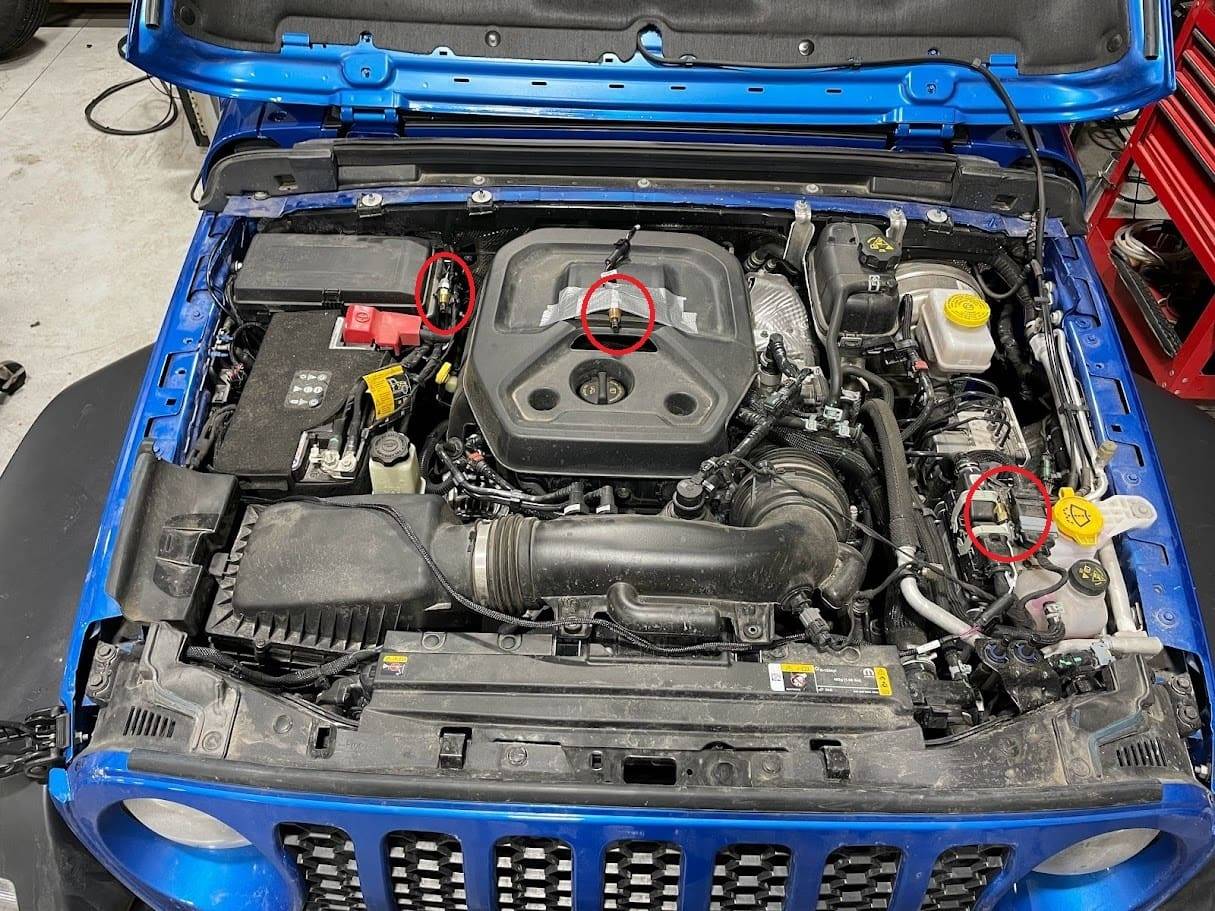
To take readings, we turned to Banks Engineering who we consider to be at the pinnacle of the aftermarket industry. They use their own products for internal testing so we followed suite. We ordered their Banks Data Monster and coupled it with 3 separate temperature sensors that we strategically placed throughout the engine bay. We wanted to sample an average engine bay temperature as well as temperatures at critical electrical components.

Jeep Wrangler JL TOTL Innovation H.E.R.O. Hood Performance Testing Results (Temperature / Cooling Measurements) TOTL-Hood-Testing-EngineBay


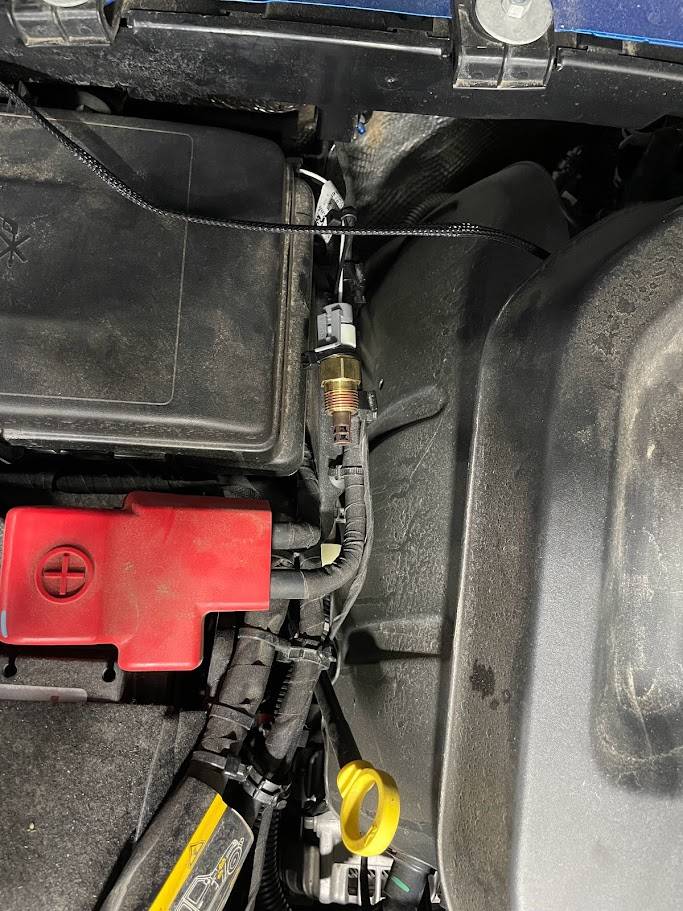
The first temperature sensor was placed close to the fuse box located by the passenger side firewall

Jeep Wrangler JL TOTL Innovation H.E.R.O. Hood Performance Testing Results (Temperature / Cooling Measurements) TOTL-Hood-Testing-FuseBoxTem


The second temperature sensor was placed on top of the engine cover and was spaced away from the surface using a foam pad. This was meant to give us an average engine bay temperature reading.

Jeep Wrangler JL TOTL Innovation H.E.R.O. Hood Performance Testing Results (Temperature / Cooling Measurements) TOTL-Hood-Testing-EngineTem


The last temperature sensor was placed by the factory ECU on the driver’s side

Jeep Wrangler JL TOTL Innovation H.E.R.O. Hood Performance Testing Results (Temperature / Cooling Measurements) TOTL-Hood-Testing-ComputerTem


In addition to the 3 temperature sensors, we also mounted a Banks Air Mouse inside the factory air box. The Air Mouse is an extremely powerful sensor that acts like a weather station allowing us to measure multiple conditions inside the air box.

Jeep Wrangler JL TOTL Innovation H.E.R.O. Hood Performance Testing Results (Temperature / Cooling Measurements) TOTL-Hood-Testing-AirMouse


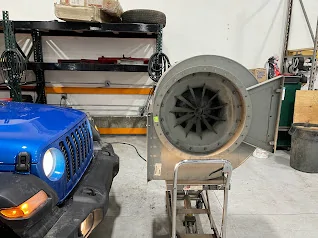
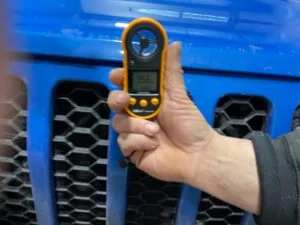
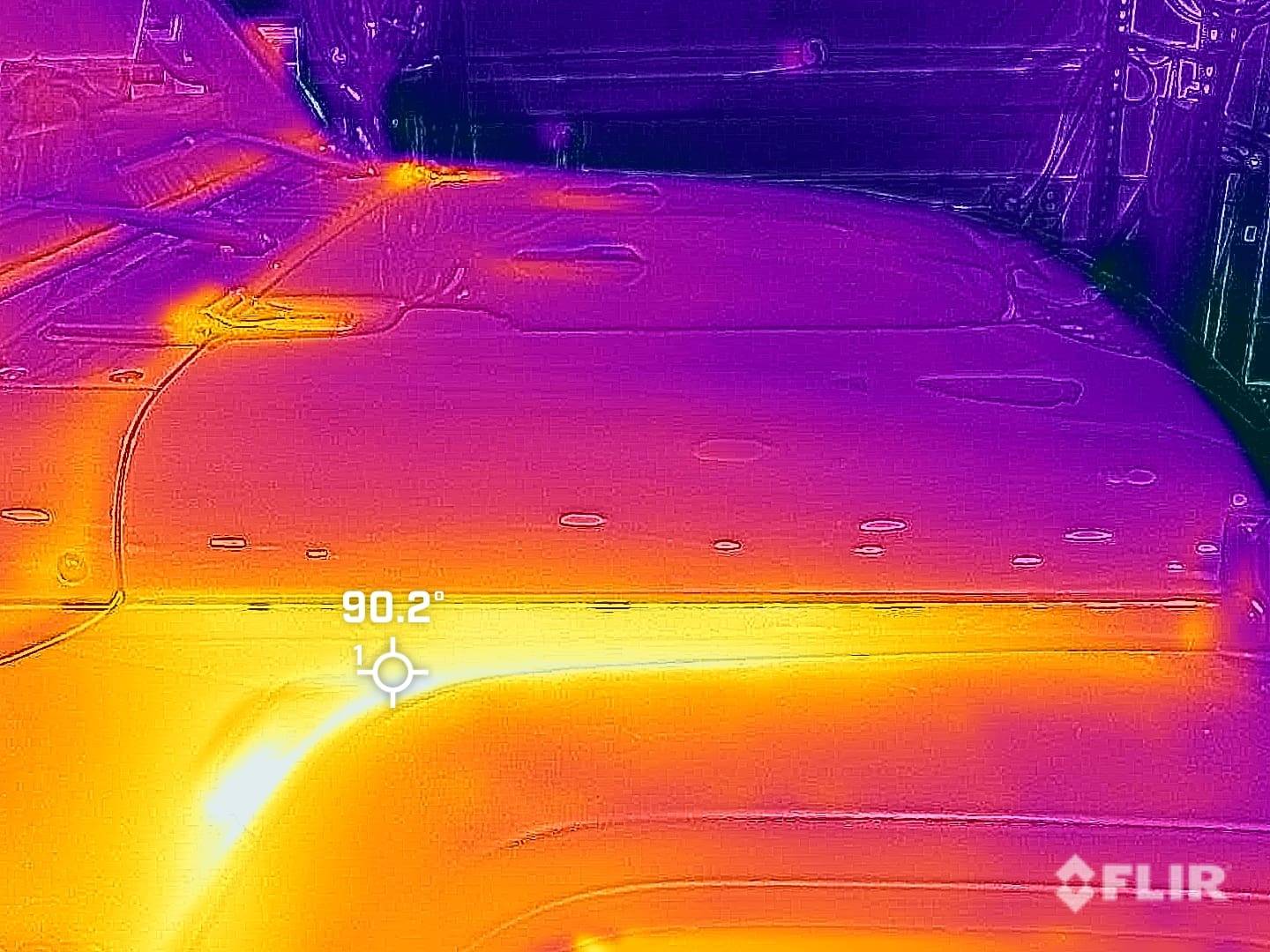
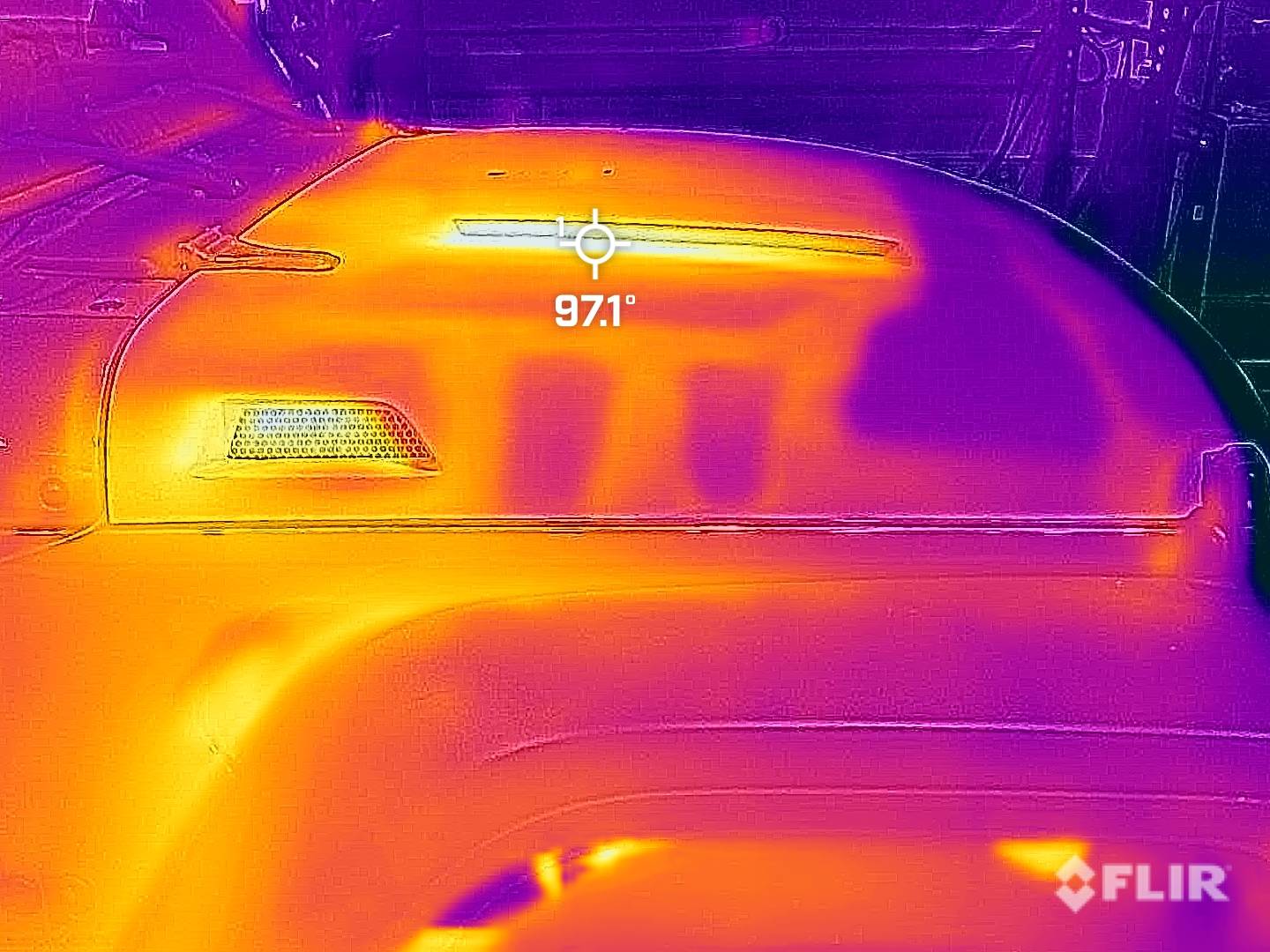
For thermal imagery, we used a FLIR One PRO. Thermal imagery was taken immediately after each log was stopped and this allowed us to capture some amazing information. Lastly we used an Amazon bought Anemometer to measure the wind speed of our dyno fan to determine the speed for our driving test.
 
OP
OP
TOTL Innovations

TOTL Innovations

Well-Known Member
Rock Sponsor (Level 1)
Joined
May 12, 2019
Threads
11
Messages
340
Reaction score
400
Location
Colorado
Website
www.totlinnovations.com
Vehicle(s)
2008 JK
TEST SETUP

To begin each test, we let the Jeep idle until we noticed all 3 of our temperature sensors had reached a consistent temperature. At the point, we considered the engine bay to be at its saturated operating temperature and an equal starting point for each test. We would like to note that we monitored coolant and oil temperatures at the same time and couldn’t use them as a reference for starting each test because they reached their specified operating temperatures well before the engine bay temperatures.

Once temperatures were reached, the test started and we logged each one for approximately one minute. Once a test was complete, we waited for temperatures to reach the same baselines previously established before moving on to the next test.

For the speed test described below, we measured that the wind speed at the front of grille was 35 mph when the dyno fan was roughly 25” away from the Jeep so we decided to run these tests at that speed to try to simulate as close to real world as we could.

Jeep Wrangler JL TOTL Innovation H.E.R.O. Hood Performance Testing Results (Temperature / Cooling Measurements) TOTL-Hood-Testing-Dyno
Jeep Wrangler JL TOTL Innovation H.E.R.O. Hood Performance Testing Results (Temperature / Cooling Measurements) TOTL-Hood-Testing-DynoSpeed-300x225
 
OP
OP
TOTL Innovations

TOTL Innovations

Well-Known Member
Rock Sponsor (Level 1)
Joined
May 12, 2019
Threads
11
Messages
340
Reaction score
400
Location
Colorado
Website
www.totlinnovations.com
Vehicle(s)
2008 JK
IDLE TEST

The first test we wanted to perform was a Jeep sitting at idle. We wanted to see what is happening in the engine bay without any sort of external factors so the dyno fan was not running. This would be similar to a real world traffic at a stand still type of scenario. We also wanted to measure the impact that any hood would have on the engine bay so for this round of testing, we actually tested the factory hood, our H.E.R.O. Hood and one additional test where the hood was rested over on the windshield. This would give us a floor of the best conditions possible had nothing been covering the engine bay at all. This was the only test where we tested with the hood completely removed from the equation. All other tests were the factory hood vs. our H.E.R.O. Hood

Looking at the summarized averages of the three tests below, you can see that there is roughly a 60 degree difference across the three temperature sensors between having no hood and running the factory hood but look at how much heat is able to escape the engine bay through our two stage vent design. Switching over to our H.E.R.O. Hood netted an average 26 degree drop across the three sensors.

OPEN HOODFACTORYTOTLDIFFERENCE
Fuse Box Temp (°F)122.00187.27163.8823.39
Center Engine Bay Temp (°F)149.99210.03184.6325.40
ECU Temp (°F)115.31187.86159.2628.59


What really surprised us on this test is what was happening inside the air box once we got all this heat out of the engine bay. The air temperature going into the motor also dropped by 25 degrees as measured by both the Air Mouse (Ambient Air Temp) located in the air box and the factory ECU (Intake Air Temp) resulting in a slightly better ambient air density. For those interested in reading why we are focused on air density, Banks has a pretty detailed explanation:

AIR DENSITY, WHAT IS IT AND WHY IS IT IMPORTANT?


OPEN HOODFACTORYTOTLDIFFERENCE
Ambient Air Temp (°F)115.28144.46119.2625.20
Intake Air Temp (°F)105.25156.20131.1825.02
Density Ambient Air (LB/1kFT³)54.4751.8654.01(2.15) Increase

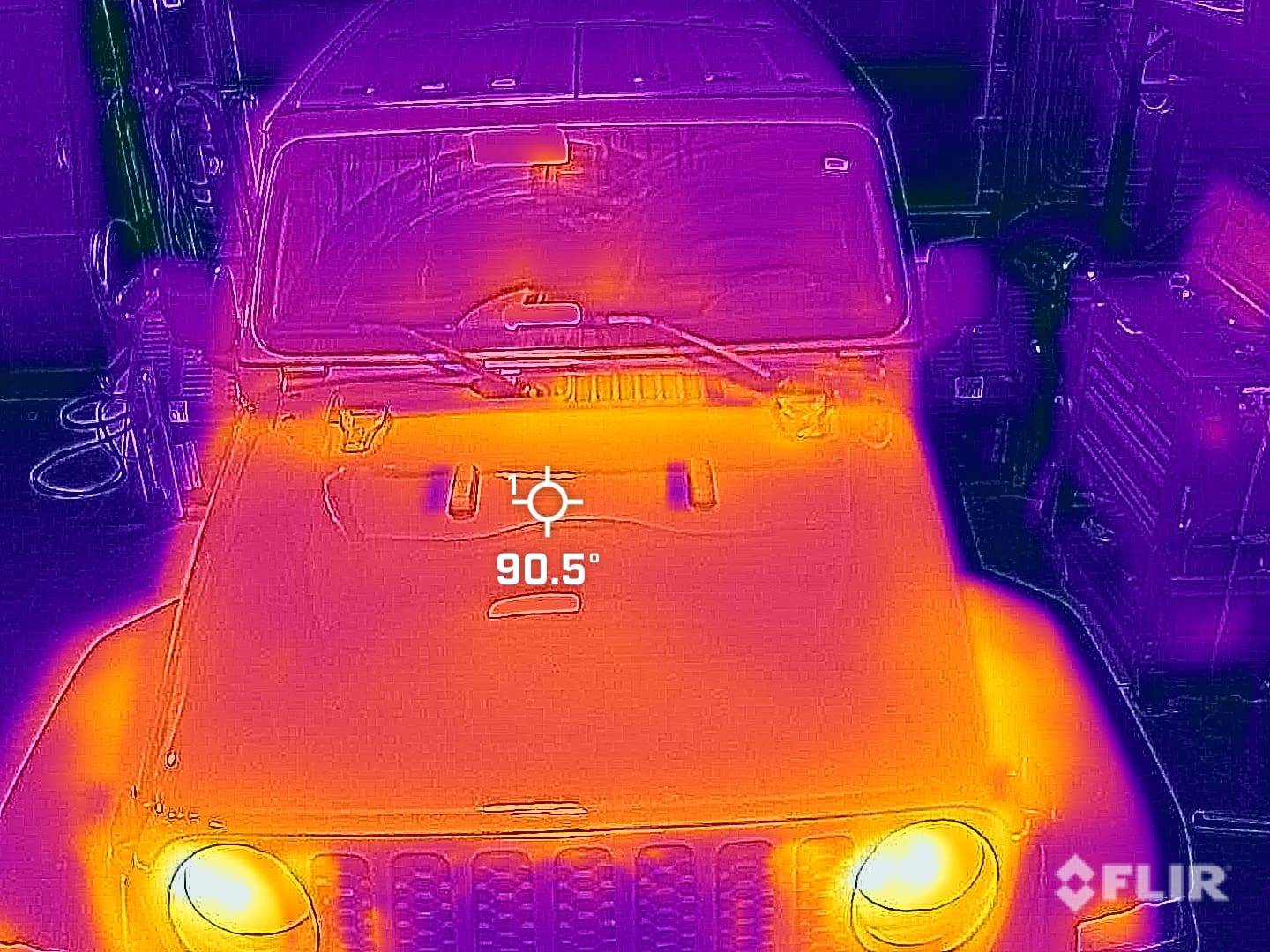
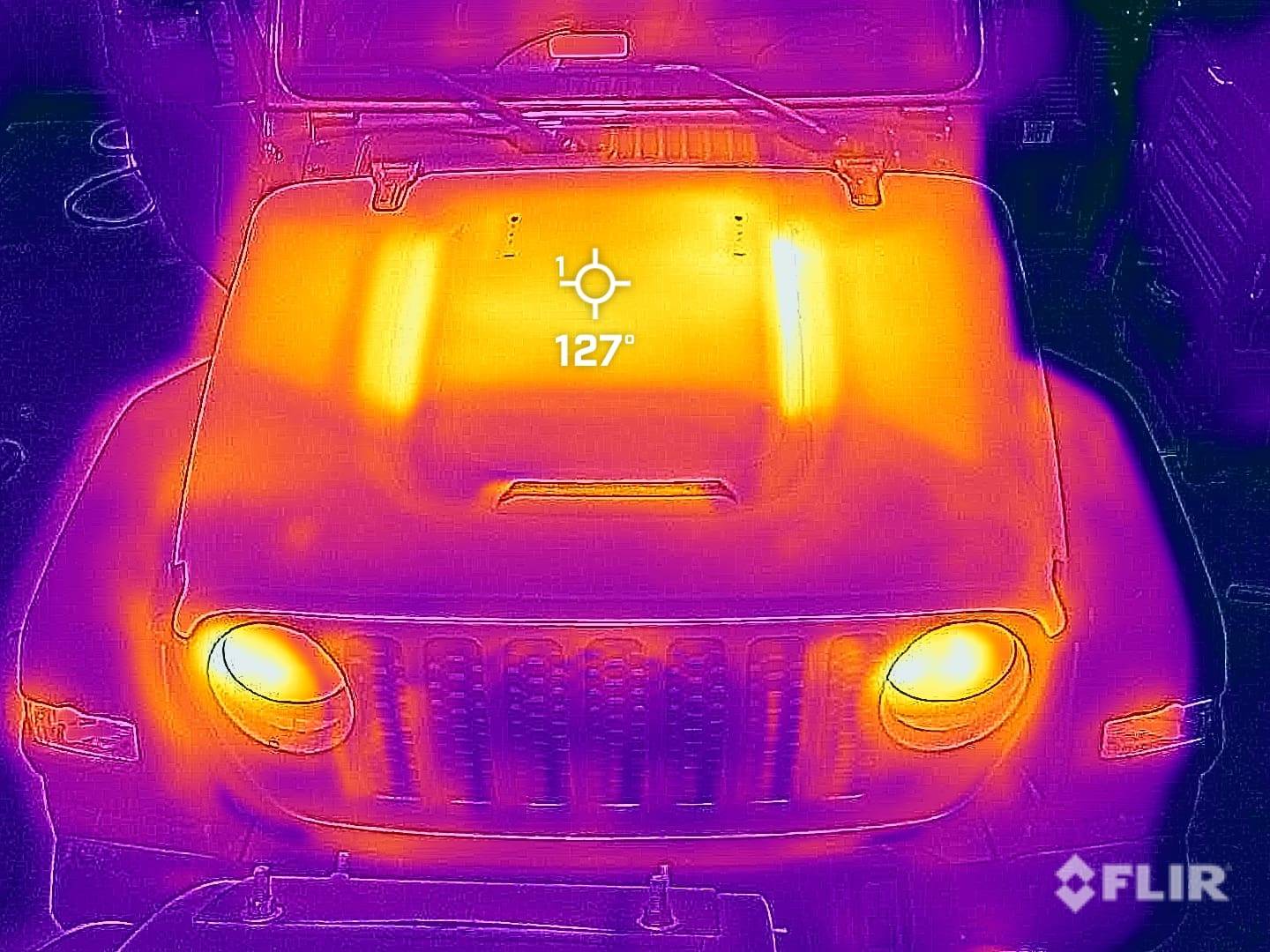
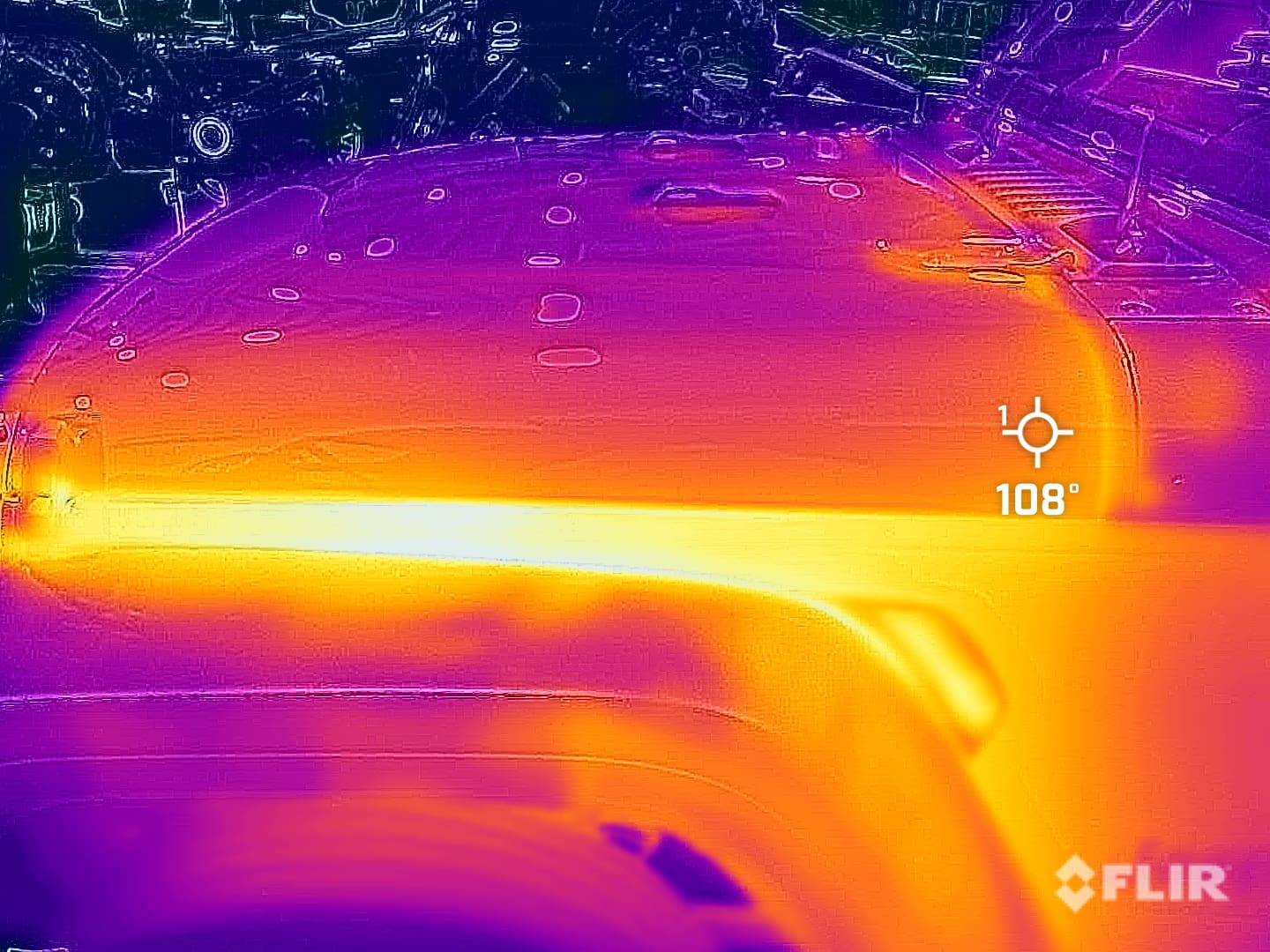
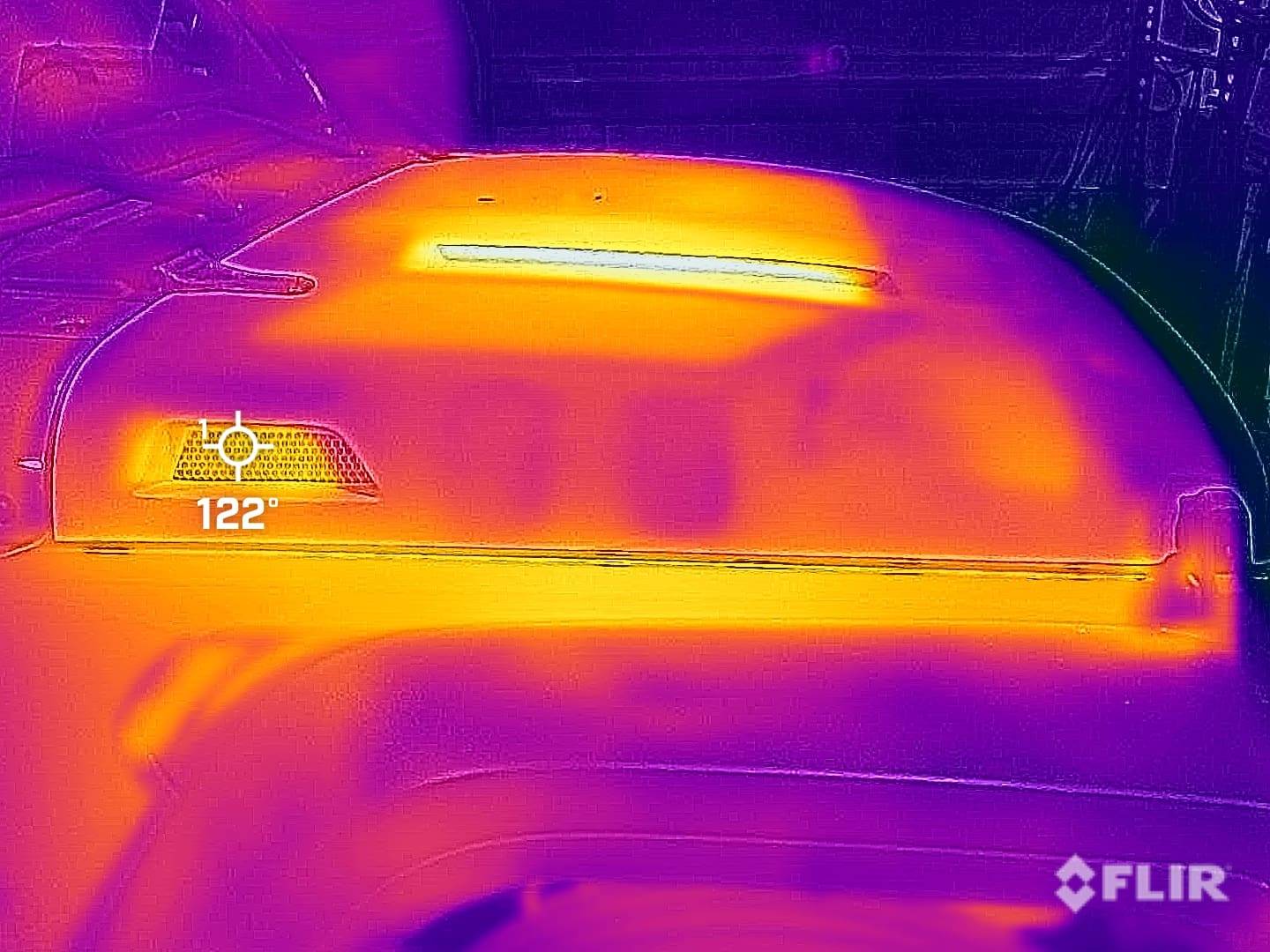
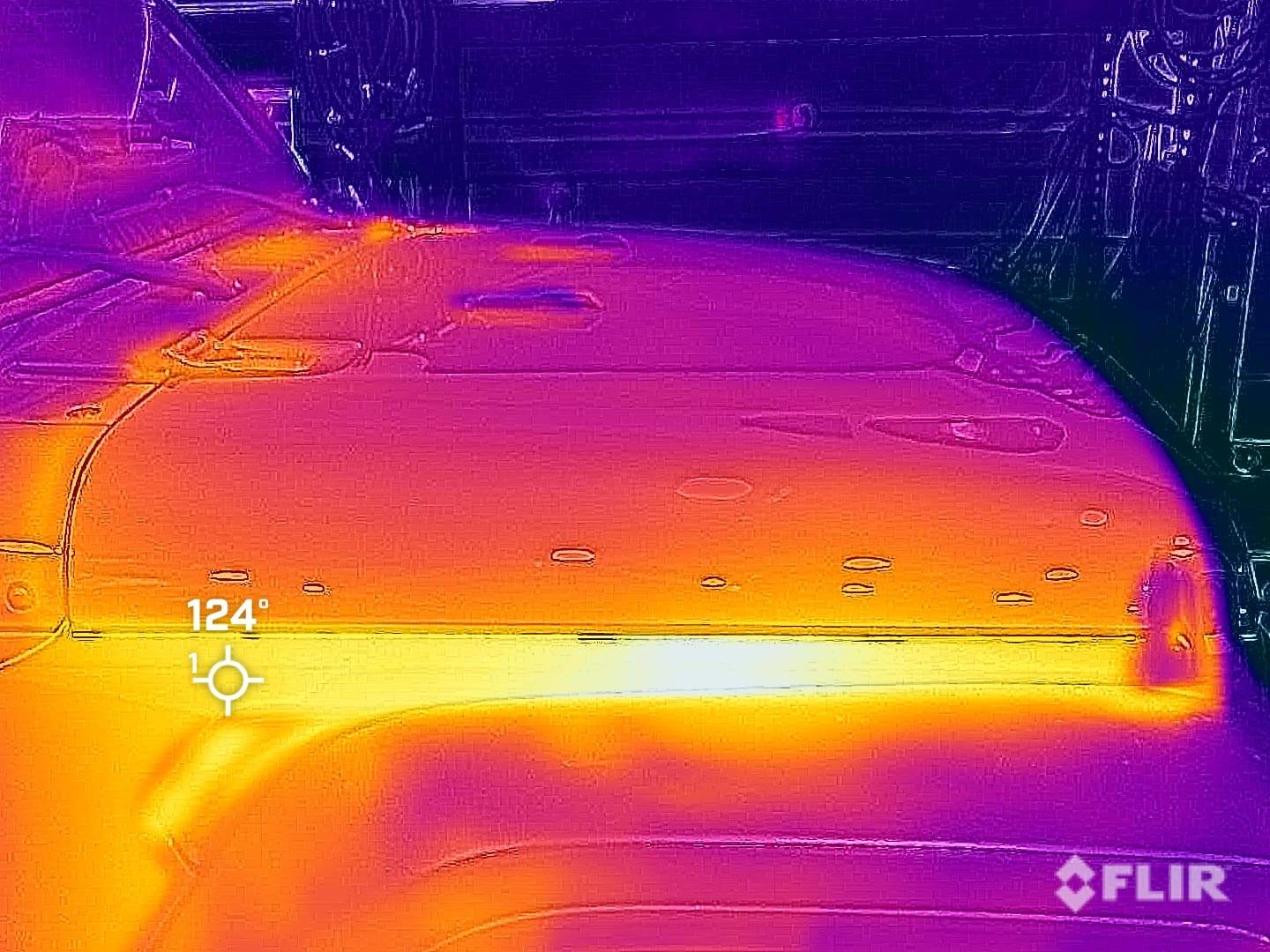
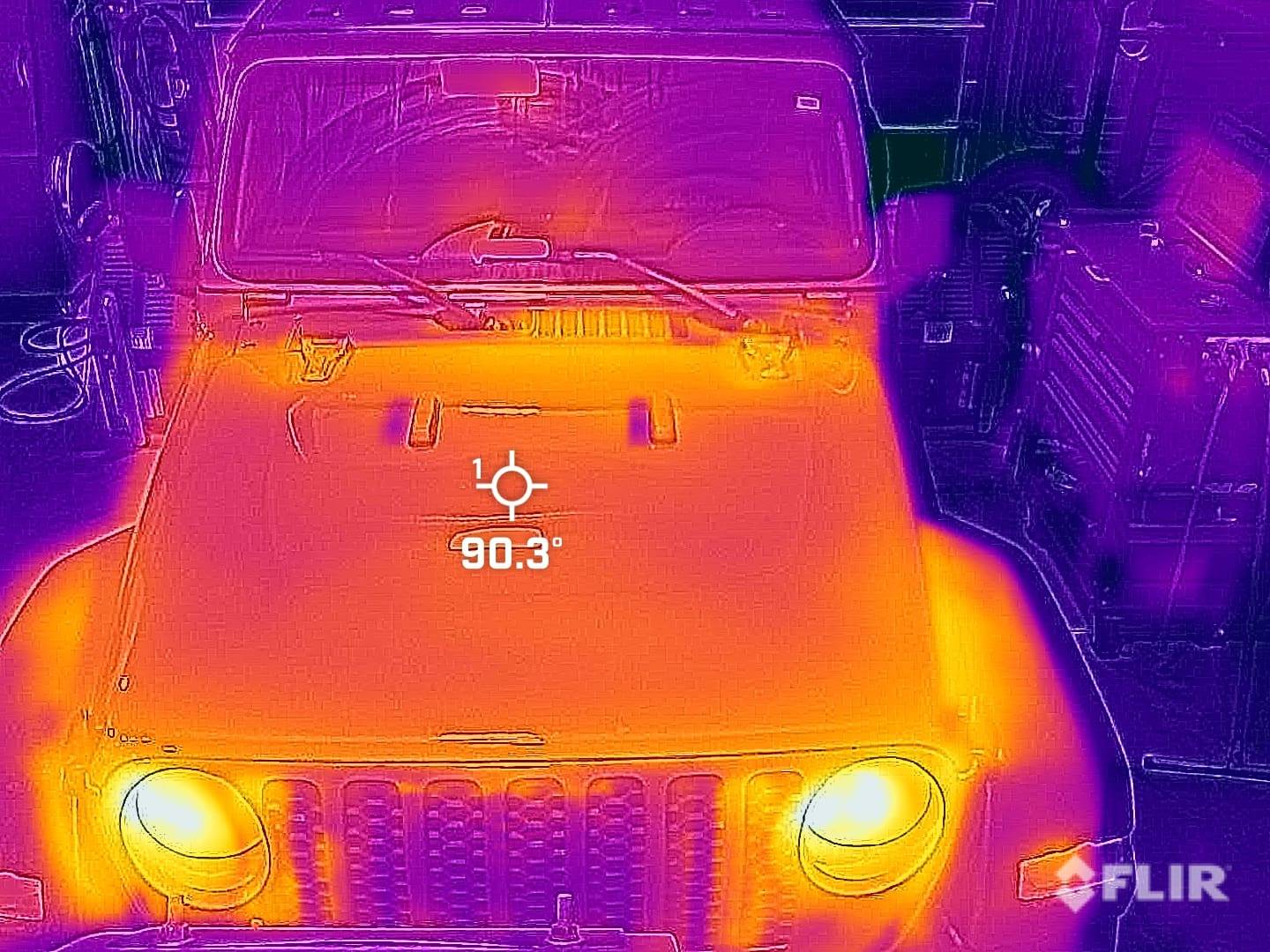
Below are the thermal images taken during this test. It gives you a pretty good idea of how much heat is escaping from the vents on our H.E.R.O. Hood.

Jeep Wrangler JL TOTL Innovation H.E.R.O. Hood Performance Testing Results (Temperature / Cooling Measurements) TOTL-Hood-Testing-DynoSpeed-300x225
Jeep Wrangler JL TOTL Innovation H.E.R.O. Hood Performance Testing Results (Temperature / Cooling Measurements) TOTL-Hood-Testing_HERO-Hood-Idle_1
Jeep Wrangler JL TOTL Innovation H.E.R.O. Hood Performance Testing Results (Temperature / Cooling Measurements) TOTL-Hood-Testing_Factory-Hood-Idle_2
Jeep Wrangler JL TOTL Innovation H.E.R.O. Hood Performance Testing Results (Temperature / Cooling Measurements) TOTL-Hood-Testing_HERO-Hood-Idle_3
Jeep Wrangler JL TOTL Innovation H.E.R.O. Hood Performance Testing Results (Temperature / Cooling Measurements) TOTL-Hood-Testing_Factory-Hood-Idle_3
Jeep Wrangler JL TOTL Innovation H.E.R.O. Hood Performance Testing Results (Temperature / Cooling Measurements) TOTL-Hood-Testing_HERO-Hood-Idle_4
Jeep Wrangler JL TOTL Innovation H.E.R.O. Hood Performance Testing Results (Temperature / Cooling Measurements) TOTL-Hood-Testing_Factory-Hood-Idle_4
Jeep Wrangler JL TOTL Innovation H.E.R.O. Hood Performance Testing Results (Temperature / Cooling Measurements) TOTL-Hood-Testing_HERO-Hood-Idle_7
Jeep Wrangler JL TOTL Innovation H.E.R.O. Hood Performance Testing Results (Temperature / Cooling Measurements) TOTL-Hood-Testing_Factory-Hood-Idle_5
Jeep Wrangler JL TOTL Innovation H.E.R.O. Hood Performance Testing Results (Temperature / Cooling Measurements) TOTL-Hood-Testing_HERO-Hood-Idle_6
 
Last edited:
OP
OP
TOTL Innovations

TOTL Innovations

Well-Known Member
Rock Sponsor (Level 1)
Joined
May 12, 2019
Threads
11
Messages
340
Reaction score
400
Location
Colorado
Website
www.totlinnovations.com
Vehicle(s)
2008 JK
CRAWL TEST

The purpose of this test was to try to simulate what is happening when you are out wheeling your Jeep. We ran the Jeep at 10 mph without the dyno fan running to simulate a slow crawl with little to no airflow to help the factory cooling system. This is similar to the previous test but everything is under increased strain because the Jeep is running under load without any sort of external cooling.
Our H.E.R.O. Hood resulted in an average 31 degree drop measured across the 3 temperature sensors

FACTORYTOTLDIFFERENCE
Fuse Box Temp (°F)194.13163.3830.75
Center Engine Bay Temp (°F)214.94184.1630.78
ECU Temp (°F)195.97162.6533.32
As a result of the decreased engine bay temperatures, we again saw a benefit with air intake temperatures dropping 18+ degrees resulting in denser ambient air

FACTORYTOTLDIFFERENCE
Ambient Air Temp (°F)151.93133.7018.23
Intake Air Temp (°F)163.40142.1521.25
Density Ambient Air (LB/1kFT³)51.3552.82(1.47) Increase
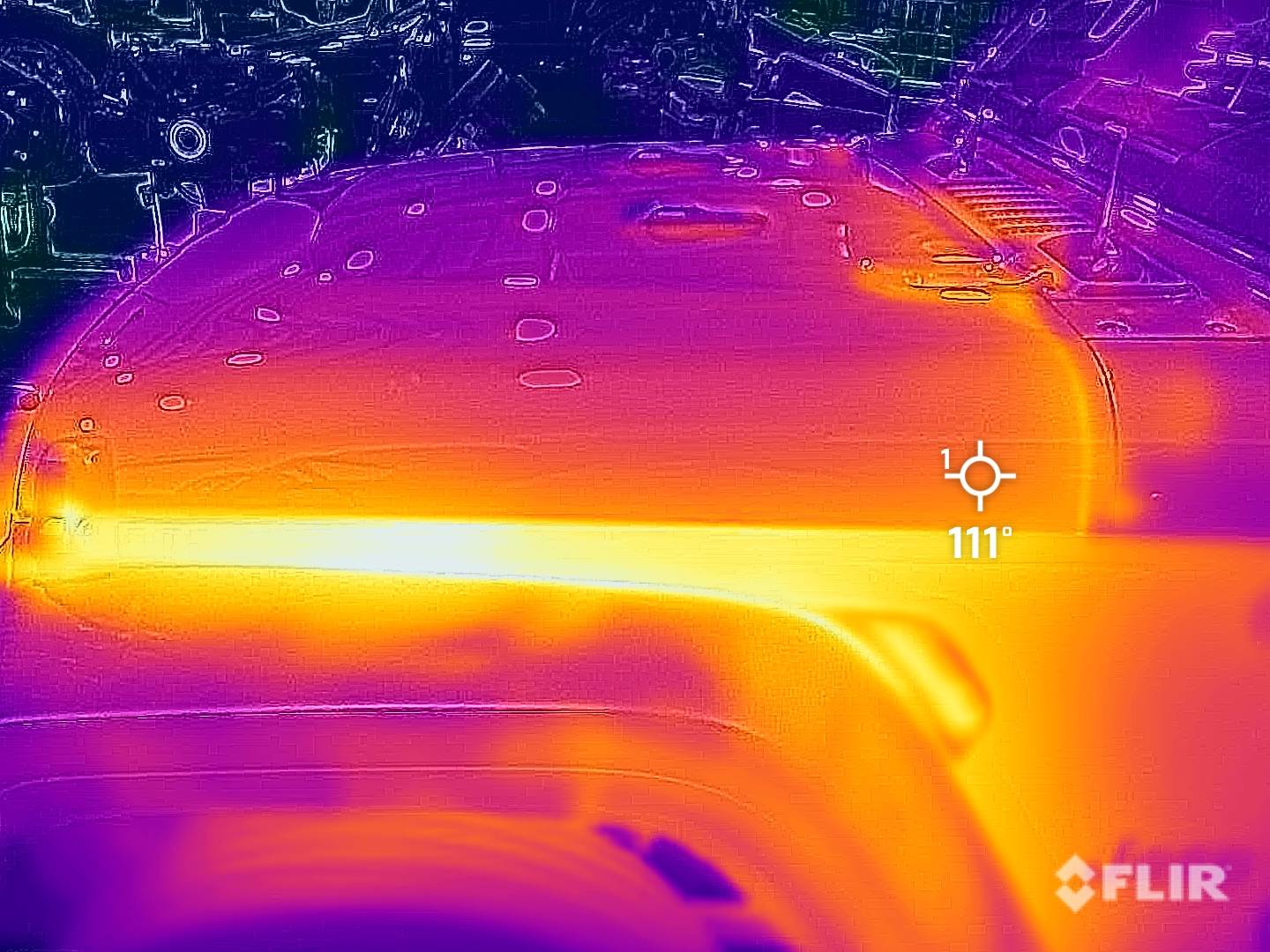
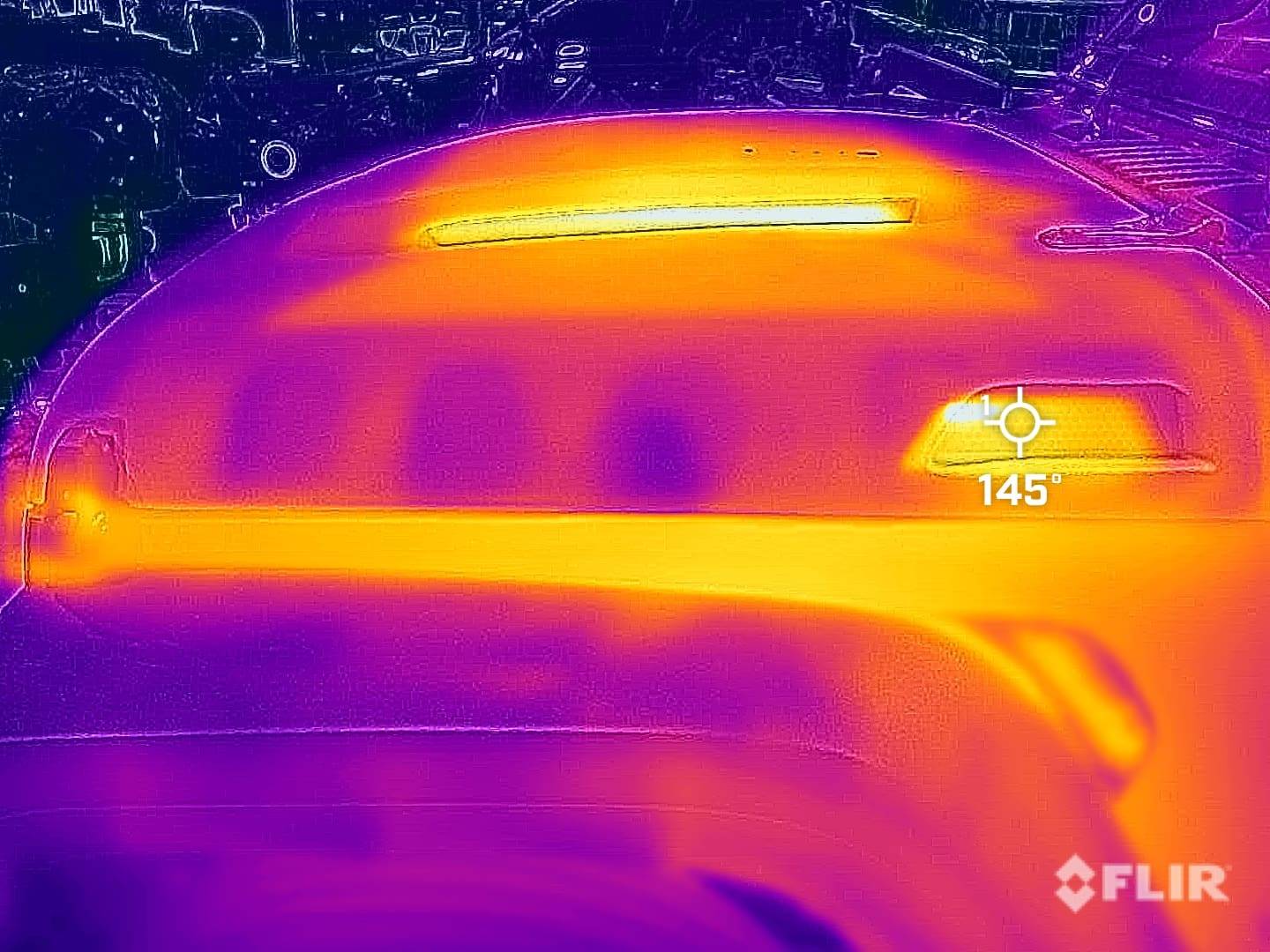
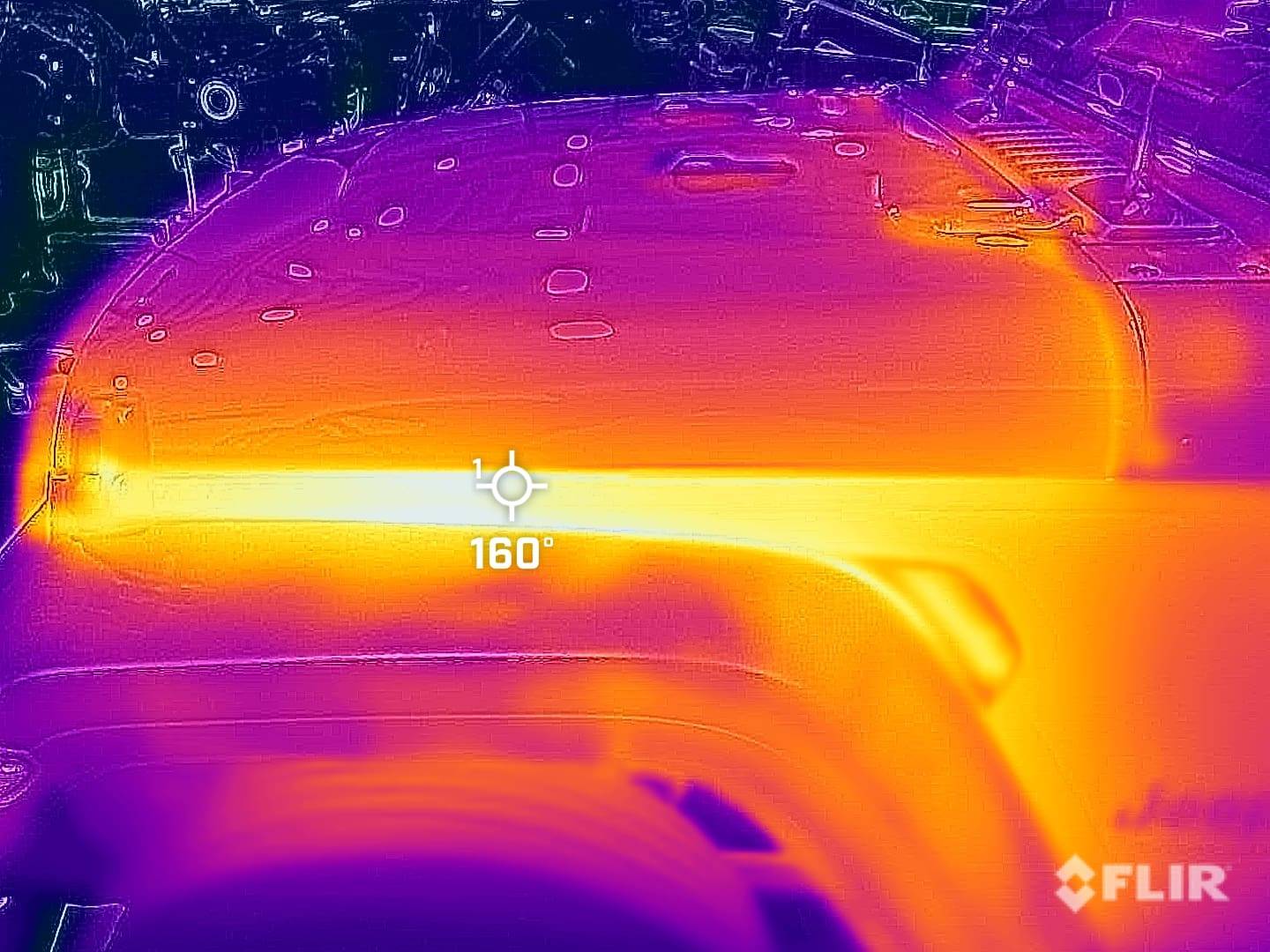
The thermal images from this test were very similar to the idle test but you can see that temperatures have increased.

Jeep Wrangler JL TOTL Innovation H.E.R.O. Hood Performance Testing Results (Temperature / Cooling Measurements) TOTL-Hood-Testing_Factory-Hood-Crawl_1
Jeep Wrangler JL TOTL Innovation H.E.R.O. Hood Performance Testing Results (Temperature / Cooling Measurements) TOTL-Hood-Testing_HERO-Hood-Crawl_2
Jeep Wrangler JL TOTL Innovation H.E.R.O. Hood Performance Testing Results (Temperature / Cooling Measurements) TOTL-Hood-Testing_Factory-Hood-Crawl_2
Jeep Wrangler JL TOTL Innovation H.E.R.O. Hood Performance Testing Results (Temperature / Cooling Measurements) TOTL-Hood-Testing_HERO-Hood-Crawl_3
Jeep Wrangler JL TOTL Innovation H.E.R.O. Hood Performance Testing Results (Temperature / Cooling Measurements) TOTL-Hood-Testing_Factory-Hood-Crawl_3
Jeep Wrangler JL TOTL Innovation H.E.R.O. Hood Performance Testing Results (Temperature / Cooling Measurements) TOTL-Hood-Testing_HERO-Hood-Crawl_4
Jeep Wrangler JL TOTL Innovation H.E.R.O. Hood Performance Testing Results (Temperature / Cooling Measurements) TOTL-Hood-Testing_Factory-Hood-Crawl_5
Jeep Wrangler JL TOTL Innovation H.E.R.O. Hood Performance Testing Results (Temperature / Cooling Measurements) TOTL-Hood-Testing_HERO-Hood-Crawl_7
Jeep Wrangler JL TOTL Innovation H.E.R.O. Hood Performance Testing Results (Temperature / Cooling Measurements) TOTL-Hood-Testing_Factory-Hood-Crawl_4
Jeep Wrangler JL TOTL Innovation H.E.R.O. Hood Performance Testing Results (Temperature / Cooling Measurements) TOTL-Hood-Testing_HERO-Hood-Crawl_8
 
Last edited:

Sponsored

OP
OP
TOTL Innovations

TOTL Innovations

Well-Known Member
Rock Sponsor (Level 1)
Joined
May 12, 2019
Threads
11
Messages
340
Reaction score
400
Location
Colorado
Website
www.totlinnovations.com
Vehicle(s)
2008 JK
CRUISING SPEED TEST

The purpose of this test was to simulate what happens when you are out driving on the street. Even with 35 mph, the H.E.R.O. Hood continues to deliver a reduction in under hood temperatures

FACTORYTOTLDIFFERENCE
Fuse Box Temp (°F)169.17151.4817.69
Center Engine Bay Temp (°F)178.01164.3113.70
ECU Temp (°F)160.39137.1723.22
For intake air temperature and performance, we unfortunately encountered an issue. We did email Banks with our logs to confirm our suspicion that the test using our H.E.R.O. Hood began with a heat soaked Air Mouse. The factory hood test started with a 126 Ambient air temperature while the same test with our H.E.R.O. Hood started out at 143 degrees. Had the test started properly, the Air Mouse reading would have been in line with the factory air temperature readings just as it has been for all the other tests. We would then have been able to provide a correct increase in Ambient Air Density. None the less, you can still see a 15+ degree reduction in air temperature compared to stock.

FACTORYTOTLDIFFERENCE
Intake Air Temp (°F)139.36123.4115.96
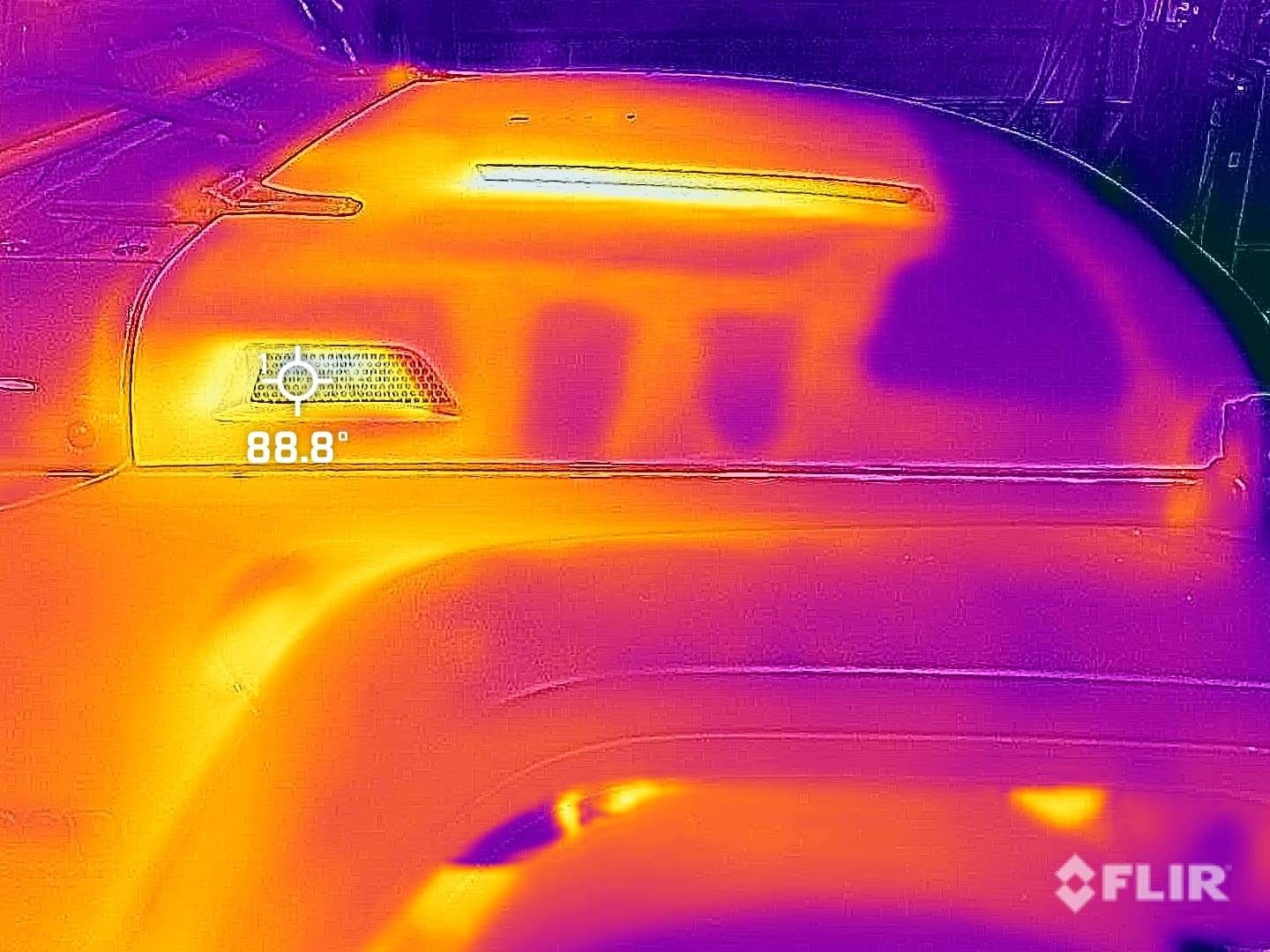
If a picture is truly worth a thousand words, then of all the tests, I think the thermal images from this last test tell the most. In particular, you can actually see the cold ram air in action represented by the blue section going from the air scoop directly to the factory air box pre chamber. How cool (pun intended) is that?
Jeep Wrangler JL TOTL Innovation H.E.R.O. Hood Performance Testing Results (Temperature / Cooling Measurements) TOTL-Hood-Testing_HERO-Hood-Speed_5


Jeep Wrangler JL TOTL Innovation H.E.R.O. Hood Performance Testing Results (Temperature / Cooling Measurements) TOTL-Hood-Testing_Factory-Hood-Speed_1
Jeep Wrangler JL TOTL Innovation H.E.R.O. Hood Performance Testing Results (Temperature / Cooling Measurements) TOTL-Hood-Testing_HERO-Hood-Speed_1
Jeep Wrangler JL TOTL Innovation H.E.R.O. Hood Performance Testing Results (Temperature / Cooling Measurements) TOTL-Hood-Testing_Factory-Hood-Speed_2
Jeep Wrangler JL TOTL Innovation H.E.R.O. Hood Performance Testing Results (Temperature / Cooling Measurements) TOTL-Hood-Testing_HERO-Hood-Speed_2
Jeep Wrangler JL TOTL Innovation H.E.R.O. Hood Performance Testing Results (Temperature / Cooling Measurements) TOTL-Hood-Testing_Factory-Hood-Speed_3
Jeep Wrangler JL TOTL Innovation H.E.R.O. Hood Performance Testing Results (Temperature / Cooling Measurements) TOTL-Hood-Testing_HERO-Hood-Speed_4
Jeep Wrangler JL TOTL Innovation H.E.R.O. Hood Performance Testing Results (Temperature / Cooling Measurements) TOTL-Hood-Testing_Factory-Hood-Speed_5
Jeep Wrangler JL TOTL Innovation H.E.R.O. Hood Performance Testing Results (Temperature / Cooling Measurements) TOTL-Hood-Testing_HERO-Hood-Speed_6
Jeep Wrangler JL TOTL Innovation H.E.R.O. Hood Performance Testing Results (Temperature / Cooling Measurements) TOTL-Hood-Testing_Factory-Hood-Speed_4
Jeep Wrangler JL TOTL Innovation H.E.R.O. Hood Performance Testing Results (Temperature / Cooling Measurements) TOTL-Hood-Testing_HERO-Hood-Speed_8
 
Last edited:

zouch

Well-Known Member
Joined
Sep 17, 2020
Threads
39
Messages
3,765
Reaction score
3,858
Location
Berkeley, CA
Vehicle(s)
XJ, JLUWD
how do you define "cruising speeds"?

all i saw referenced for speed was 35MPH; real-world use would put cruising speeds at twice that (or better), and that's where we see these vehicles heating up.

do you have any test data for use at actual highway speeds?


I know we have been promising some real test results on the benefits of our JL/JT H.E.R.O. Hood for quite some time not and we are very sorry it has taken this long but without further ado:


For those that just want to know the results, here they are:
  • Average 25+ degree drop in engine bay temperatures at slow speeds
  • Average 20+ degree drop in intake air temperatures at slow speeds
  • Average 18+ degree drop in engine bay temperatures at cruising speeds
  • Average 15+ degree drop in intake air temperatures at cruising speeds


Disclaimer: These are the results of our testing. Results will vary depending on the conditions your Jeep is experiencing.
 

Sponsored
mgroeger

Well-Known Member
First Name
Mike
Joined
Feb 1, 2018
Threads
162
Messages
6,208
Reaction score
9,269
Location
Southern UT
Vehicle(s)
2021 JLUR 2.0T
Vehicle Showcase
1
Pretty cool. I cut my vents about four years ago.
Ted, I cut the hood vent on the driver side which really helps the heat get out from the turbo. I've been hesitant to cut the passenger side one since it is pretty much on top of the battery. Have you noticed any issues with water getting through that vent and making a mess on the battery?
 
OP
OP
TOTL Innovations

TOTL Innovations

Well-Known Member
Rock Sponsor (Level 1)
Joined
May 12, 2019
Threads
11
Messages
340
Reaction score
400
Location
Colorado
Website
www.totlinnovations.com
Vehicle(s)
2008 JK
how do you define "cruising speeds"?

all i saw referenced for speed was 35MPH; real-world use would put cruising speeds at twice that (or better), and that's where we see these vehicles heating up.

do you have any test data for use at actual highway speeds?
Cruising speed might not have been the best name for it. Should have just called it a 35 mph test. The output of the dyno fan as measured at the front of the Jeep was only 35 mph so we didnt run a test where the simulated vehicle speed didnt match the air that we were pushing at it.

We didnt do any testing on the highway because we wanted to have a controlled environment to compare factory vs. our hood equally.
 
OP
OP
TOTL Innovations

TOTL Innovations

Well-Known Member
Rock Sponsor (Level 1)
Joined
May 12, 2019
Threads
11
Messages
340
Reaction score
400
Location
Colorado
Website
www.totlinnovations.com
Vehicle(s)
2008 JK
I look the look and the heat numbers are appealing.
How prepped for paint is it? Is the fiberglass primed? Smooth enough to simply wrap it?
Hood is primed so it will need sanding for paint. For wrap, I would probably still say a fine scuff is required.
 

Fast-n-Furious

Well-Known Member
Joined
Jul 29, 2022
Threads
35
Messages
756
Reaction score
802
Location
PA
Vehicle(s)
2022 392 XR
Great to see these tests and the results! Two questions:

1. Do the factory side vents by the fenders make a difference in your comparison? With your hood design, more hot air gets extracted, I’m wondering if it means less will escape from the factory side vents. They are very small but still functional.

2. for the 392 hood, it channels cool air into the air box directly. But the engine bay also gets very hot. What’s your thought on extracting more hot air out and any suggestions?
Sponsored


Top