Sponsored

extension cord?

NJ_JL 2020

Well-Known Member
Joined
Jun 8, 2020
Threads
16
Messages
55
Reaction score
23
Location
NJ
Vehicle(s)
2020 Wrangler JL Unlimited S
Anyone using extension chords for charging? I know about the voltage drop and how this will draw more current, and that typical cheaper cords are thinner and not rated for high currents. Before digging into this I did charge with a 50' cord, and have since stopped using this. Its a bit tight but manageable.

Anyone else using cords? it helps when my other cars are in the garage and the jeep is in the driveway.

Thanks.
Sponsored
 
OP
OP

NJ_JL 2020

Well-Known Member
Joined
Jun 8, 2020
Threads
16
Messages
55
Reaction score
23
Location
NJ
Vehicle(s)
2020 Wrangler JL Unlimited S
Thx. Looking at options now.
 

DonH63

Well-Known Member
First Name
Don
Joined
Jun 22, 2023
Threads
2
Messages
10,707
Reaction score
60,986
Location
Monument, CO
Vehicle(s)
21 GC Trailhawk, 23 JLU 392 XR
Occupation
Retired EE; musician (trumpet)
Just get one the proper size and make sure connections are good, not corroded or loose. House wiring these days is usually 14 AWG for 15-A runs (vast majority), 12 AWG for 20-A runs, so a 50' cord 14 AWG or larger (12 or 10 AWG) should be fine. I've been using a 50', 14 AWG outdoor cord on my charger and compressor for years. Do not get a small 18 or 16 AWG cord.
 
OP
OP

NJ_JL 2020

Well-Known Member
Joined
Jun 8, 2020
Threads
16
Messages
55
Reaction score
23
Location
NJ
Vehicle(s)
2020 Wrangler JL Unlimited S
Just get one the proper size and make sure connections are good, not corroded or loose. House wiring these days is usually 14 AWG for 15-A runs (vast majority), 12 AWG for 20-A runs, so a 50' cord 14 AWG or larger (12 or 10 AWG) should be fine. I've been using a 50', 14 AWG outdoor cord on my charger and compressor for years. Do not get a small 18 or 16 AWG cord.

Thanks, this is the info I was looking for!!
 

Sponsored

driventoadventure

Well-Known Member
First Name
Lrr
Joined
Aug 23, 2021
Threads
30
Messages
955
Reaction score
1,555
Location
Northern Front-Range, Colorado
Vehicle(s)
21 JLURD
Build Thread
Link
Occupation
Employed Gainfully
Clubs
 
Just get one the proper size and make sure connections are good, not corroded or loose. House wiring these days is usually 14 AWG for 15-A runs (vast majority), 12 AWG for 20-A runs, so a 50' cord 14 AWG or larger (12 or 10 AWG) should be fine. I've been using a 50', 14 AWG outdoor cord on my charger and compressor for years. Do not get a small 18 or 16 AWG cord.
This is the right answer. Voltage drop is a function of resistance which is governed by the wire gauge (and load, but given a static load, the gauge is the factor we care about for this example). Get yourself a good 12AWG extension cable and your voltage drop across the extension at 15 amps will only be about 2.6v, or about 2%. That's well within the capabilities of the cord to dissipate heat, and the charger/circuit to manage load. If you're really worried, drop your charging to 12 amps, and your less likely to be on the max continuous load of your circuit breaker. (Those numbers are for 50 feet, the numbers basically double for 100ft, but still will be reasonable enough if you limit the current to say 12a. I wouldn't do 100ft with 12awg, but it's not likely to result in fire as long as the cord remains pristine.) If you are REALLY worried, you can get a 10awg from Home Depot - $130 for 50ft and $170 for 100ft. Then you're somewhere around 1% loss, and your in-wall wiring becomes the issue. Don't forget that your in-wall circuit length needs to be calculated.

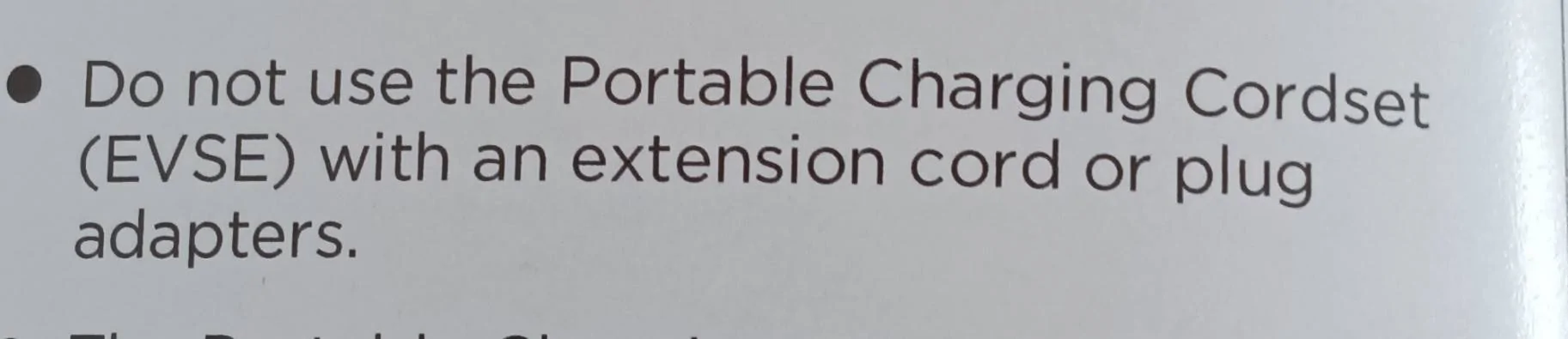
As Per Owners Handbook
IMG_20240611_101209.webp
It only states this for liability reasons. People don't know how electricity works. They will just get a 50ft extension that's 16 AWG and run it at full 15a load, not realizing that the drop is significant enough to be an issue - a ~6v droop at 15a results in 90watts of heat generated on the cable and can potentially be enough to cause melting or fire and will almost certainly result in failure.

Also, even experts sometimes forget that the in-wall wiring is likely only 12awg and your length really needs to account for that in-wall length, so depending on where the extension is, that could be adding another 20ft to the circuit.
 
Last edited:

ras815

Well-Known Member
Joined
Dec 17, 2021
Threads
0
Messages
126
Reaction score
179
Location
USA
Vehicle(s)
4xe
I would strongly consider first: is that a risk you really want to take at your home?
 

alphawolff

Well-Known Member
Joined
Jul 31, 2023
Threads
1
Messages
3,327
Reaction score
5,561
Location
california
Vehicle(s)
2021 JLU
Just a heads up, if you use an extension cord you will almost certainly get a service charging system light from time to time. The jeep monitors amperage input and if it drops (or spikes) unexpectedly it will stop charging and sometimes prevent charging until the code is cleared.

When using a level 1 charger this is a *very* common issue, especially if the house's wiring is older. My house built in 1942 was an absolute crapshoot if it managed to charge overnight. An extension cord will have roughly the same effect, but also amplifying the issue if your home wiring isn't up to snuff.

Get a proper 8-10 gauge extension cord and you won't have any fire issues or anything like that, but don't be surprised if you go out in the morning and it's not charged like you expected it to be.
 

DonH63

Well-Known Member
First Name
Don
Joined
Jun 22, 2023
Threads
2
Messages
10,707
Reaction score
60,986
Location
Monument, CO
Vehicle(s)
21 GC Trailhawk, 23 JLU 392 XR
Occupation
Retired EE; musician (trumpet)
Oops, I was thinking of a typical battery charger, not an EV plug. Using the correct AWG is still true, but you may need a much larger wire (lower AWG number), and should get as short a cord as practical. For my tablesaw, I have a 10-foot 8 or 10 AWG cord so I can move it outside the shed but near the outlet right near the door (put there for that reason). I have seen a few EV extensions (friend with a couple of Teslas got one); they were very large and expensive.

The other thing to do is to check the connectors (plugs) at each end of the cord and make sure they are not getting too warm. That indicates a poor connection and can lead to a fire. I have seen a number of high-power equipment plugs get so hot they actually charred due to a poor socket connection.

The maximum current a wire can carry gets a little complicated. It depends upon the length and environment -- a wire enclosed in conduit can carry less than one out in the open -- as well as how much voltage drop the equipment can handle.
 

GATORB8

Well-Known Member
First Name
Matt
Joined
May 30, 2021
Threads
29
Messages
8,829
Reaction score
11,726
Location
CLT NC
Vehicle(s)
21 JLURe, 06 LJ, 25 HDZR2
Oops, I was thinking of a typical battery charger, not an EV plug. Using the correct AWG is still true, but you may need a much larger wire (lower AWG number), and should get as short a cord as practical. For my tablesaw, I have a 10-foot 8 or 10 AWG cord so I can move it outside the shed but near the outlet right near the door (put there for that reason). I have seen a few EV extensions (friend with a couple of Teslas got one); they were very large and expensive.

The other thing to do is to check the connectors (plugs) at each end of the cord and make sure they are not getting too warm. That indicates a poor connection and can lead to a fire. I have seen a number of high-power equipment plugs get so hot they actually charred due to a poor socket connection.

The maximum current a wire can carry gets a little complicated. It depends upon the length and environment -- a wire enclosed in conduit can carry less than one out in the open -- as well as how much voltage drop the equipment can handle.
For the Level 2, I use a 30 ft extension to get my 240V over to the correct side of the garage. 30 amp charger on a 50 amp circuit. I use a UL listed 6/3+8/1 Gauge with no heat or voltage drop issues.

Level 1, IIRC, we've seen issues with both quality of supply (i.e. campground garbage circuits) and lighter extension cords. Splitters (three ways) will not work even with the level 1 plugged into a three way at the outlet. I don't believe we've had issues with quality 25 ft 12/3s where the charger would work directly in the outlet.
 

Sponsored

R3TRO

Well-Known Member
First Name
Steve
Joined
Jun 7, 2020
Threads
22
Messages
762
Reaction score
1,064
Location
Pasadena, CA
Vehicle(s)
'20 Jeep Willys
Occupation
Film Industry

GATORB8

Well-Known Member
First Name
Matt
Joined
May 30, 2021
Threads
29
Messages
8,829
Reaction score
11,726
Location
CLT NC
Vehicle(s)
21 JLURe, 06 LJ, 25 HDZR2

DonH63

Well-Known Member
First Name
Don
Joined
Jun 22, 2023
Threads
2
Messages
10,707
Reaction score
60,986
Location
Monument, CO
Vehicle(s)
21 GC Trailhawk, 23 JLU 392 XR
Occupation
Retired EE; musician (trumpet)
From what I found after a quick search, the Mopar Level 1 charger cable is rated for 12 A/1440 W, which is on the high side of most Level 1 chargers that mostly seem to run in the 5~8 A range. With that much charging current, I would get a 10 AWG extension cord, and monitor the temperature (with just a "palm thermometer") to make sure it got no more than barely warm. If the cord is hot to the touch, it is too small.

Beware cheap cords; some are undersized (plenty of articles online showing wire diameter smaller than rated AWG, some with very thick insulation so it looks bigger), and CCA (copper-clad aluminum) is about half the price but also much higher resistance, and can have major connectivity problems compared to pure copper wire.

Side note: A 25'~50' cord is not a long transmission line, but long enough to not be considered short. For power transmission, wires are usually derated by about a factor of 4 compared to a very short ("chassis") length. A 12 AWG cable is rated for about 10 A, and 10 AWG for 15 A, as a "transmission line". There are a lot of online references, some (perhaps many) of which conflict, but here is one: https://www.powerstream.com/Wire_Size.htm For reference, in-wall wiring code here (CO) for standard 15-A circuits is 14 AWG, and 12 AWG for 20-A circuits (both 120 V) but recommended load is no more than 80% and that is for a single continuous line. Connections derate capacity significantly.

So if we are talking about a Level 1 charger and not a regular 12 V battery charger as I mistakenly initially thought, then I would be looking for a 10 AWG minimum and probably 8 AWG extension. Do not expect it to be cheap. And check the connector prongs now and then; keep them clean (I use Berryman's, CRC is also good, for a spray contact cleaner).

HTH, sorry for my initial confusion - Don
 

GATORB8

Well-Known Member
First Name
Matt
Joined
May 30, 2021
Threads
29
Messages
8,829
Reaction score
11,726
Location
CLT NC
Vehicle(s)
21 JLURe, 06 LJ, 25 HDZR2
Well I'm charing at level 1 speeds... 120V. You must be level 2? Maybe I missed that in the thread?!
I was referencing level 1. 5 amps at 120V is 600W/hr. That would take 26 hours to charge the 4xe battery from a hypothetical 10% reserve to 100% (17,300W x 90% / 600w/hr). While not pulling a full 15 amps, a full level one charge from indicated 0% on ours utilizing the Level 1 charger included with the 4xe was approximately half that.
Sponsored


Top