I ran 85 in my JK with mostly the same engine. It ran perfectly fine. One day heading up a mountain pass it would no longer make any power. I pulled over for like 10 minutes and continued on after without any issues. I switched to 87 after that point but I honestly have no clue what caused that one-time instance. Could have just been bad gas or really anything. Either way 85 and 87 seem to run the same to me.
I think my uneasiness is mainly the chance of bad gas. I think this was partly a way to make a buck by offloading some lower grade gas off the refinery tower.
I think an occasional tank won't kill it (I had to because Costco only does 85 and 91). 85 is new to me, hadn't noticed mountain states offered it until recently. I think the explanations about it make sense (elevation equals less oxygen so less chance to detonate, thus you can lower octane rating). I just want manufacturers to state it's ok. Also I worry about driving east one day on 85 octane and suddenly dealing with issues.
Forgot to add, previous car was a Subaru STi, manual states 93. Couldn't find 93 ever so ran 91. Ran fine through 165k miles, so I guess the knock sensors work just fine in modern cars but be ready for less power on the 3.6 on lower octane would be the moral of the story.
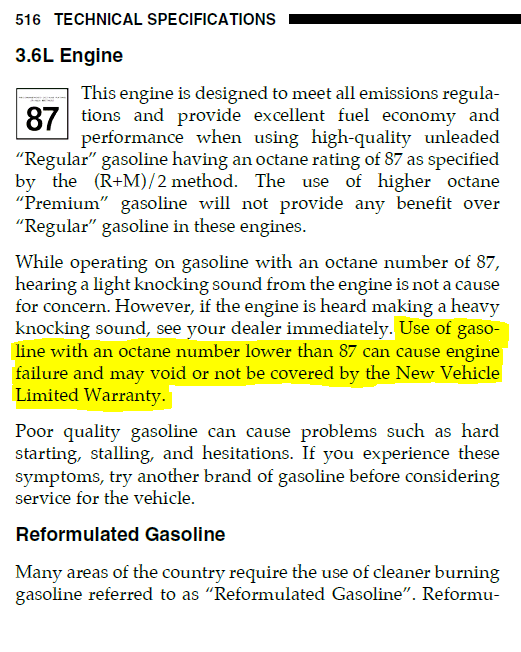
The JL owners manual says 87 octane is required for the 3.6, 91 octane for the 2.0 turbo.
As for power, I am a new Jeep owner and confused as to what kind of "power" you're talking about. These are big vehicles with relatively weak engines. None of the engine options produce more than 300HP, and that's nothing, really. My GTI was a tiny rocket and had more HP than my JL, but it was designed to be quick. What kind of "power" should we expect from a Jeep?
The JL owners manual says 87 octane is required for the 3.6, 91 octane for the 2.0 turbo.
As for power, I am a new Jeep owner but still confused as to what kind of "power" you're talking about. These are big vehicles with relatively weak engines. None of the engine options produce more than 300HP, and that's nothing, really. My GTI was a tiny rocket and had more HP than my JL, but it was designed to be quick. What are you expecting?? 0-60 in 4 seconds??