This has been answered a few times. There are a lot of ways a dealer can make money selling below invoice:
- The dealers have a holdback of roughly 3% of the invoice price. So their true cost for the vehicle is 3% below invoice
- Dealer doc fees are basically pure profit
- Dealers get incentives from the factory that are not known to the public. These can be regional incentives on particular vehicles, or sales thresholds where the factory gives bonuses on every sale
- Dealers use sold (factory) orders to pump up their numbers which gives them more stock for the lot and access to more special edition vehicles. Those vehicles sell at higher margins
- There is some kind of fleet program that has factory support that allows them to sell at lower prices
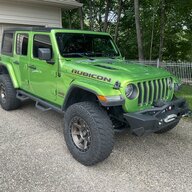
I've been lurking for a while and wanted to have my first post be my build sheet or pics of my awesome new Rubicon, but there are a lot of ideas getting posted that I can shed some light on. The above list of ways a dealer makes money is probably the most comprehensive and accurate in terms of a high-level overview. Not sure of the fleet program as fleet sales generally don't make any money at all, but some manufacturers allow dealers to place certain models into their service vehicle fleet and consider it a "sold" unit, which in turn helps them reach goals. AutoNews just had an article about this with RAM allowing the 1500 into similar program, which is unusual for a flagship model.
Simply , "invoice" is far above what the dealers owe for the vehicle . Giving you a price "below invoice" is another way of saying they are making gross revenue of 20% over what they paid .
If a vehicle is 100K , the dealer owes 75K . If "invoice" is 96K . Dealer sells it to you for 95K , "below invoice" . Dealer still makes gross revenue 20K . Think Porsche .
The more expensive , the bigger the spread , because the bigger risk for a dealer to sell a super-expensive vehicle , think Aston-Martin or Ferrari.
"Invoice" is a fake marketing tool ; the buyer is not getting anything below dealer cost , and never will . That would be impossible . It's a business , with partners , all making money .
To give you an idea of the numbers involved : FCA just published first quarter Revenue of Euros 25 Billion , and Profit of US $ 1.24 Billion . And that is only the first three months of the year . My guess is that each of about 4,000 dealers worldwide has about over US $ 1 Million gross revenue over three months . After all the expenses , that would leave maybe $ 200,000 profit for the dealership . It's a business .
Sort of, and I'll preface this by referring to the above section with how dealership's make money, but the invoice they provide you IS the price the dealership "paid", and that's the price the they're paying interest on. Unless it's a shady dealership who produces their own invoices, in that case your "doc fee" just went up! Haha. In terms of a "real" invoice price that takes into account all of the possible incentives and shows a bottom line price the dealership may realize based on sales performance, customer service scores, having a factory compliant building, etc., that doesn't exist. It's just not possible with all of variables that come into play.
The thing to keep in mind is new vehicle sales actually do have fairly thin margins and represent a small portion of a dealership's cash flows. Well-run dealerships (subjective statement) make their money in the finance department and on Service/Parts. You can sell 200 cars a month, but if your finance guys can't sell and the service bays are empty, you're not making as much money as you should, and you better pray there's not another recession.
I can't talk to what FCA makes on the units, but I think you're underestimating the cost of running a dealership and can tell you with 100% certainty that none of the 4,000 dealerships have a 20% profit margin. 1-2% is much more likely, with market, brand, and the operator/owner being large variables.
Don't get me wrong, try to get the best price you can, but thinking your dealership only paid $35k for your $50k Rubicon is just not the case.
I've been lurking for a while and wanted to have my first post be my build sheet or pics of my awesome new Rubicon, but there are a lot of ideas getting posted that I can shed some light on. The above list of ways a dealer makes money is probably the most comprehensive and accurate in terms of a high-level overview. Not sure of the fleet program as fleet sales generally don't make any money at all, but some manufacturers allow dealers to place certain models into their service vehicle fleet and consider it a "sold" unit, which in turn helps them reach goals. AutoNews just had an article about this with RAM allowing the 1500 into similar program, which is unusual for a flagship model.
Sort of, and I'll preface this by referring to the above section with how dealership's make money, but the invoice they provide you IS the price the dealership "paid", and that's the price the they're paying interest on. Unless it's a shady dealership who produces their own invoices, in that case your "doc fee" just went up! Haha. In terms of a "real" invoice price that takes into account all of the possible incentives and shows a bottom line price the dealership may realize based on sales performance, customer service scores, having a factory compliant building, etc., that doesn't exist. It's just not possible with all of variables that come into play.
The thing to keep in mind is new vehicle sales actually do have fairly thin margins and represent a small portion of a dealership's cash flows. Well-run dealerships (subjective statement) make their money in the finance department and on Service/Parts. You can sell 200 cars a month, but if your finance guys can't sell and the service bays are empty, you're not making as much money as you should, and you better pray there's not another recession.
I can't talk to what FCA makes on the units, but I think you're underestimating the cost of running a dealership and can tell you with 100% certainty that none of the 4,000 dealerships have a 20% profit margin. 1-2% is much more likely, with market, brand, and the operator/owner being large variables.
Don't get me wrong, try to get the best price you can, but thinking your dealership only paid $35k for your $50k Rubicon is just not the case.
Good post. I can't believe I left out financing. I am going to edit my post to add it. Dealers can add interest points to make money off of financing. And they can also get commissions from banks for using their financing.
The thing to keep in mind is new vehicle sales actually do have fairly thin margins and represent a small portion of a dealership's cash flows. Well-run dealerships (subjective statement) make their money in the finance department and on Service/Parts. You can sell 200 cars a month, but if your finance guys can't sell and the service bays are empty, you're not making as much money as you should, and you better pray there's not another recession.
Good post. I can't believe I left out financing. I am going to edit my post to add it. Dealers can add interest points to make money off of financing. And they can also get commissions from banks for using their financing.
Yeah, when a dealership has a retail banking relationship it can definitely be lucrative if the sales volumes are there. They generally get a reduction on the rate they pay to finance their inventory. Considering how interest rates are moving now, and the $$ figures we're talking, can be a huge benefit.