
StephenM129
Member
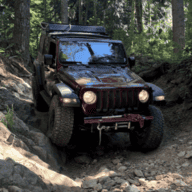
When I bought my 21 JLUR 2.0t it had stock 4.10s, 3.5” lift, 20x10 wheels and 37x13.5 MTs. The first thing I changed was the wheel/tire combo to 17x8.5 wheels and 37x12.5 ATs. The change in mass, about 25lbs per corner, plus the reduced rolling resistance from the AT lug pattern made my jeep feel much lighter, less throttle required to accelerate and hold speed. It was never slow or lacked power by any means but now the engine doesn’t have to work as hard and it’s very noticeable. I could feel a difference even backing out of my driveway which tells me rotating mass might play a role in how the jeep feels performance wise in first gear and reverse. Hard to say how much of that is from the difference in tread pattern though.
I think bigger tires and the affect they have on axle ratios plays a huge part in an engine and transmission’s performance. The gap in shifts becomes longer as well, even with the 8 speed auto. So by adding larger diameter heavier tires not only does the engine have to work harder by applying more throttle, burning more fuel and making more boost but it also has to recover from shifting to a lower rpm. We have to remember that the 2.0t is just that, a little four cylinder with a turbo that is tasked with pushing a nearly 6000 Lb brick down or up the road. It does it very well, especially with 33” tires I imagine but add a lift and bigger tires then the engine requires more fuel and manifold pressure to achieve the same thing. Probably less noticeable if you drive around unloaded with a heavy right foot keeping the rpm’s up and turbo spooling.
I have 5.13 gears that I’m installing when I have time cause I don’t want to make my engine work that hard under normal driving conditions.
We did a 3,500 mile overland/wheeling road trip loaded with camping gear and I won’t be doing that again till I get the 5.13s installed. I recalibrated tire size but even with the tire size calibrated which did improve the shift points greatly, it wasn’t enough to make up for the added weight and bigger heavier tires. On the freeways I found the Transmission waiting too long to downshift on steep grades and then after downshifting it would hold around 4500 rpm’s just to maintain 60-70mph. Then after an up shift the rpm’s would often be too low to maintain speed as we rounded the top and it would need to down shift again. This resulted in putting the transmission in manual to prevent the transmission from hunting for the correct gear and losing speed/momentum in the process. I don’t think regearing will change the rpm’s required to pull long hills while loaded but atleast the gaps between shifts will be shorter and may reduce hunting for the correct gear.
I’m not trying to prove or disprove anything just sharing my thoughts and experiences. We have 6000 miles on our JLUR now and are very happy with it.
I think bigger tires and the affect they have on axle ratios plays a huge part in an engine and transmission’s performance. The gap in shifts becomes longer as well, even with the 8 speed auto. So by adding larger diameter heavier tires not only does the engine have to work harder by applying more throttle, burning more fuel and making more boost but it also has to recover from shifting to a lower rpm. We have to remember that the 2.0t is just that, a little four cylinder with a turbo that is tasked with pushing a nearly 6000 Lb brick down or up the road. It does it very well, especially with 33” tires I imagine but add a lift and bigger tires then the engine requires more fuel and manifold pressure to achieve the same thing. Probably less noticeable if you drive around unloaded with a heavy right foot keeping the rpm’s up and turbo spooling.
I have 5.13 gears that I’m installing when I have time cause I don’t want to make my engine work that hard under normal driving conditions.
We did a 3,500 mile overland/wheeling road trip loaded with camping gear and I won’t be doing that again till I get the 5.13s installed. I recalibrated tire size but even with the tire size calibrated which did improve the shift points greatly, it wasn’t enough to make up for the added weight and bigger heavier tires. On the freeways I found the Transmission waiting too long to downshift on steep grades and then after downshifting it would hold around 4500 rpm’s just to maintain 60-70mph. Then after an up shift the rpm’s would often be too low to maintain speed as we rounded the top and it would need to down shift again. This resulted in putting the transmission in manual to prevent the transmission from hunting for the correct gear and losing speed/momentum in the process. I don’t think regearing will change the rpm’s required to pull long hills while loaded but atleast the gaps between shifts will be shorter and may reduce hunting for the correct gear.
I’m not trying to prove or disprove anything just sharing my thoughts and experiences. We have 6000 miles on our JLUR now and are very happy with it.
Sponsored