
Sponsored

- Banned
- #17
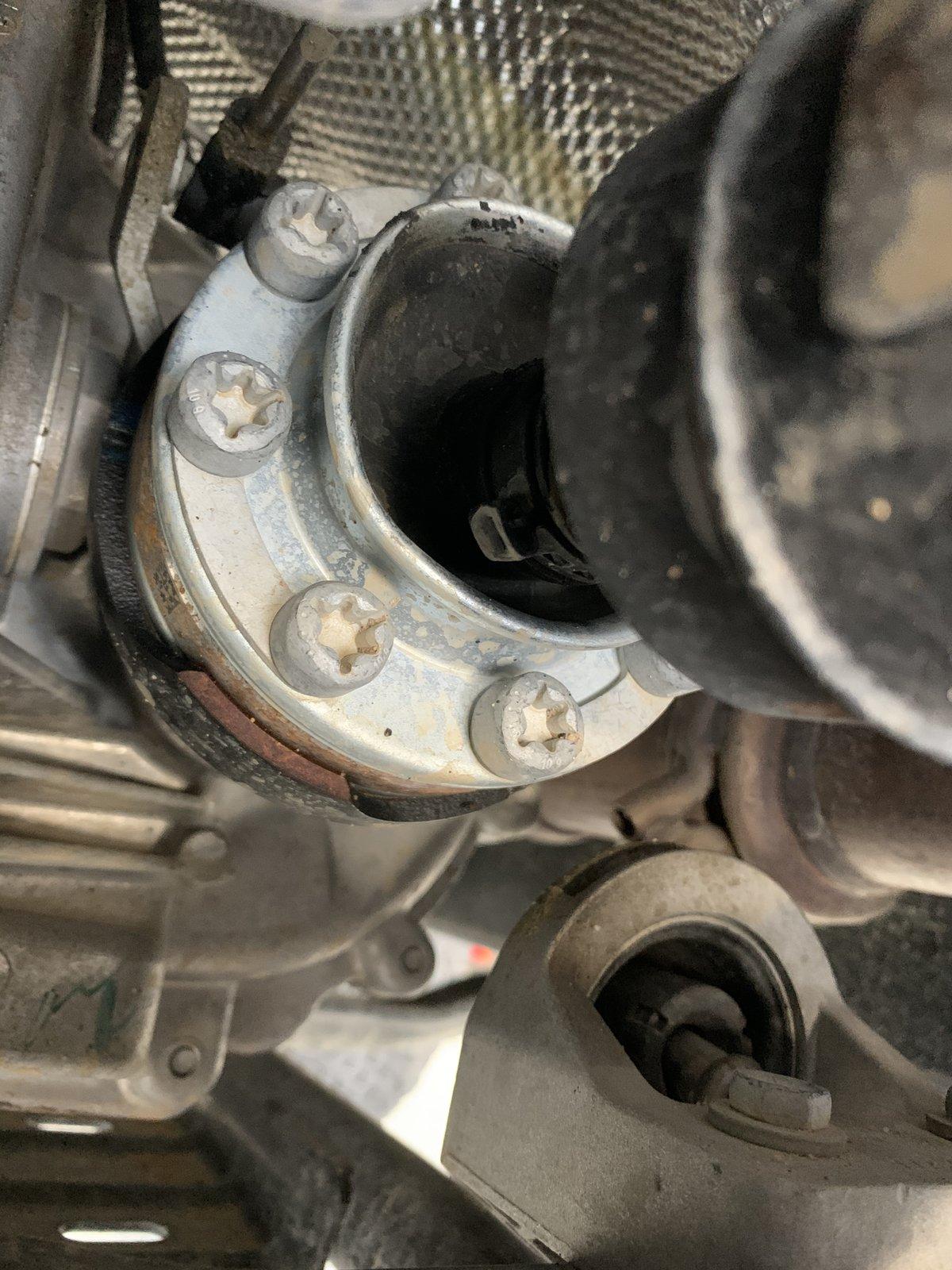
I finally got dialed in at 6 degrees caster. Drives so much better. But that drive shaft angle at the T-case... doesn’t look like there is much room for flex. There are already 2 dents in the RCV collar from sometime before just from flexing? Has me considering a replacement shaft. Keeping the FAD so doesn’t sound like vibration should be an issue. Speaking of, the FAD module is angled down now. I was also surprised how much more that is exposed.
- Banned
- #18
With most running around 6 degrees of caster, I assume this angle is normal? Looks like the flange is already fairly messed up which I didn’t expect. And that’s from before with 4.5 degrees caster and a Mopar 2” lift.


Yellow Cake Kid
Well-Known Member
Hi Brett,...6° caster is of very little concern for pinion angle.
Brett
Are you explaining that you can set the pinion angle to align with the primary axis of a CV joint equipped drive shaft AND then set the caster on the front wheels at 6 degrees with out running into any problems? How about with a 3.5" lift?
Thank you.

- First Name
- Brett
- Joined
- Sep 14, 2018
- Threads
- 41
- Messages
- 2,430
- Reaction score
- 3,031
- Location
- Navasota, TX
- Vehicle(s)
- 2019 JLUR-8 speed 2020 F-350
- Banned
- #20
I had to reread this thread. I was saying that 6° of caster isn’t going to be concern for driveshaft angle. If you start getting into the 7° and up range, there’s a possibility of vibration in 4wdHi Brett,
Are you explaining that you can set the pinion angle to align with the primary axis of a CV joint equipped drive shaft AND then set the caster on the front wheels at 6 degrees with out running into any problems? How about with a 3.5" lift?
Thank you.
I install aftermarket driveshafts in nearly every Jeep we build.
brett
Sponsored
Yellow Cake Kid
Well-Known Member
Hi Brett,I had to reread this thread. I was saying that 6° of caster isn’t going to be concern for driveshaft angle. If you start getting into the 7° and up range, there’s a possibility of vibration in 4wd
I install aftermarket driveshafts in nearly every Jeep we build.
brett
When you install the aftermarket driveshafts, do you use the double cardan constant velocity type or beefed up U-Joint designs?
If/when you work with the double cardan designs do you rotate the pinion angle of either the front or rear differentials?
If you rotate the pinion angle on the front, are you able to set the caster of the wheels back to something like 6 degrees, or is there a limit to wheel caster adjustment that causes positioning the front differentials pinion angle to match the driveshaft axis to make more problems then it solves?
Thank you.
MarkY3130
Well-Known Member
Admittedly I’m not following the question very well so I apologized if I’m not answering the right question.Hi Brett,
When you install the aftermarket driveshafts, do you use the double cardan constant velocity type or beefed up U-Joint designs?
If/when you work with the double cardan designs do you rotate the pinion angle of either the front or rear differentials?
If you rotate the pinion angle on the front, are you able to set the caster of the wheels back to something like 6 degrees, or is there a limit to wheel caster adjustment that causes positioning the front differentials pinion angle to match the driveshaft axis to make more problems then it solves?
Thank you.
Pinion angle and caster angle cannot be set independent of the other. If you adjust one it changes the other one. The only way to do them independently would be to remove the welds that secure the axle tubes to the pumpkin and rotate the axle tubes, then weld them in place. (Or other similar invasive means)
Brett is saying to set the caster to 6 degrees and the pinion angle (that changes when you set the caster automatically) will be acceptable.
Admittedly, compromises have to be made to balance both of those out as you can’t adjust them independently.
Yellow Cake Kid
Well-Known Member
Thanks for the comment. It seems like you answered my question, but the answer does leave me somewhat confused....The only way to do them independently would be to remove the welds that secure the axle tubes to the pumpkin and rotate the axle tubes, then weld them in place. (Or other similar invasive means)...
Isn't the caster adjustable on a stock Jeep with OEM fixed length control arms? If so, how do you accomplish a caster adjustment when you can't adjust the length of the control arms?
I guess, I was assuming that you could adjust the pinion angle by adjusting the lengths of the control arms and then attempt to somewhat restore the caster angle the same way one would set the caster on a Jeep with fixed length length control arms.
Thank you!
MarkY3130
Well-Known Member
Stock Jeeps don’t have adjustable control arms, but yes, buying and using adjustable control arms or some form of geometry correction brackets is how it’s done. Since a stock Jeep doesn’t have these, you actually cannot adjust pinion angle or castor. It is what it is. This is why a rubicon has lower castor from the factory than a sport. They use the same length control arms but have different ride heights. (When you lift a Jeep it will lower your castor, which is why you need adjustable arms or geometry correction brackets)Thanks for the comment. It seems like you answered my question, but the answer does leave me somewhat confused.
Isn't the caster adjustable on a stock Jeep with OEM fixed length control arms? If so, how do you accomplish a caster adjustment when you can't adjust the length of the control arms?
I guess, I was assuming that you could adjust the pinion angle by adjusting the lengths of the control arms and then attempt to somewhat restore the caster angle the same way one would set the caster on a Jeep with fixed length length control arms.
Thank you!
Think of it this way, the adjustable arms, when you adjust them, rotate the axle tubes. The axle tubes are welded to the pumpkin (pinion welded to pumpkin) and on the other end the tube is welded to the ‘C’ that holds the ball joints. (Where castor is)
Since it’s all welded to the axle tubes, any adjustment made using the adjustable arms will effect, and rotate, the pinion and the ’C’s’ on the end of the tubes. Without breaking welds, it’s impossible to make an adjustment to just pinion angle or castor.
- Banned
- #25
What mark said. The only alignment adjustment on a stock Jeep is the toe setting. Caster and pinion are fixed.Thanks for the comment. It seems like you answered my question, but the answer does leave me somewhat confused.
Isn't the caster adjustable on a stock Jeep with OEM fixed length control arms? If so, how do you accomplish a caster adjustment when you can't adjust the length of the control arms?
I guess, I was assuming that you could adjust the pinion angle by adjusting the lengths of the control arms and then attempt to somewhat restore the caster angle the same way one would set the caster on a Jeep with fixed length length control arms.
Thank you!
Aftermarket components would be required to adjust. Even then, caster and pinion are not independent. Increasing one decreases the other and vise versa.
Yellow Cake Kid
Well-Known Member
Thanks for the follow up explanation.Stock Jeeps don’t have adjustable control arms, but yes, buying and using adjustable control arms or some form of geometry correction brackets is how it’s done. Since a stock Jeep doesn’t have these, you actually cannot adjust pinion angle or castor.
I understand what you are saying but was holding out for the possibility that castor was somehow adjustable on a stock axle.
I was confused, and still feel like I have read dozens of posts where owners of completely stock Wrangler JLs, that experienced death wobble, were advised to have their front castor adjusted to a greater value.
I completely missed the idea that you would HAVE to buy a set of control arms to do this... and you would also be setting your pinion angle in a less auspicious position for the drive line.
Thank you!
Sponsored


