Sponsored

HP Tuners for 3.6 models - Fixing what Jeep won’t

Traveller128

Well-Known Member
First Name
Robert
Joined
Dec 18, 2021
Threads
2
Messages
929
Reaction score
1,617
Location
Oasis Idaho
Vehicle(s)
2022 Willys 2 Door 6 speed
Occupation
Volvo Master Technician
Livernois has been able to move the torque curve to the left a bit so there's more low end. They've also got something called a "tow" tune that I might be doing on ours.

They got rid of the TQ dip and made a smooth curve which is meaningful for towing and passing already.

Their tune defaults ESS to off but allows you to manually turn it on if you want.

Tunes for manual and auto trans, 87, 91, 93, E85 available plus the "tow" tune which I find interesting.
Sponsored

 

Stetson

Well-Known Member
First Name
Brian
Joined
Nov 20, 2019
Threads
3
Messages
903
Reaction score
1,815
Location
Salt Lake City
Vehicle(s)
2019 JL Sahara, 2023 392 Rubicon, 2020 GMC 3500 Denali
Occupation
Project Manager
Following. I have a 2025 with the 6MT. I have noticed a slight hesitation or miss when driving constant low speed like 35mph in 4th. Not sure what causes it, no check engine light or code…happens once in a while and is annoying. lol.

Watching to see the news and interested in this project
 

Traveller128

Well-Known Member
First Name
Robert
Joined
Dec 18, 2021
Threads
2
Messages
929
Reaction score
1,617
Location
Oasis Idaho
Vehicle(s)
2022 Willys 2 Door 6 speed
Occupation
Volvo Master Technician
If anyone can chime in, I am looking for a summary of other tune related things you would like to see improved on your JL. Here is what I plan on working on:

-Creating a more linear throttle response, not so spongy
-Changing when and where the torque converter locks up, i think lockup in 2nd gear is a bit extreme.
-Disabling auto start stop so button no longer needs to be pressed every start up.
-Allowing the trans to ride in 4th and 5th gear more in town not being so eager to get into high gear to help with engine bogging down.
-Changing cooling fan activation points, because coolant temps get high in summer.
-Changing VVT and cam timing to help with low end grunt around town.
-Taking some of the slop out of normal in town shifting, shifting seems a little too sluggish at part throttle, seems okay at wide open throttle might tweak WOT just a little bit though.
-Truely optimizing spark timing for those who only run 87 fuel, sure Jeep says it's "safe" and sure it is by the book, but trust me, I've tuned enough modern vehicles to know that your enigne is borderline detonating on 87 fuel no matter what your manufacturer says, and I'd rather not have the engine ping and bouncing off the knock sensors.
-Maybe add about 20-30 HP with some extra timing for those willing to run premium fuel.
All that stuff has been done in the GPEC-2A tune by Livernois, they worked through the same issues. Might want to take a look at that. They added a bunch of power just bumping to 91 octane for exactly the reasons you're stating. They did an 87 tune that improves it quite a bit.

They turned off start/stop (default off) while retaining the function (can manually be turned back on).

I think the VVT positions are going to be the thing that will need to be addressed for low rpm detonation, because the cylinder pressure due to static compression ratio is an issue.

I get why they bumped static compression so high, it's because running down the road at light throttle it allows for increased efficiency without getting into detonation because the load is low. You can improve cruise power and emissions and then when you need higher pressures you use the cam phasing to change dynamic compression ratio.

Lower RPM with high load (resistance to acceleration) is an issue. Idle to 2800 is the detonation zone that we all fear on the dyno. Especially with boosted engines.
 

Mustapha Mond

Well-Known Member
Joined
Dec 20, 2024
Threads
5
Messages
51
Reaction score
106
Location
NM
Vehicle(s)
Jeep
Build Thread
Link
If anyone can chime in, I am looking for a summary of other tune related things you would like to see improved on your JL. Here is what I plan on working on:

-Creating a more linear throttle response, not so spongy
-Changing when and where the torque converter locks up, i think lockup in 2nd gear is a bit extreme.
-Disabling auto start stop so button no longer needs to be pressed every start up.
-Allowing the trans to ride in 4th and 5th gear more in town not being so eager to get into high gear to help with engine bogging down.
-Changing cooling fan activation points, because coolant temps get high in summer.
-Changing VVT and cam timing to help with low end grunt around town.
-Taking some of the slop out of normal in town shifting, shifting seems a little too sluggish at part throttle, seems okay at wide open throttle might tweak WOT just a little bit though.
-Truely optimizing spark timing for those who only run 87 fuel, sure Jeep says it's "safe" and sure it is by the book, but trust me, I've tuned enough modern vehicles to know that your enigne is borderline detonating on 87 fuel no matter what your manufacturer says, and I'd rather not have the engine ping and bouncing off the knock sensors.
-Maybe add about 20-30 HP with some extra timing for those willing to run premium fuel.
I have a 2025 with the 6 speed manual. The run away throttle at cold start is particularly annoying. I assume it is trying to warm up the cats as fast as possible, but it is stupid having to ride the clutch in parking lots in 1st gear because the engine is trying to idle at 2,000+RPM.

The 3.6L also seems ridiculously easy to stall. This might be more of an issue of the flywheel weight, but I have driven manuals my whole life, and the most comparable vehicle to my Jeep I own is my Bronco II on 37"s which has a 115 HP 150 FtLb 2.8L V6 with a much higher 1st gear (3.97 vs. 5.13 in the Wrangler) and it is way harder to stall than the Jeep. The Jeep also seems to idle around 1,000RPM once warmed up and it still stalls easily.

Any torque improvements for RPMs < 2k would also be welcomed.
Agreed! I didn't expect the 3.6L to be a torque monster, but I was a bit disappointed with how gutless it is under ~2,500 RPM. Once you get above 3,000RPM, it seems to pull pretty well all the way to redline.
 

GabeBoyTheGreat

Well-Known Member
Joined
Mar 29, 2025
Threads
7
Messages
539
Reaction score
718
Location
Virginia
Vehicle(s)
2018 JL Sport, 2025 JLU Willys
Occupation
Test Engineer
The 3.6L also seems ridiculously easy to stall. This might be more of an issue of the flywheel weight, but I have driven manuals my whole life, and the most comparable vehicle to my Jeep I own is my Bronco II on 37"s which has a 115 HP 150 FtLb 2.8L V6 with a much higher 1st gear (3.97 vs. 5.13 in the Wrangler) and it is way harder to stall than the Jeep. The Jeep also seems to idle around 1,000RPM once warmed up and it still stalls easily.
The stalling issue is mostly due to the lightweight flywheel. Members who have installed heavier flywheels have mentioned that it fixes the stalling issue, but I wouldn't recommend doing that because the aftermarket clutches seem to fail after about 10k miles.

If you haven't already, you should look into replacing the clutch pedal assist spring with the ACT spring. While it doesn't improve the clutch performance per say, it does make the clutch pedal easier to modulate, and as a result, I am less likely to stall it.
 

Sponsored

dstevens

Well-Known Member
Joined
Apr 13, 2023
Threads
8
Messages
946
Reaction score
1,602
Location
CA
Vehicle(s)
2024 JLURX
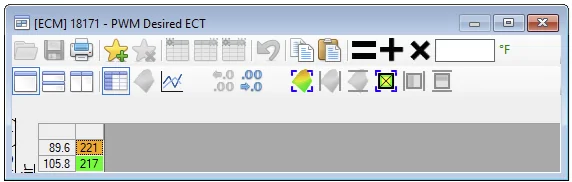
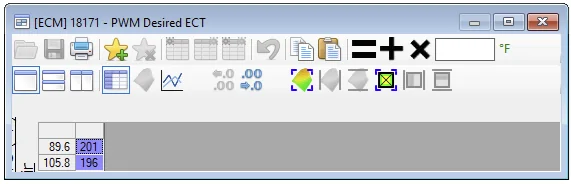
roaniecowpony and myself just finished testing the radiator fan settings yesterday. I started to write that up last night. I planned to cover PCM compatibility and cloning as well.

Factory
Jeep Wrangler JL HP Tuners for 3.6 models - Fixing what Jeep won’t 1771428685657-pa


New settings
Jeep Wrangler JL HP Tuners for 3.6 models - Fixing what Jeep won’t 1771428730055-fu


There's no access to the PID control so the fans still cycle but it is a 100% improvement over the factory behavior.

Untested
Jeep Wrangler JL HP Tuners for 3.6 models - Fixing what Jeep won’t 1771428925234-pv


Also
https://www.jlwranglerforums.com/fo...ast-downhill-in-4lo.96322/page-5#post-3185656

I've done some work on the transmission programming, but mainly to fix the torque reduction in 4LO and stop it up shifting with increasing throttle. I also have mapped some of the modes to patterns eg 4LO without OR+ uses patterns 50/51. You can increase the oncoming clutch ramp pressures and the line pressures very mildly to help the shifts. I would not disable the TCC as it can result in more heat when off road in 4HI. What I have seen is the TCC tables overlapping so that at certain speeds and loads the TCC engages/disengages over and over.

With spark tuning my belief is the knock control works on lower octane. Removing timing can be a problem as it makes more heat, but if there is one spot when it does pull timing it is best to address that area and often the overall timing will increase.
 

Mustapha Mond

Well-Known Member
Joined
Dec 20, 2024
Threads
5
Messages
51
Reaction score
106
Location
NM
Vehicle(s)
Jeep
Build Thread
Link
The stalling issue is mostly due to the lightweight flywheel. Members who have installed heavier flywheels have mentioned that it fixes the stalling issue, but I wouldn't recommend doing that because the aftermarket clutches seem to fail after about 10k miles.

If you haven't already, you should look into replacing the clutch pedal assist spring with the ACT spring. While it doesn't improve the clutch performance per say, it does make the clutch pedal easier to modulate, and as a result, I am less likely to stall it.
I actually don't mind the extremely light clutch pedal, and for me anyway, it is not an issue of clutch pedal modulation. The engine just immediately stalls and won't even try to lug at all. The 5.38 axle gears help a lot, but it was really bad when it was stock.


Also, I forgot to echo the cooling fan gripe. It is stupid that it keeps the fans off and will let the engine run in the 220-230°F range on the trail. I have found that actually turning the AC on on the trail drops the coolant temperatures down where I would like to see them (190-210°F) since it forces the fan to run.
 

dstevens

Well-Known Member
Joined
Apr 13, 2023
Threads
8
Messages
946
Reaction score
1,602
Location
CA
Vehicle(s)
2024 JLURX
With regards to the first video (PCM removal) I would add a step to clean around the PCM. With the GPEC2A where the connectors are on the side, if you Jeep is actually taken off road you get a lot of dirt and grit around the connectors. And so the levered slides do not want to operate and the connector housing need to come apart to get the locks off. We took an hour to undo the connectors the first time.
 
OP
OP
bmpcamry09

bmpcamry09

Well-Known Member
First Name
Brad
Joined
Feb 13, 2026
Threads
7
Messages
502
Reaction score
1,019
Location
New Athens, IL
Vehicle(s)
2025 JLU Sport S 3.6 8AT
All that stuff has been done in the GPEC-2A tune by Livernois, they worked through the same issues. Might want to take a look at that. They added a bunch of power just bumping to 91 octane for exactly the reasons you're stating. They did an 87 tune that improves it quite a bit.

They turned off start/stop (default off) while retaining the function (can manually be turned back on).

I think the VVT positions are going to be the thing that will need to be addressed for low rpm detonation, because the cylinder pressure due to static compression ratio is an issue.

I get why they bumped static compression so high, it's because running down the road at light throttle it allows for increased efficiency without getting into detonation because the load is low. You can improve cruise power and emissions and then when you need higher pressures you use the cam phasing to change dynamic compression ratio.

Lower RPM with high load (resistance to acceleration) is an issue. Idle to 2800 is the detonation zone that we all fear on the dyno. Especially with boosted engines. Jeep Wrangler JL HP Tuners for 3.6 models - Fixing what Jeep won’t 1771428925234-pv bmpcamry09
I am very familiar with Livernois. They do a lot of Ecoboost stuff which is the first platform I really honed in on. I won’t share my opinion here about them, but I’ve seen the inner workings of some of their work and I’ve talked to some of the biggest names in the calibration world and they have a certain reputation. Their pricing is nice in comparison to the HP Tuners process for these, but their dedicated device doesn’t give DIY people versatility like the MPVI and HP Tuners platform. But sort of a different customer base between the two products.

You are dead on about the static compression at low load. I’ve pulled out as much as 15 degrees of spark timing on GM when changing cam behavior to manage cylinder pressure. The trick is always finding the sweet spot between managing cylinder pressure but not having too much overlap with the exhaust and having to pull so much timing where you create heat.

I’ll make a video soon discussing some of these principles and showing how the manufacture is implementing them.
 
OP
OP
bmpcamry09

bmpcamry09

Well-Known Member
First Name
Brad
Joined
Feb 13, 2026
Threads
7
Messages
502
Reaction score
1,019
Location
New Athens, IL
Vehicle(s)
2025 JLU Sport S 3.6 8AT
Livernois has been able to move the torque curve to the left a bit so there's more low end. They've also got something called a "tow" tune that I might be doing on ours.

They got rid of the TQ dip and made a smooth curve which is meaningful for towing and passing already.

Their tune defaults ESS to off but allows you to manually turn it on if you want.

Tunes for manual and auto trans, 87, 91, 93, E85 available plus the "tow" tune which I find interesting.
The torque curve moving to the left will be easy to duplicate. Advancing the intake VVT at lower RPM accomplishes this pretty easy on most platforms, I looked at a GPEC5 Gladiator file and at one point around 2000 RPM, the PCM is looking for 144 degrees on the intake cam, which is actually fully retarded intake cam timing (the same number used at idle), the complete opposite of where tuners like to go to up the down low pull., while retarding the exhaust cam at WOT can smooth the transition area usually just past the peak of the torque curve.

Tow tunes are pretty easy to accomplish, basically focus on responsiveness and driveability but keeping cylinder pressures and timing conservative. Lots of tweaks on the auto trans side.

My number one goal is to get this odd feeling power band resolved.
 

Sponsored

OP
OP
bmpcamry09

bmpcamry09

Well-Known Member
First Name
Brad
Joined
Feb 13, 2026
Threads
7
Messages
502
Reaction score
1,019
Location
New Athens, IL
Vehicle(s)
2025 JLU Sport S 3.6 8AT
With regards to the first video (PCM removal) I would add a step to clean around the PCM. With the GPEC2A where the connectors are on the side, if you Jeep is actually taken off road you get a lot of dirt and grit around the connectors. And so the levered slides do not want to operate and the connector housing need to come apart to get the locks off. We took an hour to undo the connectors the first time.
Good point! I was lucky enough to be able to do this on an untouched basically new connector lol
 
OP
OP
bmpcamry09

bmpcamry09

Well-Known Member
First Name
Brad
Joined
Feb 13, 2026
Threads
7
Messages
502
Reaction score
1,019
Location
New Athens, IL
Vehicle(s)
2025 JLU Sport S 3.6 8AT
I have a 2025 with the 6 speed manual. The run away throttle at cold start is particularly annoying. I assume it is trying to warm up the cats as fast as possible, but it is stupid having to ride the clutch in parking lots in 1st gear because the engine is trying to idle at 2,000+RPM.

The 3.6L also seems ridiculously easy to stall. This might be more of an issue of the flywheel weight, but I have driven manuals my whole life, and the most comparable vehicle to my Jeep I own is my Bronco II on 37"s which has a 115 HP 150 FtLb 2.8L V6 with a much higher 1st gear (3.97 vs. 5.13 in the Wrangler) and it is way harder to stall than the Jeep. The Jeep also seems to idle around 1,000RPM once warmed up and it still stalls easily.


Agreed! I didn't expect the 3.6L to be a torque monster, but I was a bit disappointed with how gutless it is under ~2,500 RPM. Once you get above 3,000RPM, it seems to pull pretty well all the way to redline.
You are correct, the strategies companies use for cat converter light off are usually the same in that regard, high injector pulse width paired with heavily retarded spark timing to get things hot as hot as possible. I wish I had a manual in person to play around with that. But there are ways to make that cat lightoff a little less obnoxious by managing some of the minimum spark tables it appears.
 

dstevens

Well-Known Member
Joined
Apr 13, 2023
Threads
8
Messages
946
Reaction score
1,602
Location
CA
Vehicle(s)
2024 JLURX
Wait until you log the 2.0T and find that it is running -6 degrees timing at highway cruise. No wonder it gets hot. I also found at 75 mph I was getting poorer fuel economy than a 392 since the engine was strangling itself.
 
OP
OP
bmpcamry09

bmpcamry09

Well-Known Member
First Name
Brad
Joined
Feb 13, 2026
Threads
7
Messages
502
Reaction score
1,019
Location
New Athens, IL
Vehicle(s)
2025 JLU Sport S 3.6 8AT
Wait until you log the 2.0T and find that it is running -6 degrees timing at highway cruise. No wonder it gets hot. I also found at 75 mph I was getting poorer fuel economy than a 392 since the engine was strangling itself.
Yikes. We got rid of our 2020 2.0 JL last year. I wanted to develop it also but wife missed the refinement of the V6. Hated that the 2.0 sounded like an old farm tractor until warmed up. Drove great though and loved cold air and 93 octane. Was actually solid reliability wise too.
 

Traveller128

Well-Known Member
First Name
Robert
Joined
Dec 18, 2021
Threads
2
Messages
929
Reaction score
1,617
Location
Oasis Idaho
Vehicle(s)
2022 Willys 2 Door 6 speed
Occupation
Volvo Master Technician
I am very familiar with Livernois. They do a lot of Ecoboost stuff which is the first platform I really honed in on. I won’t share my opinion here about them, but I’ve seen the inner workings of some of their work and I’ve talked to some of the biggest names in the calibration world and they have a certain reputation. Their pricing is nice in comparison to the HP Tuners process for these, but their dedicated device doesn’t give DIY people versatility like the MPVI and HP Tuners platform. But sort of a different customer base between the two products.

You are dead on about the static compression at low load. I’ve pulled out as much as 15 degrees of spark timing on GM when changing cam behavior to manage cylinder pressure. The trick is always finding the sweet spot between managing cylinder pressure but not having too much overlap with the exhaust and having to pull so much timing where you create heat.

I’ll make a video soon discussing some of these principles and showing how the manufacture is implementing them.
I have been considering tunes for our '22 6 speed 2 door, and they are in the running. I'm concerned that I won't be able to have anyone tweak it, their jail broken version of the PCM is only open to their tuning afterwards. Diablosport does the same thing. They crack the security and install their own basically.

I'd love to tune my own stuff, but it really does need time, a dyno and all the tuning equipment. I did this several years ago at a specialized performance shop/machine shop. I build motor stuff on the side still, performance work, mostly cylinder head work now for drag racers and hot rodders. I'm not doing cast iron anymore though. Too many guys wanting to give me 55-65 year old cast iron wanting performance on par with modern heads, that have been heat cycled and overheated for 55-65 years.

I'm back to being a Euro car master tech, it pays better. Been working on cars since, well, I'll just say a long time! Coming up on 50 years. I was into high performance stuff in 1982, so I'm really impressed with how much we can do on the modern vehicles that we had to try to crutch back then.

Cylinder pressure at high throttle/loading at lower RPM wasn't a thing, because high performance cams usually had overlap and bled pressure at the lower RPM. You kept static compression down a bit with lower duration cams so that you didn't detonate. It was fixed cam timing and the lobes were married in relation to each other.

I attended the School of Automotive Machinists some years ago, and that's essentially a NASCAR and NHRA feeder school. I can build some nasty stuff pretty much budget limited. But the modern cars with all the functions for modern drivability and emissions are a balancing act at all times due to fuels and the huge range of operation. I work on Euro stuff and we're dancing with detonation on compound supercharged engines. You can put a 91 octane requirement on at the factory and you will ALWAYS have people that want to run a high static compression/boosted engine on 87 octane. The tuning is crutched as heck to meet emissions on crap fuel.
Sponsored


Top