Sponsored

Start Stop battery out again

Fudster

Banned
Banned
Banned
First Name
Elliot
Joined
Mar 9, 2022
Threads
29
Messages
656
Reaction score
684
Location
Athens, GA
Vehicle(s)
2019 Sahara
Please send me the aforementioned links
There are two basic approaches to getting your dual battery JL/JT to function well by bypassing the ESS/Aux battery, both, thanks to Jerry @Jebiruph. (Actually there are 3 IMHO.)

The first older but no less worthy technique involves placing a fused jumper between terminals N1 and N2 on the high amp fuses in the Power Distribution Center (PDC.) That's a mouthful, so here's the link https://www.jlwranglerforums.com/forum/threads/3-6l-ess-aux-battery-bypass.17293/ .

In less technical terms you are electrically rerouting all calls to the ESS/Aux battery to the main one.

In this and the following second technique, the cable that attaches to the negative post of the main battery and that finds its way back to the negative post of the ESS battery (which is hidden from view at the ESS end) is disconnected, and its loose end insulated to prevent a short. Which cable this is seems to depend on your JLs model year, as Stellantis, it is reported, switched the cables in 2021. Again, Jerry elaborates for us here, my thinking, given your 2020 JL is that it is for you cable "B."

https://www.jlwranglerforums.com/forum/threads/ess-battery-cable-change.86624/#post-2263792

Disconnecting this cable prevents the completion of a closed circuit to the ESS battery, taking it out of the electrical schematic of the vehicle.

The second more recently developed technique, which is NOT incompatible with the first, just another way of accomplishing a similar objective, involves pulling Fuse 42 of the PDC (in addition to the cable disconnect above.)

More on that begins here: https://www.jlwranglerforums.com/forum/threads/jumperless-aux-battery-bypass.95945/

The less technically explanation of this second technique is based on the fact that 99% of the time the two batteries are connected in parallel. The only time this isn't the case as an instant at cold crank, where the ESS battery is isolated to test it, and during ESS events, where the main battery is temporarily taken out of the electrical schema of the vehicle to bear the brunt of the load to crank the engine after an ESS event.

Well....this separation of the batteries is done through a relay (a switch that controls electric current through a separate electrical current). When you pull that fuse 42 the relay won't get the power it needs to separate the batteries and all calls for electrical current will flow to any/all available batteries--which in your case is just the main battery after you yank that cable that makes the ESS battery electrically inaccessible.

I would advise you to turn ESS off when running with one battery. I don't think, nor have I ever, that its the end of the world if ESS engages with just your main battery. But this one battery setup robs your post ESS event cranking battery of power. Push the ESS off button, buy tech to do it for you: it's all good. (Many vehicles do ESS with one battery. Many vehicles also don't have after market energy hungry appliances like the JL/JT.)

There is a 3rd method. It's the easiest and IMHO the best, but it gets little attention.

Simply pull the cable that connects the negatives of the two batteries described above.

Crank your JL. Expect it to fail, because it found no ESS battery connected. Now, attempt to crank again. Your 2020 JL should automatically try cranking off the main battery, and if successful, automatically turn the ESS off light on for you. It will remain this way until the next cold crank, if any, that an energized ESS battery is detected.

(This last technique won't work on early model 2018's unless they are flashed with TSB 18-092-19.)

People who don't like idiot lights on their dash should use one of the first two techniques. I don't judge. I just offer info. :)
Sponsored


multicam

Well-Known Member
First Name
Tanner
Joined
Feb 11, 2019
Threads
8
Messages
1,924
Reaction score
5,532
Location
Alaska
Vehicle(s)
2018 4Runner, 2019 JLR
Vehicle Showcase
1
[rant time]

Shit like this is why people hate ESS and resent the myriad of factors that led to its invention and propagation.

From my standpoint as an end user, below is a summary of the gains and costs of the system:

Gains:
-I would save about $70 worth of gas over the time period that it took for my 1st ESS battery to die (yes, hand-calculated… I used ESS for roughly the first half of the time period and didn’t use it for the second half).
-Benefits the environment due to less idling (this is tiny but measurable and I don’t doubt that it’s a good thing, technically. How much it will impact global temperatures leading to worldwide catastrophe for my great great grandchildren is a separate question).

Costs:
-The ESS battery itself was about $95 to replace, making it a ~$25 net loss compared to gas savings
-If my driving habits change (which they did; I now have a six mile commute which is putting a strain on my ESS battery and therefore my main battery) I now have to worry about my ESS battery killing my main battery leading to earlier replacement
-Extra cost built into vehicle’s purchase price due to added complexity (unknown amount)
-Changing the ESS battery means changing the main battery
-Time: changing batteries is now a multi-hour task vs. 10 minutes
-Blood: I cut my hand when changing the ESS battery. That was annoying when I washed the dishes later that night
-Time: researching ways around ESS and implementing them takes time
-Environmental cost: that’s one more battery to be replaced and manufactured, not to mention the premature replacement of the main battery that sometimes occurs
-Extra wear on the engine and starter (unknown; possibly completely negligible… but maybe not)
-Complexity- the jeep is more complex, plain and simple. More things to fail or strand you in the middle of nowhere. More difficult to jump the jeep.

Bottom line: the costs do not outweigh the benefits. Feel free to let me know if you have any additions to either category, I’d especially be interested in benefits that I’m not thinking of.

[/rant]
 
Last edited:
OP
OP
dchemphill1

dchemphill1

Well-Known Member
First Name
David
Joined
Oct 20, 2020
Threads
61
Messages
917
Reaction score
1,602
Location
Nebraska
Vehicle(s)
2020 Wrangler Rubicon Recon
Occupation
School Administrator
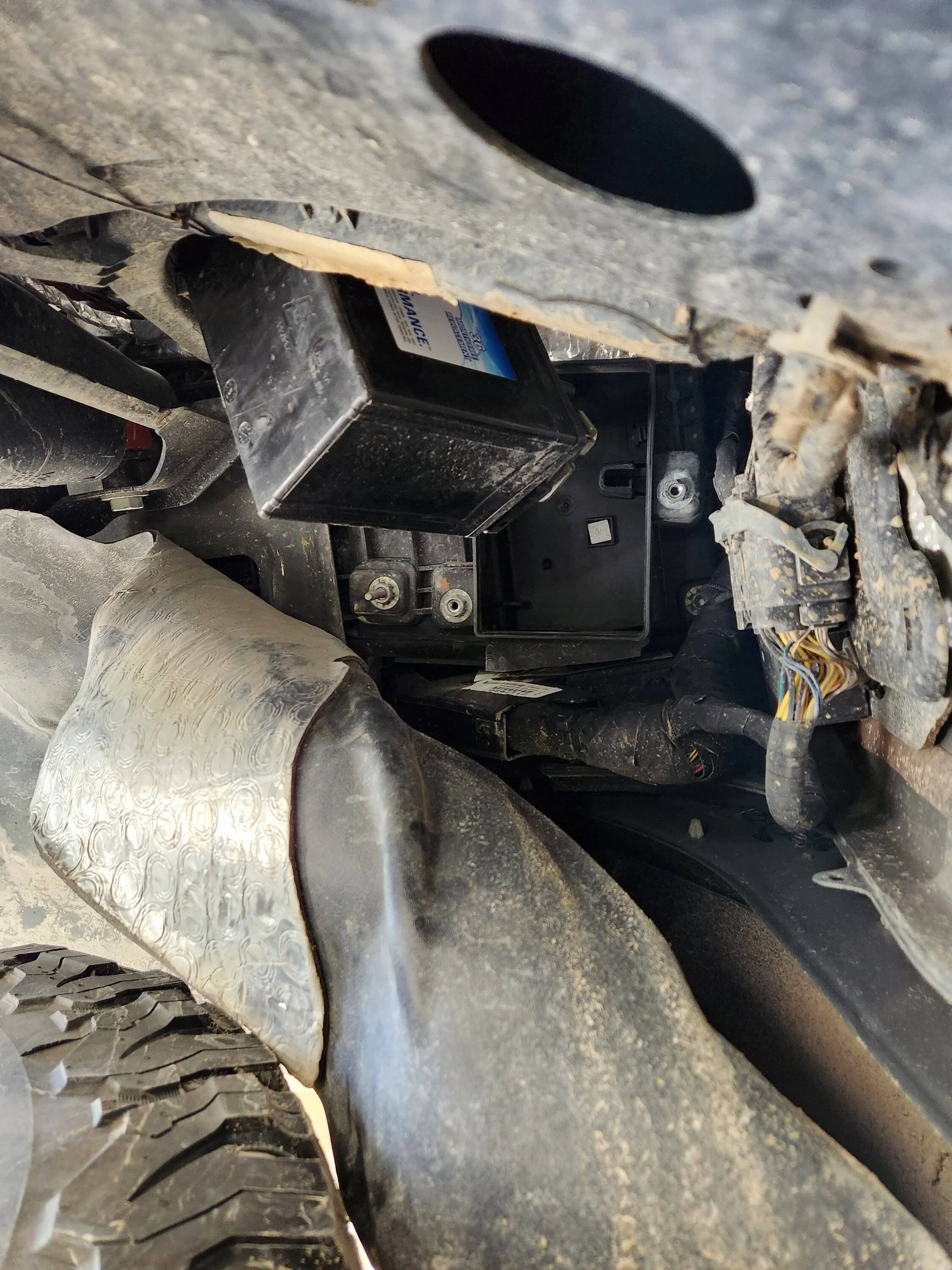
Not sure how many are aware of this method to get at the Aux battery. You do not need to take apart the whole main battery, fuse box, electric hub or remove the tire and pull the fender and liner. I removed these two push pins
Jeep Wrangler JL Start Stop battery out again 20230220_161507

and folded the wheel well liner over so it was stuck on the top of tire....then laying on the ground next to the passenger tire...looking straight up into the engine bay you have access to the Aux battery compartment.
Jeep Wrangler JL Start Stop battery out again 20230220_141410

You need a 10mm socket to take the three bolts that holds the box in place. And a small 10mm wrench to disconnect the battery....I pulled mine in about 15 min.....that long because I had to slide out and find a smaller wrench for the battery...I put the wires and cover back in the box and reattached....no more Aux battery. I had already disconnected the negative wire from the main battery and pulled fuse #42.
You could reinstall one this way if you want. Pretty slick and only needed to remove two pins on the wheel well.
 

Fudster

Banned
Banned
Banned
First Name
Elliot
Joined
Mar 9, 2022
Threads
29
Messages
656
Reaction score
684
Location
Athens, GA
Vehicle(s)
2019 Sahara
[rant time]

Shit like this is why people hate ESS and resent the myriad of factors that led to its invention and propagation.

From my standpoint as an end user, below is a summary of the gains and costs of the system:

Gains:
-I would save about $70 worth of gas over the time period that it took for my 1st ESS battery to die (yes, hand-calculated… I used ESS for roughly the first half of the time period and didn’t use it for the second half).
-Benefits the environment due to less idling (this is tiny but measurable and I don’t doubt that it’s a good thing, technically. How much it will impact global temperatures leading to worldwide catastrophe for my great great grandchildren is a separate question).

Costs:
-The ESS battery itself was about $95 to replace, making it a ~$25 net loss compared to gas savings
-If my driving habits change (which they did; I now have a six mile commute which is putting a strain on my ESS battery and therefore my main battery) I now have to worry about my ESS battery killing my main battery leading to earlier replacement
-Extra cost built into vehicle’s purchase price due to added complexity (unknown amount)
-Changing the ESS battery means changing the main battery
-Time: changing batteries is now a multi-hour task vs. 10 minutes
-Blood: I cut my hand when changing the ESS battery. That was annoying when I washed the dishes later that night
-Time: researching ways around ESS and implementing them takes time
-Environmental cost: that’s one more battery to be replaced and manufactured, not to mention the premature replacement of the main battery that sometimes occurs
-Extra wear on the engine and starter (unknown; possibly completely negligible… but maybe not)
-Complexity- the jeep is more complex, plain and simple. More things to fail or strand you in the middle of nowhere. More difficult to jump the jeep.

Bottom line: the costs do not outweigh the benefits. Feel free to let me know if you have any additions to either category, I’d especially be interested in benefits that I’m not thinking of.

[/rant]
Well thought out Tanner.

Many aspects of ESS suck; no debate. And yet the EPA directives, warts and all, that motivated the technology have merit.

ESS is our generation's "pet rock." It is the automotive industry's solution of least resistance, right now, to achieve better overall average fleet MPGs, that takes advantage of the laws of inertia to charge an ESS battery when the engine is already idling at a fair clip, such that the marginal additional taxing of the engine by the alternator to effect this battery charge is less of a hit to MPGs than the MPGs saved by cumulative ESS events.

You're right. The whole ESS system adds complexity, and net net, after you've buried all those dead batteries, I'm not even sure its better for the environment. I wonder if the smog we save today is nothing more than addressing a more pressing immediate problem that 20 years from now will transition into the more pressing need to clean up a toxic ground water table, polluted by battery parts that couldn't be recycled. The armchair warrior's reply would be that ESS will have about a decade of prevalence before EVs make it irrelevant.

But--and here's the kicker--these ever more stringent CAFE standards are, by design, making electric vehicles "cheaper" relative to their ICE counterparts, to incentivize the investment and economies of scale to produce cheaper and higher quality EVs.

Only in hindsight will the lessor of all evils reveal itself.
 

multicam

Well-Known Member
First Name
Tanner
Joined
Feb 11, 2019
Threads
8
Messages
1,924
Reaction score
5,532
Location
Alaska
Vehicle(s)
2018 4Runner, 2019 JLR
Vehicle Showcase
1
Not sure how many are aware of this method to get at the Aux battery. You do not need to take apart the whole main battery, fuse box, electric hub or remove the tire and pull the fender and liner. I removed these two push pins
20230220_161507.jpg

and folded the wheel well liner over so it was stuck on the top of tire....then laying on the ground next to the passenger tire...looking straight up into the engine bay you have access to the Aux battery compartment.
20230220_141410.webp

You need a 10mm socket to take the three bolts that holds the box in place. And a small 10mm wrench to disconnect the battery....I pulled mine in about 15 min.....that long because I had to slide out and find a smaller wrench for the battery...I put the wires and cover back in the box and reattached....no more Aux battery. I had already disconnected the negative wire from the main battery and pulled fuse #42.
You could reinstall one this way if you want. Pretty slick and only needed to remove two pins on the wheel well.
Thanks for the pics and the write up. I was aware of this method, I just wanted to try the other way from the top because I had heard some people say they broke those little plastic retaining clips and didn’t want to risk that, but next time I’ll probably use this method.

I do have a couple questions-

1. I assume you insulated the connections that go to the aux battery right? Did you just use electrical tape?

2. After doing this, do you get a dummy light on your dash saying “ESS Unavailable” or anything?

3. Does ESS still happen?

I’m definitely going to delete the aux battery at some point, just waiting for the best way to do it.
 

Sponsored

Fudster

Banned
Banned
Banned
First Name
Elliot
Joined
Mar 9, 2022
Threads
29
Messages
656
Reaction score
684
Location
Athens, GA
Vehicle(s)
2019 Sahara
....I’m definitely going to delete the aux battery at some point, just waiting for the best way to do it.
Hi again Tanner:

I might argue that the best way to delete the aux battery is to simply remove the cable that starts at its negative post, and ends at the main battery's negative post, from the main battery's negative post, insulate its loose end with, say, electrical tape, and stop.

Spending the time and effort to remove the ESS battery is likely not worth it. In the unlikely event in springs a leak the battery rides closest to the ground and is unlikely to cause damage to other under the hood components.

As you probably know, disconnecting this cable often comes in concert (but need not**) with either pulling Fuse 42 in the PDC, to deenergize the relay that separates the batteries, and/or fused jumpering of connection points N1 and N2 in the PDC. I just wrote out the links to do so for somebody else yesterday here: https://www.jlwranglerforums.com/fo...-battery-out-again.101383/page-5#post-2265817 .

I hold the opinion that either of these steps should be in concert with turning ESS off so as to not tax the one main cranking battery after ESS events, during ESS events. This is not to say that the occasional one battery ESS event is terrible: many vehicles do ESS with one battery.

**There is a third way that's fine for all JLs but the early 2018s not flashed with TSB 18-092-19:

Disconnect the cable and do no more. In that case, your first attempt to crank will fail as no ESS battery will be found. But all subsequent attempts to crank will be off the main battery, and if successful, the "ESS off" light will be illuminated in the EVIC for you. This condition will remain until the crank after the connection, if ever, of an energized ESS battery again.

I think this latter technique "kills two birds with one stone." as it's less steps and turns ESS off for you. But if EVIC lights aren't your thing, either of the first two techniques will likely be best for you.
 

entropy

Well-Known Member
Joined
Sep 19, 2018
Threads
90
Messages
4,747
Reaction score
8,257
Location
Foothills of the San Gabriels
Vehicle(s)
2025 Jeep Wrangler Willys XR '41
Build Thread
Link
Occupation
OF top 1% content creator
9 months after having my Start Stop battery changed out....the new one is going again! Warranty on Jeep runs out end of the month but the battery has warranty...so should be good. Hard to believe the quality of the OEM battery! Really 9 months!
Bypass it. It takes 5 minutes. Keep it as a backup battery.
 

multicam

Well-Known Member
First Name
Tanner
Joined
Feb 11, 2019
Threads
8
Messages
1,924
Reaction score
5,532
Location
Alaska
Vehicle(s)
2018 4Runner, 2019 JLR
Vehicle Showcase
1
Hi again Tanner:

I might argue that the best way to delete the aux battery is to simply remove the cable that starts at its negative post, and ends at the main battery's negative post, from the main battery's negative post, insulate its loose end with, say, electrical tape, and stop.

Spending the time and effort to remove the ESS battery is likely not worth it. In the unlikely event in springs a leak the battery rides closest to the ground and is unlikely to cause damage to other under the hood components.

As you probably know, disconnecting this cable often comes in concert (but need not**) with either pulling Fuse 42 in the PDC, to deenergize the relay that separates the batteries, and/or fused jumpering of connection points N1 and N2 in the PDC. I just wrote out the links to do so for somebody else yesterday here: https://www.jlwranglerforums.com/fo...-battery-out-again.101383/page-5#post-2265817 .

I hold the opinion that either of these steps should be in concert with turning ESS off so as to not tax the one main cranking battery after ESS events, during ESS events. This is not to say that the occasional one battery ESS event is terrible: many vehicles do ESS with one battery.

**There is a third way that's fine for all JLs but the early 2018s not flashed with TSB 18-092-19:

Disconnect the cable and do no more. In that case, your first attempt to crank will fail as no ESS battery will be found. But all subsequent attempts to crank will be off the main battery, and if successful, the "ESS off" light will be illuminated in the EVIC for you. This condition will remain until the crank after the connection, if ever, of an energized ESS battery again.

I think this latter technique "kills two birds with one stone." as it's less steps and turns ESS off for you. But if EVIC lights aren't your thing, either of the first two techniques will likely be best for you.
Thanks again! Yeah I just went ahead and did what you described: pulled the negative cable, taped it up with electrical tape and secured it, pulled fuse 42 and the jeep is behaving exactly as normal, no error codes. (Also thanks @Jebiruph I know you’re big in this space). Easy peasy. I’m already in the habit of turning off ESS so until I get a tazer I’ll just keep doing that.

Bypass it. It takes 5 minutes. Keep it as a backup battery.
Yeah, seriously. It really is that easy.
 

MitsJeep

Well-Known Member
Joined
Feb 3, 2023
Threads
5
Messages
231
Reaction score
150
Location
South Carolina
Vehicle(s)
2018 Black JLUS
Just had my ESS light come on this week. Found this thread today. Im not keen on replacing the ESS battery at all, So I can basically bypass it? I dont really want to stare at a light on the display, so pulling and taping the negative cable, as well as fuse 42 will solve it with no lights? What negative are you referencing? The connecting one that comes from the main battery to the ESS battery? Just want to confirm this pesky problem.
 

multicam

Well-Known Member
First Name
Tanner
Joined
Feb 11, 2019
Threads
8
Messages
1,924
Reaction score
5,532
Location
Alaska
Vehicle(s)
2018 4Runner, 2019 JLR
Vehicle Showcase
1
Just had my ESS light come on this week. Found this thread today. Im not keen on replacing the ESS battery at all, So I can basically bypass it? I dont really want to stare at a light on the display, so pulling and taping the negative cable, as well as fuse 42 will solve it with no lights? What negative are you referencing? The connecting one that comes from the main battery to the ESS battery? Just want to confirm this pesky problem.
Yes, no lights. My jeep appears exactly as it did before. Just recommend you don’t let ESS stay enabled because it will pull from the main battery to start it back up.

Yes, the negative that is attached to the main battery that goes to the aux battery is the correct one. There are pics in some of the threads linked on this thread which show which cable it is.
 

Sponsored

MitsJeep

Well-Known Member
Joined
Feb 3, 2023
Threads
5
Messages
231
Reaction score
150
Location
South Carolina
Vehicle(s)
2018 Black JLUS
Yes, no lights. My jeep appears exactly as it did before. Just recommend you don’t let ESS stay enabled because it will pull from the main battery to start it back up.

Yes, the negative that is attached to the main battery that goes to the aux battery is the correct one. There are pics in some of the threads linked on this thread which show which cable it is.
Awesome. Thanks. Part of me is now almost wanting to just drop the aux battery out the bottom and then tape the leads. Did you think about attempting that at all? just curious. The jeep should still start without the aux battery in right?
 

multicam

Well-Known Member
First Name
Tanner
Joined
Feb 11, 2019
Threads
8
Messages
1,924
Reaction score
5,532
Location
Alaska
Vehicle(s)
2018 4Runner, 2019 JLR
Vehicle Showcase
1
Awesome. Thanks. Part of me is now almost wanting to just drop the aux battery out the bottom and then tape the leads. Did you think about attempting that at all? just curious. The jeep should still start without the aux battery in right?
Yes- once you do what I described you can leave it in or remove it, up to you. It won’t know the difference.

I left mine in because I may reconnect it later. If I’m going to take a long road trip I could see reconnecting it so that it takes that time to recharge. Or if I need a jump battery it’s still down there and I can reconnect it for a little extra juice. In my mind it does no harm to leave it in. Plus it’s a pain to remove (I’ve replaced it once).
 

Fudster

Banned
Banned
Banned
First Name
Elliot
Joined
Mar 9, 2022
Threads
29
Messages
656
Reaction score
684
Location
Athens, GA
Vehicle(s)
2019 Sahara
Awesome. Thanks. Part of me is now almost wanting to just drop the aux battery out the bottom and then tape the leads. Did you think about attempting that at all? just curious. The jeep should still start without the aux battery in right?
To add to Tanner:

At cold crank a dual battery JL will attempt to energize a relay that separates the two batteries to independently test the ESS battery.

Attempts at energizing that relay will fail because Fuse 42 is pulled. So the pre-crank test of the ESS battery becomes a test of all batteries that are connected--which is only one, your main.

Assuming your main has power the crank then begins using all available batteries to effect it, of which you again only have one connected, your main. The vehicle is none the wiser to your fuse and cable changes.
 
OP
OP
dchemphill1

dchemphill1

Well-Known Member
First Name
David
Joined
Oct 20, 2020
Threads
61
Messages
917
Reaction score
1,602
Location
Nebraska
Vehicle(s)
2020 Wrangler Rubicon Recon
Occupation
School Administrator
Awesome. Thanks. Part of me is now almost wanting to just drop the aux battery out the bottom and then tape the leads. Did you think about attempting that at all? just curious. The jeep should still start without the aux battery in right?
I removed mine completely. You can do this from under the Jeep...no need to mess with going through fuse box, or pulling the fender and wheel well liner completely off. Once out no need to tape anything as you do not have a complete circuit since you pulled negative cable to AUX battery off the main battery. I still touch the the switch if I remember to turn it off...but have forgotten and I have never had it try and start stop with the main battery.
 

STW

Well-Known Member
Joined
Oct 25, 2021
Threads
49
Messages
550
Reaction score
571
Location
Utah
Vehicle(s)
2022 JLR 2door 2.0T Rubicon stingrey
Anyone who has removed the Aux battery know what size or size-group the smaller Aux battery is? Length x heigh x width?

Not replacing my Aux (it's disconnected, fuse pulled) but wondering if my ARB air tank will fit in that battery compartment. Not sure I'd want to mount it in such a hard to get to spot, though.
Sponsored


Top