Flip
Well-Known Member
I didn't buy a jeep for fuel efficiency. I'm not saying ASS doesn't conserve fuel, its just not for this old dog.
Stay thirsty my friends.
Stay thirsty my friends.
Sponsored
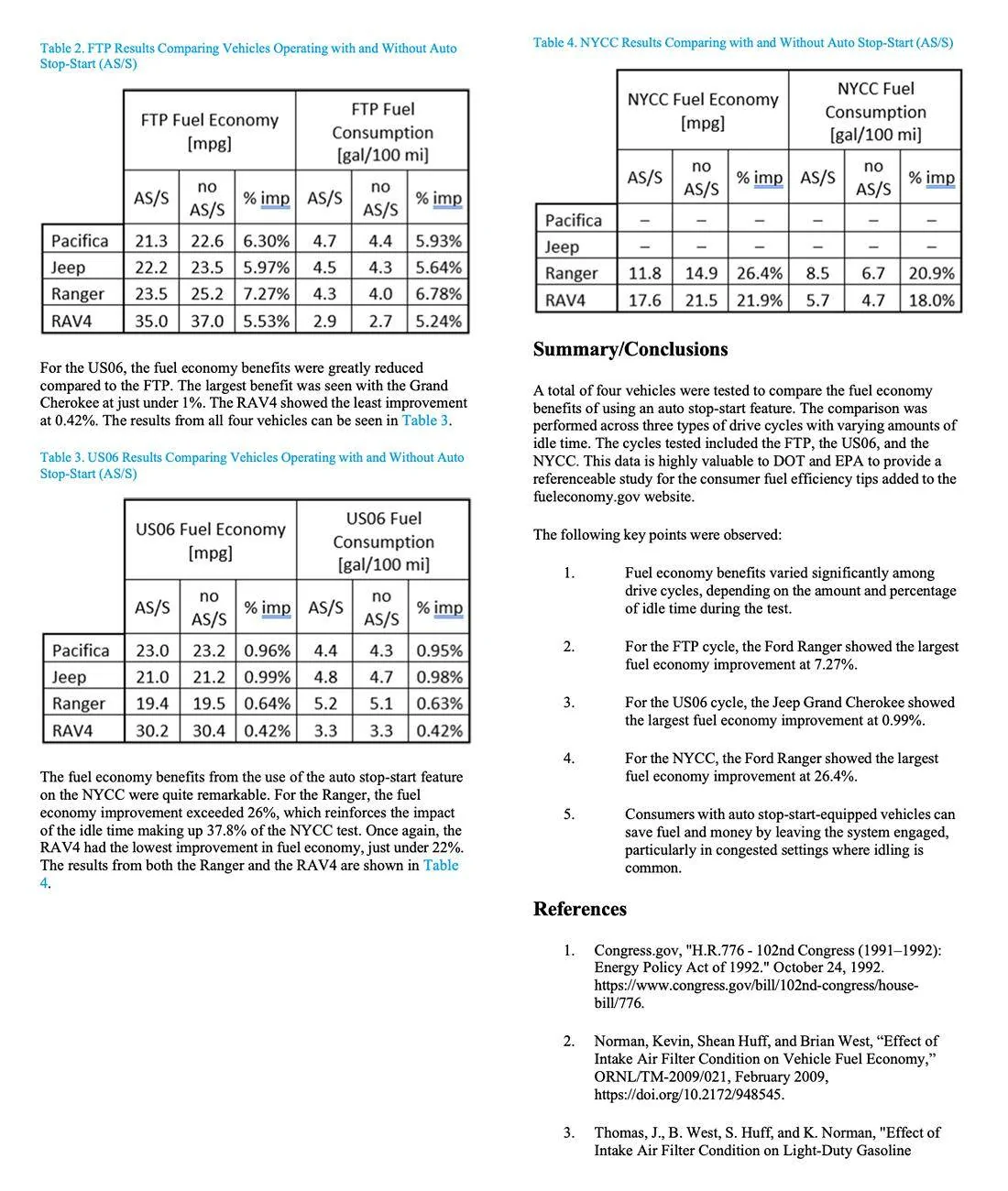
Here's the study. The ~25% mpg improvement figure is based on the single biggest outlier datum (resulting from a simulation of a light truck traveling 1.18 miles over 10 minutes in NYC traffic).You know there is good data in the DoE and EPA studies which found the benefit can be a 25% increase in fuel economy from stop-start tech alone. Of course, those studies have been ripped down from those websites because, well...you know why. They don't support the current narrative. But those studies still exist, and the data was sound.

This. 100% designed for EPA tests and not actual consumer benefit. This is why the new admin doesn't like them. Everyone knows it's a scam.S/S does indeed save fuel, especially in heavy red light prone city driving.
That being said, it was primarily designed to cheat the EPA city MPG testing. This is done as roughly ~34% of the test is spent idling. The system needed to be automatic before the EPA would certify it as legit, so here we are.
What the engineers failed to realize is the wear and tear it would put on batteries. They thought about the starter, at least. Most heavy S/S users end up replacing their batteries every 2 years at most. Very few make it 3 years. Compare that to a conventional system where a battery can last 5-7 on average. The additional maintenance cost most likely outweighs any fuel savings, especially now that you're paying for two batteries. If you're paying someone else to install them for you I don't think it's possible to even break even there. There's also the increased chance of being stranded from a dead battery no-start.
This also led to the hilariously incompetent clutch situation on the manual JLs. Had to be light enough for S/S to function, and ended up being weak garbage as a result. I wonder how much cheaper it would've been to pay EPA fines instead of releasing 3 different recalls for clutch failures.

Love the reference my friendI didn't buy a jeep for fuel efficiency. I'm not saying ASS doesn't conserve fuel, its just not for this old dog.
Stay thirsty my friends.


Sounds like a very real use case.Here's the study. The ~25% mpg improvement figure is based on the single biggest outlier datum (resulting from a simulation of a light truck traveling 1.18 miles over 10 minutes in NYC traffic).
I found it was actually worse on gas mileage around town. Making brief stop and go at stop lights is the most gas consuming thing on earth. Thats my story and Im sticken to it. I disabled that shit so fast your head would spin. What an annoying feature for a gas powered vehicle.Thats great if you drive primarily in stop and go city traffic.
Now, what about the rest of us that do primarily highway driving and seldom come to a stop (as compared to city driving). We are hauling around an extra bit of weight and obviously a more complex system with next to no benefit.
And while my driving style tends to get me the best fuel economy possible the day I become that concerned about fuel mileage is the day I start walking everywhere.
After watching the video, what's your theory on why it seems to get worse gas mileage around town with ASS enabled?I found it was actually worse on gas mileage around town. Making brief stop and go at stop lights is the most gas consuming thing on earth. Thats my story and Im sticken to it. I disabled that shit so fast your head would spin. What an annoying feature for a gas powered vehicle.
It's "like a very real use case" that's intentionally designed to not represent overall "benefit... in fuel economy from stop-start tech". The fact is, that particular test shows a 26.4% improvement in mpg requires idling a Ford Ranger for 37.8% of the test period.Sounds like a very real use case.
You'll see from the summary/conclusions that "Consumers with auto stop-start-equipped vehicles can save fuel and money by leaving the system engaged, particularly in congested settings where idling is common."It's "like a very real use case" that's intentionally designed to not represent overall "benefit... in fuel economy from stop-start tech". The fact is, that particular test shows a 26.4% improvement in mpg requires idling a Ford Ranger for 37.8% of the test period.
It's clearly not a "good" study with "sound" data; the authors chose 4 relatively inefficient vehicles for unscientific reasons ("The use of these particular vehicles was highly opportunistic."), and inexplicably didn't put 2 of the vehicles through one of the 3 tests. It also looks to me like they sloppily inverted table data/labels, but maybe I'm missing something. In any case, it's a somewhat interesting experiment, but concluding from it that ASS-tech can improve fuel efficiency by 25% is a poor way to summarize it.
I figured with all this talk about ASS it was just a matter of time before someone brought up IBS. I've seen the commercials about IBS, yikes, having problems with your IBS away from home doesn't sound like fun to me.Am I the only one who is channeling their inner Eric Cartman from South Park with the whole ASS saving gas topic?