Sponsored

Help! Issues after ACT Clutch install.

SadRobot

Well-Known Member
Joined
Aug 31, 2019
Threads
144
Messages
7,492
Reaction score
20,073
Location
Los Angeles
Vehicle(s)
2025 Prius LE
I'm assuming no more fluid leaks at this point? What the hell is going on...
We're pretty sure no more leaks. At least not leaking at all from the connector to the master cylinder anymore.

I have no idea what the hell is happening and why. I just want my Jeep back and it's really frustrating.
Sponsored

 

autotragic

Banned
Banned
Banned
Joined
Nov 29, 2023
Threads
7
Messages
3,199
Reaction score
6,516
Location
the cornbelt
Vehicle(s)
'21 JLR 6MT
We're pretty sure no more leaks. At least not leaking at all from the connector to the master cylinder anymore.

I have no idea what the hell is happening and why. I just want my Jeep back and it's really frustrating.
So once upon a time I swapped the clutch in my mustang and I had the same issue with the clutch engaging or disengaging super low to the floor and having a bunch of useless pedal travel.

The problem is that it was a manual cable activated clutch not hydraulic.

But it was definitely an adjustment issue.

See you've been driving yours for a while on this new clutch and you've definitely put some wear on it and then you started having issues... I just feel like this is the clutch not adjusting on its own like it should be. Now whether it's because there's air in the system or something else I don't know and since I can't physically see it for myself I don't even know where to start.

Actually I do know what I would do and that is I would start ripping my transfer case and transmission out to see what the hell was going on in there. But I don't think that's something that you're comfortable with doing.

But I can tell you after having a manually adjusted clutch that every few months I had to go and just turn that firewall adjuster knob out a little bit to keep the clutch engaging like it was supposed to die to it wearing down and it not having an auto adjust system.

Otherwise I had to push the clutch practically all the way to the floor to get it to disengage and engage after a while. And it was hard to get into gear which is the exact same symptoms that you have the only difference is how the clutch actuates.

Which is why I think there's definitely some kind of issue going on with how your clutch is supposed to adjust because with hydraulic system it's definitely supposed to auto adjust. Now from the factory my cable actuated clutch also auto adjusted but that system wasn't really compatible with the aftermarket heavy duty clutch.

Interestingly enough the Center Force clutch for our Jeeps does make changes to the hydraulic system...

I'm beginning to suspect there's a good reason for that.

Maybe @roaniecowpony can chime in and add something since he's seen your Jeep first hand and has a better idea what's going on with it.

Is there a way to manually adjust the clutch in these things? How does the clutch pedal actuate the hydraulics? there might be an adjustment nut on there. I doubt it but I thought I would ask just in case.
 

SadRobot

Well-Known Member
Joined
Aug 31, 2019
Threads
144
Messages
7,492
Reaction score
20,073
Location
Los Angeles
Vehicle(s)
2025 Prius LE
So once upon a time I swapped the clutch in my mustang and I had the same issue with the clutch engaging or disengaging super low to the floor and having a bunch of useless pedal travel.

The problem is that it was a manual cable activated clutch not hydraulic.

But it was definitely an adjustment issue.

See you've been driving yours for a while on this new clutch and you've definitely put some wear on it and then you started having issues... I just feel like this is the clutch not adjusting on its own like it should be. Now whether it's because there's air in the system or something else I don't know and since I can't physically see it for myself I don't even know where to start.

Actually I do know what I would do and that is I would start ripping my transfer case and transmission out to see what the hell was going on in there. But I don't think that's something that you're comfortable with doing.

But I can tell you after having a manually adjusted clutch that every few months I had to go and just turn that firewall adjuster knob out a little bit to keep the clutch engaging like it was supposed to die to it wearing down and it not having an auto adjust system.

Otherwise I had to push the clutch practically all the way to the floor to get it to disengage and engage after a while. And it was hard to get into gear which is the exact same symptoms that you have the only difference is how the clutch actuates.

Which is why I think there's definitely some kind of issue going on with how your clutch is supposed to adjust because with hydraulic system it's definitely supposed to auto adjust. Now from the factory my cable actuated clutch also auto adjusted but that system wasn't really compatible with the aftermarket heavy duty clutch.

Interestingly enough the Center Force clutch for our Jeeps does make changes to the hydraulic system...

I'm beginning to suspect there's a good reason for that.

Maybe @roaniecowpony can chime in and add something since he's seen your Jeep first hand and has a better idea what's going on with it.

Is there a way to manually adjust the clutch in these things? How does the clutch pedal actuate the hydraulics? there might be an adjustment nut on there. I doubt it but I thought I would ask just in case.
Yes he has a better idea of what is happening. I have a rough idea now but not enough to diagnose exactly what is going wrong or how to fix.

I think the only real test to know is to take the ACT clutch out, put in a different clutch and see how it performs. If issues are the same then it's 100% hydraulics. If no issues, it's the ACT clutch that's the problem.
 

autotragic

Banned
Banned
Banned
Joined
Nov 29, 2023
Threads
7
Messages
3,199
Reaction score
6,516
Location
the cornbelt
Vehicle(s)
'21 JLR 6MT
Yes he has a better idea of what is happening. I have a rough idea now but not enough to diagnose exactly what is going wrong or how to fix.

I think the only real test to know is to take the ACT clutch out, put in a different clutch and see how it performs. If issues are the same then it's 100% hydraulics. If no issues, it's the ACT clutch that's the problem.
So far you've replaced the master cylinder, the line running from the master to the slave and the slave cylinder... Now because I'm not intimately familiar with the hydraulic clutch system in our Jeeps what does the slave cylinder attach to like what's the next component in the line or what is the order that everything is connected?

In my mind the slave cylinder should be connected to some kind of clutch fork assembly so on the outside of the transmission that we connect to one end and then it would go through the bell housing and that would be what your throw out bearing rides on. With the throwout bearing itself being what pushes on the pressure plate to disengage the clutch.

Is there anything I'm missing in that?

If you don't have the big shift fork because the hydraulic throwout bearing does that part instead then what I think might be happening is the throwout bearing is collapsing. Basically you push the pedal down and instead of the hydraulics pushing out on the throwout bearing to engage the pressure plate it's just...not. that would explain the creaking sound.
 

azjl#3

Well-Known Member
First Name
Scott
Joined
Sep 24, 2022
Threads
17
Messages
3,047
Reaction score
3,692
Location
North AZ
Vehicle(s)
2024 silver zenith or atomic silver. JLUR Extreme Recon-ish
Occupation
retired, grumpy, yet, friendly
if a clutch shop has not heard of ACT, they don't do clutches.
 

Sponsored

azwjowner

Well-Known Member
Joined
Oct 8, 2020
Threads
12
Messages
2,277
Reaction score
3,971
Location
Phoenix
Vehicle(s)
2022 JL; 2004 WJ (sold but never forgotten)
s there a way to manually adjust the clutch in these things? How does the clutch pedal actuate the hydraulics? there might be an adjustment nut on there. I doubt it but I thought I would ask just in case.
I don‘t really know but I would try comparing her highest and lowest pedal position against another manual JL and see if something is weird. Maybe there is something off with the pedal assembly such that the range of travel is out of the norm.
 

fczabala

Well-Known Member
Joined
May 18, 2020
Threads
27
Messages
1,187
Reaction score
3,437
Location
FL
Vehicle(s)
JLUR; X5
Clubs
 
Yes he has a better idea of what is happening. I have a rough idea now but not enough to diagnose exactly what is going wrong or how to fix.

I think the only real test to know is to take the ACT clutch out, put in a different clutch and see how it performs. If issues are the same then it's 100% hydraulics. If no issues, it's the ACT clutch that's the problem.
just out of curiosity, did you pressure, vacuum or manually bled?

if you're sure there's no more air in the system then it's time to start inspecting down the line again, slave, release bearing and then clutch

the release bearing or the diaphragm/springs in the pressure plate might have some damage after driving for a while with the hydraulic leak
 

sherpaJL

Well-Known Member
Joined
Aug 27, 2021
Threads
47
Messages
1,557
Reaction score
3,394
Location
Keystone State
Vehicle(s)
2019 JLUR Mojito! ~ 2022 JLUR Hydro Blue
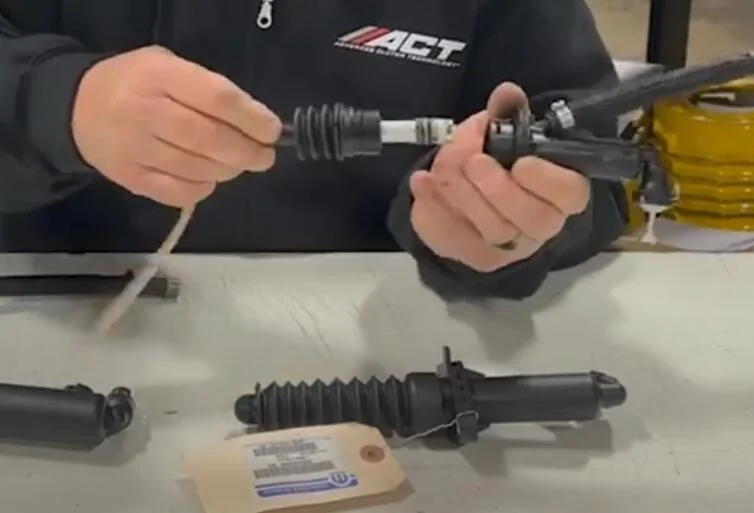
Jeep Wrangler JL Help! Issues after ACT Clutch install. 1733666275378-em


this alone is unnerving.
a completely polymer clutch slave cylinder? wow
and when exposed to under hood heat temps it's no wonder manuals have issues.
auto adjust clutch hydraulics built into the slave cylinder actuation? wth
what's the feedback loop from the actual clutch position?
give me a mechanism I can make manual adjustments to like yesteryear
I guarantee all the clutch issues I read about are due to cost cutting practices.
 

Sponsored

bjm00se

Well-Known Member
First Name
Steve
Joined
Jan 26, 2021
Threads
7
Messages
1,457
Reaction score
3,465
Location
California
Vehicle(s)
JLUR 6sp ordered 11/3/21, picked up 8/30/22
I'm no clutch expert. The thing is, after the master cylinder was replaced, everything was temporarily good.

Conditions quickly degenerated, however, with the working hypothesis being that there was a line leak letting air into the system.

The line was replaced, and now the system doesn't work.

I know you said you bled it three times, but the symptoms and history suggest that this process was unsuccessful and there's still air in the system, or that the line replacement was unsuccessful and after replacement there's a worse air leak than there was before.

As an untrained amateur mechanic (even that description is bordering on being undeservedly high praise, but I digress) , I've learned to question my own work as being the most likely cause of problems I'm experiencing.

Two cents.
 

roaniecowpony

Well-Known Member
Joined
Dec 4, 2018
Threads
194
Messages
12,914
Reaction score
20,429
Location
SoCal
Vehicle(s)
2018 JLUR, 14 GMC 1500 CC All TERRAIN
Occupation
Retired Engineer
I wasn't going to comment here on this, but all the wild speculation is really not helpful to this lady's fears of having a huge outlay of cash on a repair that she can't afford right now. I would ask that you give her nerves a break from this.

From my perspective, I see no reason or indication there is any damage to this clutch from driving it with it while it has had a low release/engagement point or a little drag that I saw and felt while driving it. It engages fully at about one third pedal travel up from the floor, which she and I agree is lower than it should be It engages solidly and has no slip or chatter. It doesn't try to drive forward or roll when in first gear with the clutch in on level ground, but it does feel like it's at the bare minimum of full disengagement. This seems to slightly deteriorate with some driving, which makes it harder to get into gear after having idled in neutral with the clutch out, then depressed and attempting to put in gear. A 1-2 count after depressing the clutch, before moving the gear lever helps.

Our bleed process was to vacuum bleed it thoroughly from the top line that normally hooks to the reservoir, a good number of times until we minimized indications of air, then connect to the reservoir, and manually bleed from the slave bleeder. I believe we will do better by vacuum bleeding from the slave. I just didn't have the bits to do that last night.

I hope you guys will hold your speculation on the clutch itself being an issue as I think this is unfounded and it appears to be doing its job properly. Our fellow member's nerves are wearing thin from this and pushing her toward a very costly action based on speculation is undue.

I'm going to leave my comments at this, for the time being.
If you want to comment directly to me for whatever reason, I'd appreciate you sending me a private message.
 

autotragic

Banned
Banned
Banned
Joined
Nov 29, 2023
Threads
7
Messages
3,199
Reaction score
6,516
Location
the cornbelt
Vehicle(s)
'21 JLR 6MT
Our bleed process was to vacuum bleed it thoroughly from the top line that normally hooks to the reservoir, a good number of times until we minimized indications of air, then connect to the reservoir, and manually bleed from the slave bleeder. I believe we will do better by vacuum bleeding from the slave. I just didn't have the bits to do that last night.
After some more research this morning I agree, it needs bled from the slave cylinder. I didn't/don't think there is anything wrong with the physical clutch parts. This has got to be a hydraulics issue.

The slave is attached to the transmission itself and pushes on the internal fork assembly that the throwout/release bearing rides on and being that it "should" be the low point in the system. Makes sense (to me anyway) after looking at it. Air is trapped in there and once you bleed it out I'd bet any amount of money her clutch works right again.
 

fczabala

Well-Known Member
Joined
May 18, 2020
Threads
27
Messages
1,187
Reaction score
3,437
Location
FL
Vehicle(s)
JLUR; X5
Clubs
 
I wasn't going to comment here on this, but all the wild speculation is really not helpful to this lady's fears of having a huge outlay of cash on a repair that she can't afford right now. I would ask that you give her nerves a break from this.

From my perspective, I see no reason or indication there is any damage to this clutch from driving it with it while it has had a low release/engagement point or a little drag that I saw and felt while driving it. It engages fully at about one third pedal travel up from the floor, which she and I agree is lower than it should be It engages solidly and has no slip or chatter. It doesn't try to drive forward or roll when in first gear with the clutch in on level ground, but it does feel like it's at the bare minimum of full disengagement. This seems to slightly deteriorate with some driving, which makes it harder to get into gear after having idled in neutral with the clutch out, then depressed and attempting to put in gear. A 1-2 count after depressing the clutch, before moving the gear lever helps.

Our bleed process was to vacuum bleed it thoroughly from the top line that normally hooks to the reservoir, a good number of times until we minimized indications of air, then connect to the reservoir, and manually bleed from the slave bleeder. I believe we will do better by vacuum bleeding from the slave. I just didn't have the bits to do that last night.

I hope you guys will hold your speculation on the clutch itself being an issue as I think this is unfounded and it appears to be doing its job properly. Our fellow member's nerves are wearing thin from this and pushing her toward a very costly action based on speculation is undue.

I'm going to leave my comments at this, for the time being.
If you want to comment directly to me for whatever reason, I'd appreciate you sending me a private message.
I sympathize completely as I too have an ACT clutch that's intermittently giving me the same issues, I say intermittently because it's been working fine for the most part for the last week or so, I was going to pressure bleed it but it started working fine so I'm leaving it alone for now, I "tested" the fluid (cheap brake fluid tester from Amazon) and fluid is "good"

my suggestion of the pressure plate being suspect is because I assumed the bleeding process was "thorough" so I was just looking "down the line" in the system

might I suggest to do a pressure bleed instead from the fluid reservoir and remove the slave to actuate the plunger fully and slowly while the bleeder valve is open until no more air comes out, that is my plan for when I decide to bleed the system
Sponsored


Top