Sponsored

3.6 power loss at elevation

MaybeRubi

Well-Known Member
Joined
Dec 1, 2023
Threads
19
Messages
170
Reaction score
180
Location
Wyoming USA
Vehicle(s)
'24 JLU Willys 3.6 Auto Anvil
I live at 6K.
Fortunately for me, I've been driving 4 cylinder cars for so many years that my 3.6 feels peppy.
(I drove a 1.6 liter for 14 years -- Geo Tracker, manual, 2-dr, soft top; $10.5K new 1991 -- excellent "fun per dollar.")
Sponsored
 

Ratbert

Well-Known Member
First Name
John
Joined
Jun 20, 2020
Threads
159
Messages
16,025
Reaction score
24,977
Location
PNW
Vehicle(s)
2022 AEV JL370 JLURD
Build Thread
Link
Occupation
Software Engineer
Clubs
 

tk1700

Well-Known Member
First Name
Tom
Joined
Nov 21, 2019
Threads
8
Messages
686
Reaction score
1,220
Location
New Mexico
Vehicle(s)
2021 JLUR, 2016 Tundra, 2025 Hyundai Palisade
That's why many piston aircraft engines have turbos. I live at 7000ft and have a 2019 JLU 3.6 and 2021 JLUR 2.0, both 8 sp auto and no etorque. Wife is primary driver of the 3.6 and when I drive it, it definatly feels more sluggish. I'm not saying it's underpowered but it's way slower to accelerate. I've driven both to TX at less than 1000 ft altitude and the 3.6 performs better there and the 2.0 is close to the same.
 

TheRaven

Well-Known Member
Joined
Oct 22, 2020
Threads
6
Messages
2,844
Reaction score
4,176
Location
Reading, Pennsylvania
Vehicle(s)
Sold
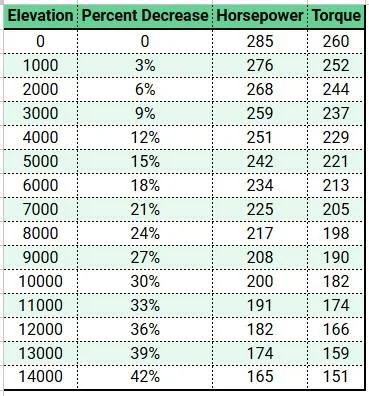
It starts with 285 horsepower. It loses ~3% for every 1,000 feet. That's a ~24% loss of power (~64 horsepower) that you don't consider to be "much at all"???
This is the problem with this argument - everyone just assumes that what they think they feel is what everyone else thinks they feel. But everyone is different, and you don't realize how much your own personal bias colors what you perceive as reality. If you have absolutely no clue that you are losing 64hp at 8000ft and you find yourself up there you may not even notice a difference. Or you might think something is wrong with your Jeep...but if you go up to 8000ft KNOWING you are losing power, you can actually talk yourself into feeling something that really isn't there OR thinking it feels worse than it really does.

This is what I was talking about in the other thread - and combine that with the fact that everyone these days is spoiled with power...consider that at 8000ft the 3.6l is still making more power than say a 2008 JLU V6 at sea level. This is why, IN MY OPINION, this whole power loss thing is overblown. Unless you live at high altitudes, I just don't see how it really matters.

Additionally, from an objective standpoint, the 2.0l is only marginally better, and only so once the turbo is spooled - taking off from a standstill is going to be even worse because of the 2.0s low-end torque deficit.

So again, THIS IS JUST MY OPINION, but I think we make this to be a much bigger deal on the net than it is in real life.
 

yokramer

Well-Known Member
Joined
Sep 8, 2022
Threads
21
Messages
30,471
Reaction score
155,571
Location
Colorado
Vehicle(s)
'23 JLR, '26 Suzuki GSX8TT, '88 10th Anny RX7
Occupation
Snark Incarnate
This is the problem with this argument - everyone just assumes that what they think they feel is what everyone else thinks they feel. But everyone is different, and you don't realize how much your own personal bias colors what you perceive as reality. If you have absolutely no clue that you are losing 64hp at 8000ft and you find yourself up there you may not even notice a difference. Or you might think something is wrong with your Jeep...but if you go up to 8000ft KNOWING you are losing power, you can actually talk yourself into feeling something that really isn't there OR thinking it feels worse than it really does.

This is what I was talking about in the other thread - and combine that with the fact that everyone these days is spoiled with power...consider that at 8000ft the 3.6l is still making more power than say a 2008 JLU V6 at sea level. This is why, IN MY OPINION, this whole power loss thing is overblown. Unless you live at high altitudes, I just don't see how it really matters.

Additionally, from an objective standpoint, the 2.0l is only marginally better, and only so once the turbo is spooled - taking off from a standstill is going to be even worse because of the 2.0s low-end torque deficit.

So again, THIS IS JUST MY OPINION, but I think we make this to be a much bigger deal on the net than it is in real life.
Jeep Wrangler JL 3.6 power loss at elevation arthur-internet
 

Sponsored

Remorseless

Well-Known Member
Joined
May 10, 2022
Threads
4
Messages
34,487
Reaction score
193,247
Location
NC
Vehicle(s)
'22 JLR 2.0T, '24 JTR, '19 Charger R/T
Build Thread
Link
Occupation
Holier Than Thou Internet Bully, Part-Time Online Boy Scout, Full-Time Arson Enthusiast, Napalm Compatible, Guy Who Defines What A Jeep Guy Is
Additionally, from an objective standpoint, the 2.0l is only marginally better, and only so once the turbo is spooled - taking off from a standstill is going to be even worse because of the 2.0s low-end torque deficit.
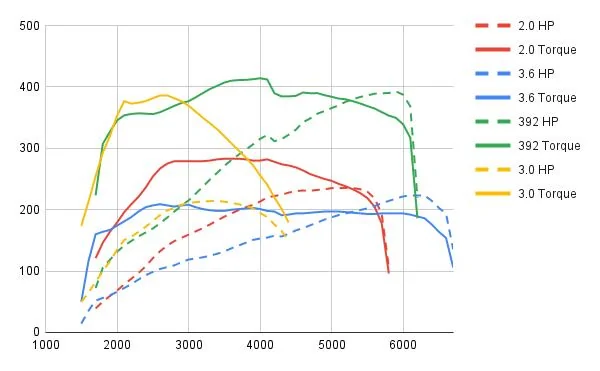
I dunno man, if you're at elevation you're going to spend a lot of time holding revs where the 2.0 is definitely in the turbo. Max torque at 2500ish RPM. At least 50 wheel torque more than the 3.6. No deficit there.

Jeep Wrangler JL 3.6 power loss at elevation 1722434545139-mg


Edited to add - to be clear, I do agree about perception. While the engine does lose power, whether it's a big deal or not is all about user perception.
 

TheRaven

Well-Known Member
Joined
Oct 22, 2020
Threads
6
Messages
2,844
Reaction score
4,176
Location
Reading, Pennsylvania
Vehicle(s)
Sold
I dunno man, if you're at elevation you're going to spend a lot of time holding revs where the 2.0 is definitely in the turbo. Max torque at 2500ish RPM. At least 50 wheel torque more than the 3.6. No deficit there.

1722434545139-mg.jpg
Sure, but you have to get INTO "the turbo" first.

Again, i'm NOT saying that there is NO difference. Just that it's a small one that we make into a much bigger one in these discussions.
 

Remorseless

Well-Known Member
Joined
May 10, 2022
Threads
4
Messages
34,487
Reaction score
193,247
Location
NC
Vehicle(s)
'22 JLR 2.0T, '24 JTR, '19 Charger R/T
Build Thread
Link
Occupation
Holier Than Thou Internet Bully, Part-Time Online Boy Scout, Full-Time Arson Enthusiast, Napalm Compatible, Guy Who Defines What A Jeep Guy Is
Sure, but you have to get INTO "the turbo" first.

Again, i'm NOT saying that there is NO difference. Just that it's a small one that we make into a much bigger one in these discussions.
Yep, gotta get turbo spooled, but my experience with hills in central NC and the mountains in western NC/eastern TN is that you spend a good amount of time in that range, with the turbo spooled. And, extrapolating on that experience, I would surmise that at 8k+ ft in the Rockies you're likely to spend even more time there due to the fact those elevations come with a steep grade many times.

I think small or large difference is going to tie into perception though. For some it will be small - like yourself - and for others it will be large.
 

TheRaven

Well-Known Member
Joined
Oct 22, 2020
Threads
6
Messages
2,844
Reaction score
4,176
Location
Reading, Pennsylvania
Vehicle(s)
Sold
I think small or large difference is going to tie into perception though. For some it will be small - like yourself - and for others it will be large.
Absolutely agreed. I just wanted to add the counterpoint because all too often no one does, and then the inexperienced leave the thread thinking OMG MY JL CAN'T CLIMB MOUNTAINS!!!!
 

Ratbert

Well-Known Member
First Name
John
Joined
Jun 20, 2020
Threads
159
Messages
16,025
Reaction score
24,977
Location
PNW
Vehicle(s)
2022 AEV JL370 JLURD
Build Thread
Link
Occupation
Software Engineer
Clubs
 
This is the problem with this argument - everyone just assumes that what they think they feel is what everyone else thinks they feel. But everyone is different, and you don't realize how much your own personal bias colors what you perceive as reality. If you have absolutely no clue that you are losing 64hp at 8000ft and you find yourself up there you may not even notice a difference. Or you might think something is wrong with your Jeep...but if you go up to 8000ft KNOWING you are losing power, you can actually talk yourself into feeling something that really isn't there OR thinking it feels worse than it really does.

This is what I was talking about in the other thread - and combine that with the fact that everyone these days is spoiled with power...consider that at 8000ft the 3.6l is still making more power than say a 2008 JLU V6 at sea level. This is why, IN MY OPINION, this whole power loss thing is overblown. Unless you live at high altitudes, I just don't see how it really matters.

Additionally, from an objective standpoint, the 2.0l is only marginally better, and only so once the turbo is spooled - taking off from a standstill is going to be even worse because of the 2.0s low-end torque deficit.

So again, THIS IS JUST MY OPINION, but I think we make this to be a much bigger deal on the net than it is in real life.
What does what someone thinks they feel have to do with the math and science of losing ~3% for every 1,000 feet? If your "calibrated butt dyno" can't feel it then that's fine, but that doesn't mean that it's not reality for the rest of the planet.

I'm giving math and science numbers. You're giving Flat Earther-esque "but that's not what I experience" responses. Are you expecting us to simply agree with your personal assessments and just ignore the facts?

Here are the numbers (not opinions) in case you forgot: The Wrangler's 3.6L V6 starts with 285 horsepower. It loses ~3% for every 1,000 feet. Going from sea level to 8k feet is a ~24% loss of power (~64 horsepower).

We frequently wheel at ~11k feet, which is a ~33% loss of power (relative to sea level) in a naturally aspirated engine like the 3.6L. And no, I don't significantly notice the additional drop of nearly 4% when I take my EcoDiesel (fortunately NOT naturally aspirated) from home to those heights.
 

Sponsored

Ratbert

Well-Known Member
First Name
John
Joined
Jun 20, 2020
Threads
159
Messages
16,025
Reaction score
24,977
Location
PNW
Vehicle(s)
2022 AEV JL370 JLURD
Build Thread
Link
Occupation
Software Engineer
Clubs
 
I think small or large difference is going to tie into perception though. For some it will be small - like yourself - and for others it will be large.
Implying that his "calibrated butt dyno" might need a recalibration?
 

Remorseless

Well-Known Member
Joined
May 10, 2022
Threads
4
Messages
34,487
Reaction score
193,247
Location
NC
Vehicle(s)
'22 JLR 2.0T, '24 JTR, '19 Charger R/T
Build Thread
Link
Occupation
Holier Than Thou Internet Bully, Part-Time Online Boy Scout, Full-Time Arson Enthusiast, Napalm Compatible, Guy Who Defines What A Jeep Guy Is
Implying that his "calibrated butt dyno" might need a recalibration?
:)

I think it's just a different discussion when it's "Does it happen" or "Does it matter that it happens".

But, I've also not experienced the 3.6 in the JL at those altitudes. Closest I've come is when I did drive my 3.6 JK from NC to Louisiana and then up through TX, NM, and the corner of CO to get to Moab (had a buddy in New Orleans I met up with and convoyed, thus the ridiculous route), but that's apples and oranges given the 5 speed Merc box in my JK vs the 8 speed in the JL. That JK, with 4.10s and 35s, was chugging along at like 10MPG and the engine wailing with stiff winds in flat ass Texas, so when we hit NM and CO it wasn't apparent if it was to do with any elevation changes or if it just was what it was.
 

TheRaven

Well-Known Member
Joined
Oct 22, 2020
Threads
6
Messages
2,844
Reaction score
4,176
Location
Reading, Pennsylvania
Vehicle(s)
Sold
What does what someone thinks they feel have to do with the math and science of losing ~3% for every 1,000 feet? If your "calibrated butt dyno" can't feel it then that's fine, but that doesn't mean that it's not reality for the rest of the planet.

I'm giving math and science numbers. You're giving Flat Earther-esque "but that's not what I experience" responses. Are you expecting us to simply agree with your personal assessments and just ignore the facts?

Here are the numbers (not opinions) in case you forgot: The Wrangler's 3.6L V6 starts with 285 horsepower. It loses ~3% for every 1,000 feet. Going from sea level to 8k feet is a ~24% loss of power (~64 horsepower).

We frequently wheel at ~11k feet, which is a ~33% loss of power (relative to sea level) in a naturally aspirated engine like the 3.6L. And no, I don't significantly notice the additional drop of nearly 4% when I take my EcoDiesel (fortunately NOT naturally aspirated) from home to those heights.
Ok Minkus, chill. Maybe you missed this part of my reply:

So again, THIS IS JUST MY OPINION, but I think we make this to be a much bigger deal on the net than it is in real life.

Having opinions does not make someone a conspiracy theorist. It also doesn't mean they don't understand or recognize science and facts.

I think it's just a different discussion when it's "Does it happen" or "Does it matter that it happens".
^ This guy gets it ^

Jeep Wrangler JL 3.6 power loss at elevation {filename}
 

CarbonSteel

Well-Known Member
Joined
Jul 21, 2019
Threads
305
Messages
5,795
Reaction score
8,214
Location
Colorado
Vehicle(s)
2001 Cherokee; 2023 Bronco Wildtrak; 2024 Grand Cherokee 4xe
Vehicle Showcase
1
As others have said: you definitely lose power at altitude, especially naturally aspirated engines.

Some people might claim that they don't really feel the difference, but you lose quite a bit.
I can easily testify to this condition. I lost 21% HP and TQ going from sea level (Houston) to 7,000 ASL (Colorado Springs) with my 3.6L--it was VERY noticeable EVEN with 5.13 gearing.

Anyone who does not feel the difference has not spent enough time between the two...

Jeep Wrangler JL 3.6 power loss at elevation Power vs. Elevation
 

cosmokenney

Well-Known Member
First Name
Cosmo
Joined
Apr 30, 2019
Threads
41
Messages
1,007
Reaction score
808
Location
Loyalton, CA
Vehicle(s)
2019 JLR (2-door)
My experience with my 2 door 3.6L, has been that I didn't notice much difference between where I used to live at 1100 feet (and would regularly drive below that) and where I live now at 5200 feet. However there seems to be a noticeable drop in performance above 6500ish feet.
Sponsored


Top